

 Retail & ecommerce
In 2026, every PIM vendor has an AI story.
The harder question is whether that AI locks you in. An AI-agnostic PIM lets you bring your own model (BYOM), choose any LLM provider, and pay them directly for tokens, so AI is a component in your stack rather than a fee on your invoice.
Who this is for: CTOs, heads of digital, and e-commerce leads at enterprise retailers and manufacturers evaluating PIM software in 2026, especially anyone allergic to vendor lock-in or paying twice for the same LLM.
What Does AI-Agnostic Mean in a PIM?
An AI-agnostic PIM (product information management system) treats the large language model behind its AI features as an interchangeable component the customer supplies, not a fixed product the vendor sells.
You connect your own LLM API key (OpenAI, Anthropic, Google, Azure, or a private deployment), and the PIM's AI runs on whichever model the key points to.
BYOM is the acronym gaining traction across enterprise software in 2026, and it's the cleanest way to describe what Bluestone PIM has done since 2019.
The PIM still does the heavy lifting:
- holding the product-data context
- applying validation rules
- publishing content to every sales channel
The LLM does the language part.
Agnostic just means the language part isn't soldered to a specific provider's roadmap or pricing tier.
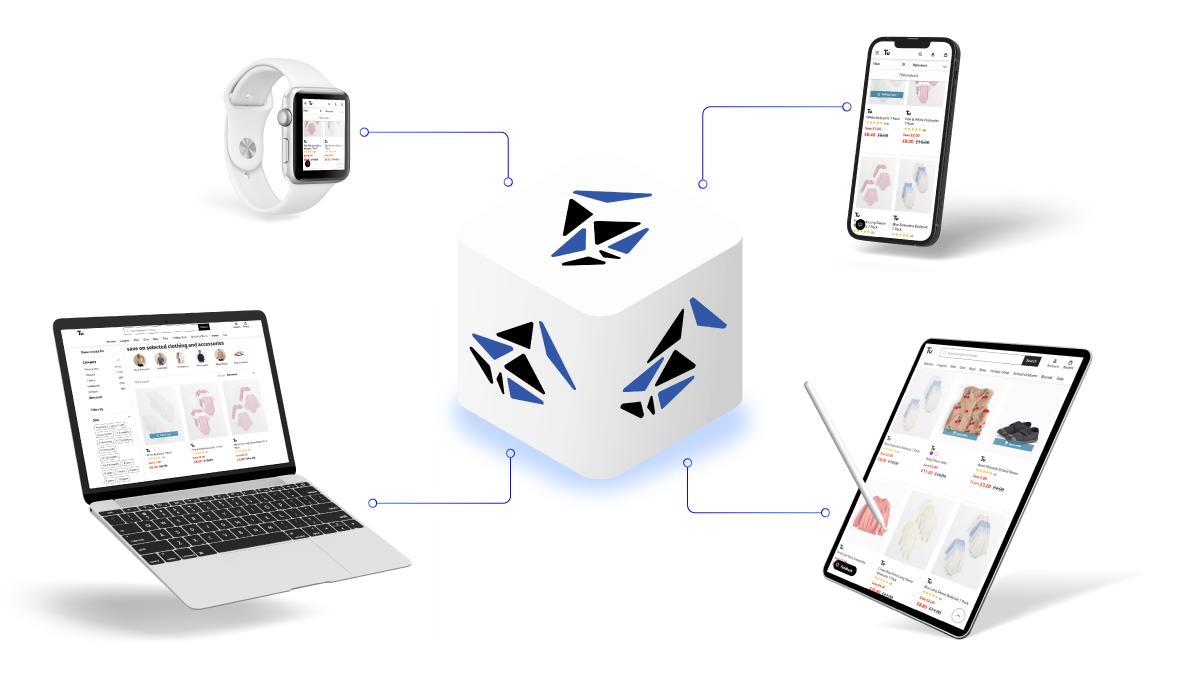
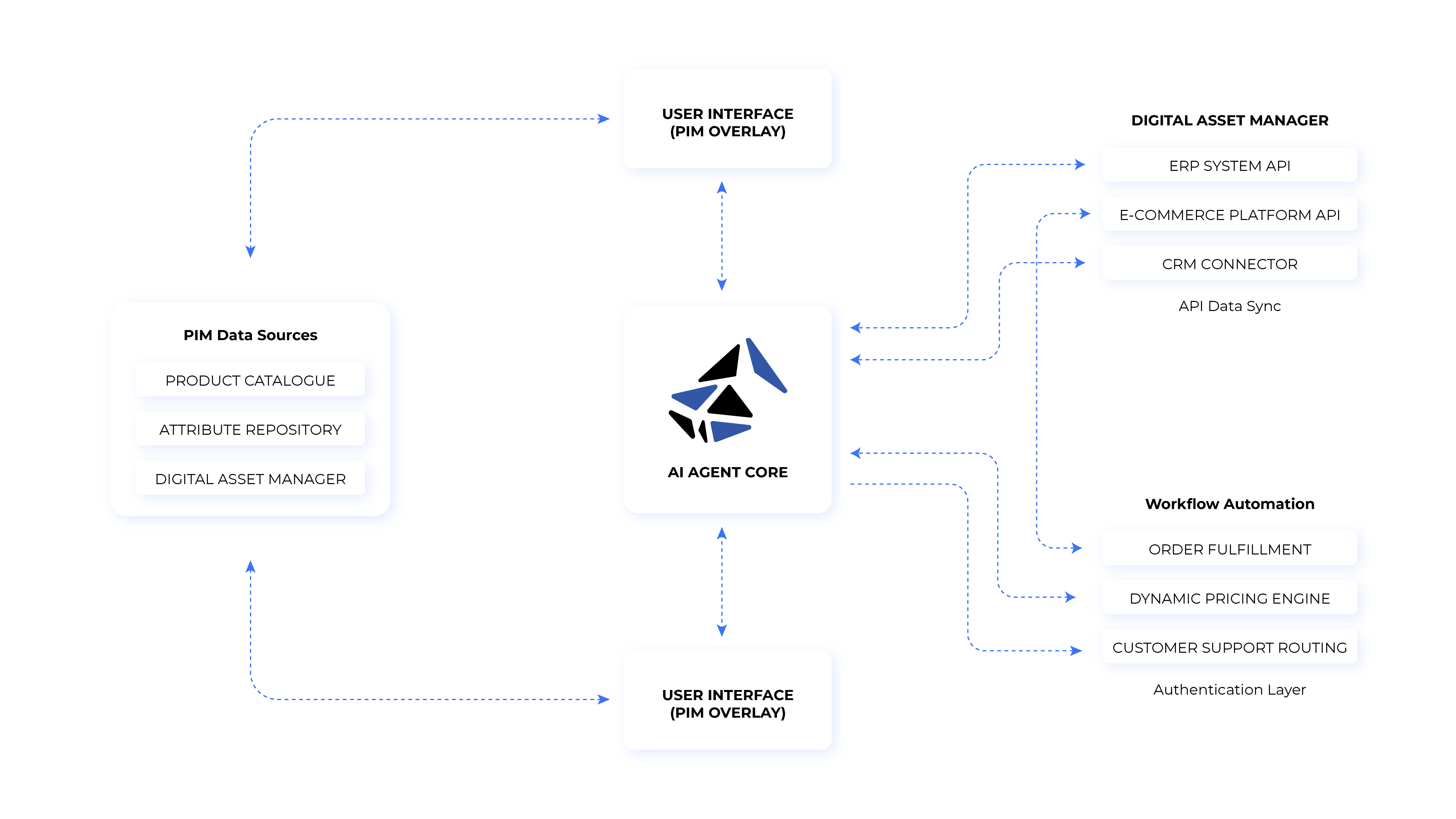
Bluestone PIM is 100% API-only with 700+ task-level endpoints, so the model layer is just another component customers compose rather than a feature they lease. The decision to keep the AI framework provider-independent aged well.

Download free e-book
How Top Retailers Use AI: 7 Smart AI Use Cases for 2026
Packed with real examples, practical tips, and the tools behind the strategies, this e-book is a must-read for retail and e-commerce leaders who want AI to really work for their business.
Why Bolted-In AI Quietly Becomes Vendor Lock-In?
When a PIM vendor includes "AI" in the product, that AI usually means one specific LLM the vendor selected, configured, and resells with a markup.
The customer doesn't get to choose.
The customer doesn't see the model's name on the invoice.
The vendor's AI add-on is a line item priced per feature, per seat, or per generated description.
It means that AI cost climbs because the vendor markup compounds with usage. For enterprise teams responsible for product data management at scale (a million SKUs is now a normal mid-market catalogue), that's the difference between a quarterly contract review and a budget surprise.
Also, when a materially better or cheaper model ships, you wait for the vendor's roadmap to catch up.
A retailer evaluating Bluestone PIM against the usual shortlist put it plainly:
"We don't want to be locking into anything that will paint us into a corner."
Imagine the PIM vendor's AI is wired to GPT-4.
In Q3, Anthropic ships a better, cheaper model. With bolted-in AI, you wait for the vendor to integrate it, then for them to price it. With BYOM, you change the key.
The lock-in is rarely sold as lock-in. It only becomes obvious eighteen months after PIM implementation.
How Bluestone PIM's Bring Your Own Model Approach Works
Bluestone PIM helps product teams add AI to product workflows without inheriting another vendor pricing curve. The mechanic is straightforward.
You bring your own LLM API key.
Bluestone PIM connects to it through standard provider APIs. From inside Bluestone PIM, customers can:
- Generate and enrich product descriptions in bulk, in the right tone of voice for each brand or channel.
- Translate product content into other languages with built-in quality checks and spell-correction.
- Find gaps, inconsistencies, and low-quality entries in product data, with a score per SKU.
- Trigger rules-based automations across the catalogue (categorisation, attribute values, related products, channel-specific overrides) and chain AI tasks into those rules.
All of those run on whichever LLM your key points to.
You can use OpenAI, Anthropic, Google, Azure OpenAI, an enterprise deployment, or rotate between them. The PIM is the workflow layer; the LLM is the language layer.
Bluestone PIM does not charge a separate AI fee.
Every AI capability listed above is included in the licence. You pay only what your provider charges for tokens, billed directly by them.
In practice, AI workflows in Bluestone PIM look the same whether you're running GPT-4o, Claude Sonnet, Gemini, or a fine-tuned private model.
A new SKU lands, a rule triggers a description generation task, the task calls the LLM via the customer's key, the LLM returns the content, and Bluestone PIM validates it against the data model. The provider can change next quarter without changing the workflow.
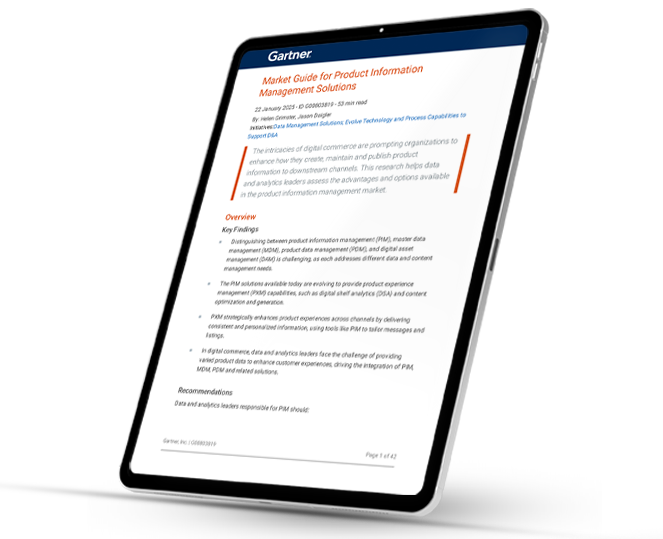
Bluestone PIM is recognised by Gartner® in the 2025 Market Guide for PIM Solutions, with AI flexibility being one of the differentiators the team consistently hears about in evaluations.
Download free e-book
Gartner® Market Guide for Product Information Management Solutions
The 2025 Gartner® Market Guide for Product Information Management is a trusted resource for business and tech leaders who want to make a confident decision about their PIM solution.
What Changes When You Bring Your Own AI Model
Four things change once the AI sits on your contract instead of the vendor's.
1) AI pricing follows your provider's curve
The cost per generated description is the raw token cost. When OpenAI cuts prices (and there have been several cuts since 2024 across the GPT-4o and GPT-4o-mini families), your AI bill drops with it. With a bundled vendor model, you wait for a contract renegotiation that may or may not pass the savings through.
2) Model swap becomes a configuration change
Anthropic recently shipped Claude Opus 4.7 with 1M context. If translation or long-document workflows benefit from it, you can switch the key in days. The Bluestone PIM workflow doesn't change.
3) Data residency stays with the provider you already audited
No extra sub-processor in the chain. Your existing contract with OpenAI, Anthropic, Azure, or Google governs the data path. Most enterprise legal teams find this easier to clear than a vendor reselling someone else's AI under its own SLA.
4) The PIM becomes a composable component, not an AI suite
Bluestone PIM becomes one piece of a composable commerce stack rather than a feature suite with embedded AI. Agnostic at the model layer is consistent with agnostic at the architecture layer. Same philosophy, applied at every level.
The Bluestone PIM team's standard answer to enterprise prospects on this question is straightforward: any pre-existing LLM the customer is already using doesn't need to be replaced for it to work within the Bluestone PIM ecosystem. The PIM blends in with the customer's existing tech stack. That's the practical version of BYOM.
Want to see how enterprise retailers are actually using AI in their product workflows? Download How Top Retailers Use AI for real use cases, model choices, and what the early adopters wish they'd done differently.
How Do You Tell if a PIM Is Genuinely AI-Agnostic?
A few PIM vendors now claim to support BYOM. Three questions tell you whether the claim is real, or marketing dressing on a bundled AI bill.
1) Who owns the API key?
If the answer is "the vendor," you're buying their AI relationship, not your own. With Bluestone PIM, the customer's own LLM provider account is the integration target. The key sits with the customer.
2) Who picks the model, and can the customer change it?
If the customer can't switch between (say) GPT-4o and Claude Sonnet without raising a vendor change ticket, the model layer isn't agnostic. With Bluestone PIM, switching from one provider to another is a configuration change inside the platform.
3) Who pays the AI cost, and at what markup?
This is where most BYOM claims fall apart. Even some PIMs that allow "connect your own LLM" still bill AI features through their own pricing layer, with a markup that compounds with usage. Ask for the unit cost in tokens and what the equivalent would be if billed directly by the provider. Bluestone PIM passes the token cost through unchanged.
Here's how the two approaches actually compare:
| Question | Bolted-in AI (most PIMs) | Bring Your Own Model (Bluestone PIM) |
|---|---|---|
| 1. Who owns the API key? | The PIM vendor | The customer |
| 2. Who picks the model? | The PIM vendor's roadmap | The customer, any provider |
| 3. Who pays AI tokens? | The vendor, with a per-feature markup | The customer, direct to provider |
| 4. What happens when a better model ships? | Wait for the vendor's next release | Swap the key, same week |
| 5. Can the LLM act on the catalogue? | Rarely, and usually read-only | Yes, via 700+ MCP actions |
| 6. How long has BYOM been live in the product? | Months to a year, in most cases | Since 2022 in Bluestone PIM |
A short checklist to take into the next vendor demo. Ask them:
- Whose API key do your AI features use?
- Can we switch to a different model provider without a contract change?
- Is AI included in the licence, or charged per generated description on top of the licence?
- Do you ship an MCP server, and how many actions does it expose? Are they read-only or can the model act?
- When did you ship BYOM, and which customers are running it in production today?
If a vendor hedges on any of these, the AI is bolted in. That's a strategic constraint, not a feature.
Bluestone PIM helps retail and manufacturing teams keep AI as a component they own, by running its AI workflows on the customer's own LLM key and charging no markup on top.
Retail & ecommerce
 API-first PIM Software