

MCP (Agent Gateway)
MCP-Native PIM for your Agent-to-Agent (A2A) Operations
Connect your preferred AI agents directly to your product catalog using native MCP. Bluestone PIM gives users, APIs, and AI agents the same access to data, so you can scale and deploy tools quickly.

API-first
MCP-native
LLM-neutral
MACH certified
EU AI Act-ready








700+
100%
MCP Native
First MACH PIM
What this gives you
One connection. Your entire PIM, agent-ready.
MCP is fast becoming the standard for how AI agents connect to the tools and data they work with. Bluestone PIM's native implementation covers the full data model — not a limited preview, not a handful of read-only endpoints. Full read/write, governed by the same rules as your platform, live today.
Any MCP-capable agent
Full data model, not a slice
Enterprise governance built in
What agents can do
Operations your agents can run.
Once connected, agents can read and write across your full data model — in pipelines, A2A workflows, or any MCP-capable tool. Think of it as the floor, not the ceiling. The more tools you expose, the more problems they can solve.
Audit completeness across markets
- Query completeness scores per context
- Surface attribute gaps by catalogue or supplier
- Route results to the next pipeline step
Enrich and write back at scale
- Read products with gaps
- Generate attributes, descriptions, or translated values
- Write back across any context without leaving the workflow
Build and reorganise catalogue structure
- Create category nodes and assign products
- Update hierarchy and membership
- Structural changes done in a single call, not hours in the UI
Validate compliance readiness
- Check against EU DPP, channel, or internal standards
- Return structured gap reports for downstream action
- Flag failures before they reach the channel
Compare data across contexts
- Diff values across language or market contexts
- Spot completeness and attribute coverage gaps
- No custom reporting logic required
Trigger publishing and sync
- Initiate channel syncs and retrieve publish history
- Inspect diffs since last sync
- Gate the trigger on upstream conditions — nothing goes live until the data is ready
How it works
What can AI agents do via Bluestone PIM MCP?
Every AI capability in Bluestone PIM — enrichment, translation, analysis, imagery — is a thin layer over a model the customer chooses. We don't ship our own foundation model and we don't lock you into someone else's. The platform is the operator. The model is interchangeable.
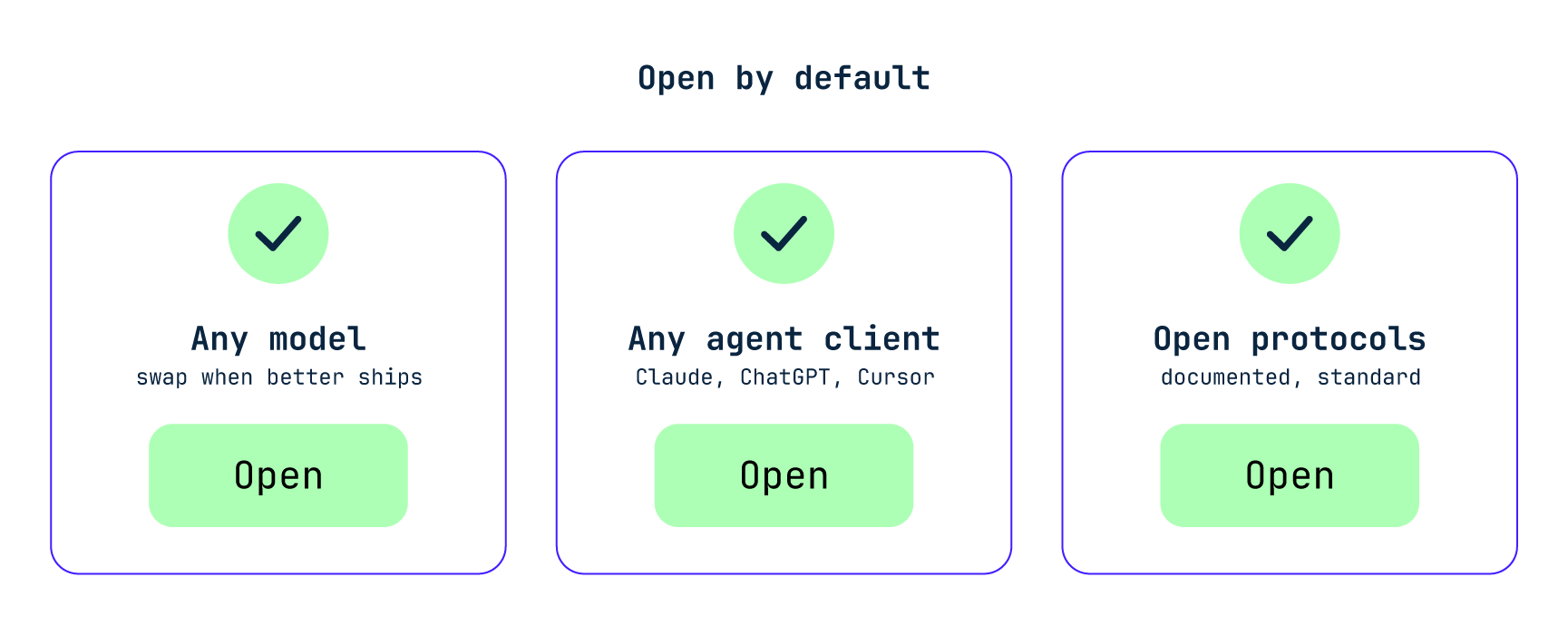
Any LLM provider
Any MCP client
No walled gardens
BYOM-first
BYOM in practice
Bring your own model. Without a re-platform.
Three concrete ways our customers exercise the openness — and what it lets them do that closed-AI platforms can't.
Match the model to the task
Stay current without waiting
Your data stays yours
What MCP gives an agent access to
Deep coverage across the core. Read and write.
| CONCEPT | READ | WRITE |
|---|---|---|
| PRODUCTS | ||
| Product (single, group, variant)Including variant group assignment and promotion | ✓ | ✓ |
| Attribute valuesSimple, dictionary, column, matrix, compound | ✓ | ✓ |
| Product connectionsCross-sell, related, accessories | ✓ | ✓ |
| Completeness scorePer context, per catalogue; create and manage requirements | ✓ | ✓ |
| Product historyWho changed what, when (read-only) | ✓ | — |
| CATALOGUES & ATTRIBUTES | ||
| Catalogues & category treesHierarchical nodes, product-to-node membership | ✓ | ✓ |
| Attribute definitionsSimple, dictionary, column, matrix, compound, relation types | ✓ | ✓ |
| CONTEXTS & ASSETS | ||
| Contexts (language/market)Read-only definitions; read/write context-scoped values | ✓ | ✓ |
| Assets & mediaSearch, browse, upload via presigned S3 flow | ✓ | ✓ |
| PUBLISHING & WORKFLOW | ||
| Sync / publishTrigger sync, view publish history, get diffs | ✓ | ✓ |
| Tasks & workflowsList, assign, update status | ✓ | ✓ |
| See the full list of the MCP tools → | ||
For Developers & Power Users
Bluestone PIM Labs
For developers and power users looking to bring Bluestone PIM into their own AI workflows — Claude, Cursor, or ChatGPT. Connect remotely, run locally, or fork it entirely. Start building your own specialised flavours of the Bluestone PIM experience, tailored to your team's specific niche and expertise.
From Labs to Production
The path to Extensions Hub
Labs is the on-ramp. If what you build gets traction, the next step is the Bluestone PIM Extensions Hub — the marketplace where integrations and tools reach the full Bluestone PIM customer base, with the option to monetize.
Related capabilities
Built for Agents
AI Capabilities
Built for Agents
MCP (Agent Gateway)
Built for Agents
Integration Patterns
INTELLIGENT BY NATURE
Common Questions About Agentic PIM
-
MCP, the Model Context Protocol, is an open standard for how AI agents connect to the tools and data they work with. Think of it as a universal plug: instead of building a custom integration for every agent, a system exposes its capabilities once over MCP, and any MCP-capable agent can use them.
Bluestone PIM is MCP-native, so agents like Claude, ChatGPT and Cursor can read and write your product data directly, governed by your platform's own rules.
-
An MCP-native PIM is a product information platform that exposes its capabilities to AI agents over the Model Context Protocol, rather than bolting on a limited preview. Bluestone PIM covers the full data model: products, catalogues, attributes, contexts, assets, publishing and workflow, with full read and write.