Headless, API-first
Your stack stays yours. Because the UI is just another client.
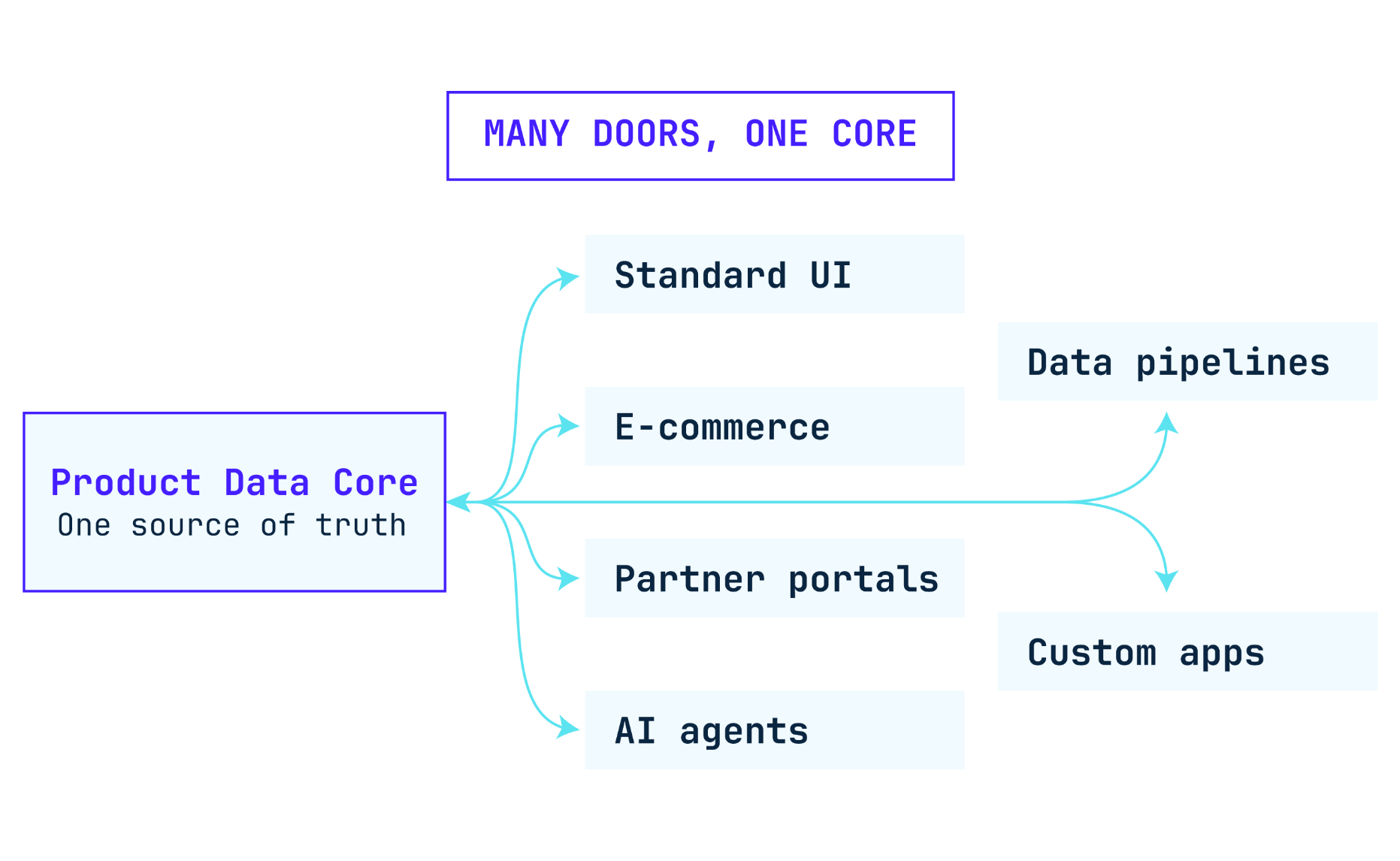
Headless commerce decoupled the storefront; a headless PIM decouples the work itself from the screen. Every function in Bluestone PIM lives behind a task-level API—surgical, granular, and invocable by any system.
Your people, your partners, and your AI agents all operate on equal footing from the exact same product truth, through whatever interface fits the job.
API-first
MCP-native
LLM-neutral
MACH certified
EU AI Act-ready
What this gives you
Own the whole stack — not just the parts the vendor exposes.
When every capability is an API, the platform bends to your roadmap instead of the other way around. Three things follow.
Yours to move
Yours to ship faster
Yours to optimise
The architecture advantage
Full UI/API parity — no native UI to defend.
Headless commerce decoupled the storefront a decade ago; for a PIM, headless goes further — it decouples the work itself from the screen, which is the precondition for agents to do that work at all. Most platforms can't make that claim cleanly: their public API is a subset of what the UI can do, because engineering was always split between the two.
Bluestone PIM has no such split — our own UI runs on the same public API any customer uses. That's what full UI/API parity actually means:
- One surface, not two. 100% of platform development goes into a single API — no second-class API, no UI debt to maintain.
- Every operation is a public call. Anything your team does in the interface is available to your code and any agent, on equal footing.
- No hidden ceiling. Nothing is locked behind a screen, so there's no operation an integration or agent can't reach.
700+
100%
10 yrs
700+
100%
MCP Native
First MACH PIM
Why it matters for a PIM
Headless changed the storefront.
For a PIM, it changes more.
Decoupling the frontend is familiar. Decoupling the product-data layer is what lets every system, channel, and agent work from one source of truth — without locking you into a rebuild.
It's the data layer, not the storefront
Headless commerce frees your frontend. A headless PIM frees your product data — so the same validated record feeds your storefront, your marketplaces, your apps, and your agents, instead of being trapped behind one screen.
It complements your ERP, MDM, and PLM
Bluestone PIM is the source of product truth, not a replacement for your systems of record. It connects to the ERP, MDM, and PLM you already run, draws from them, and shapes that data for every channel and agent downstream.
No rip-and-replace
Adopt it as a clean product-data layer alongside the stack you have. Because everything is an API, it slots into your existing integrations rather than forcing a migration to use it.
It's the part of the stack agents reach first
When customers research and buy through AI, your product data is what agents read. A headless PIM makes that data directly operable and queryable — so you're present in agent-mediated channels, not invisible to them.
What it lets you build
One API surface. A lot becomes possible.
A few of the things teams build once every operation is reachable programmatically.
Custom interfaces for any team
Launch a new channel in days
Sync the stack in real time
Let agents run the daily work
Be found in AI-mediated discovery
Automate validation and compliance
Why this matters for agents
Granular by design — so agents aren't boxed in.
The API a platform ships tells you what it was built for. An API with a few dozen broad endpoints was built for backend syndication — a nightly job, one admin key, nobody waiting. Bluestone PIM's 700+ task-level endpoints were built for the opposite: someone building a real-time interface on top. That means the API was designed with the things an agent also needs:
Per-user authorisation
Sub-100ms responses
One operation per call
When an agent decides what to do at runtime, it needs every operation exposed as something it can call — not a handful of bulk jobs. Bulk operations and scheduled automation are there too; you reach for whichever fits.
Machines aren't limited, because the API surface isn't limited.
The two-layer API
Two APIs. Two distinct jobs.
Control and delivery have different requirements. Bluestone PIM has a dedicated surface for each — so neither compromises the other.
MANAGEMENT API
MAPI
Secure read/write for integrations and agent operations.
- Granular read/write access to PIM, DAM, and core services
- OAuth and OpenID Connect token authentication
- For ERP integrations, enrichment workflows, agent operations
- Enterprise-grade identity and access management
PUBLIC API
PAPI
High-performance read-only delivery to channels.
- Read-optimised, designed for thousands of consumers
- Simple API key per system
- For headless storefronts, mobile apps, marketplace syndication
- Sub-minute latency, predictable performance
The API, in practice
From a single call to a working integration.
Two ways to see it: a real flow that populates a storefront end to end, then a sandbox to explore individual operations and their exact payloads.
A Real Integration Flow — Five Calls to Populate a Headless Storefront
Step 1 — Fetch Catalogues
GETpapi.bluestonepim.com/categories
https://{tenant}.papi.bluestonepim.com/categories \
-H "x-api-key: {API_KEY}"
Step 2 — Build the Category Tree
GETpapi.bluestonepim.com/categories/{categoryId}
https://{tenant}.papi.bluestonepim.com/categories/{categoryId} \
-H "accept: application/json" \
-H "x-api-key: {API_KEY}"
Step 3 — Populate Products
GETpapi.bluestonepim.com/categories/{categoryId}/products
https://{tenant}.papi.bluestonepim.com/categories/{categoryId}/products \
-H "x-api-key: {API_KEY}"
Step 4 — Enrich with Details
GETpapi.bluestonepim.com/products/{productId}
https://{tenant}.papi.bluestonepim.com/products/{productId} \
-H "x-api-key: {API_KEY}" # Returns attributes, media, labels, relationships — full payload
Step 5 — Subscribe to Changes (Webhook)
POSTyour-webhook-handler
POST /your-webhook-handler
{
"event": "SYNC_DONE",
"productId": "71b892ca-034f-4cab-b412-fc0866528ec1",
"updatedAt": "2026-06-10T09:14:22Z"
}
Explore Individual Operations — Pick a Call, See the Exact Payload
Create a New Product
POSThttps://app.bluestonepim.com/api/products
"https://app.bluestonepim.com/api/products" \
-H "Authorization: Bearer {MAPI_TOKEN}" \
-H "Content-Type: application/json" \
-d '{"name": "A brand new product", "number": "1234-5678-90AB"}'
# HTTP/1.1 201 Created
Find a Product by Number
GEThttps://app.bluestonepim.com/api/products/search/{number}
"https://app.bluestonepim.com/api/products/search/1234-5678-90AB" \
-H "Authorization: Bearer {MAPI_TOKEN}"
# Returns full product object with attributes, labels, relationships
Attach Attributes to a Product
POSThttps://app.bluestonepim.com/api/products/{id}/attributes
"https://app.bluestonepim.com/api/products/71b892ca-.../attributes" \
-H "Authorization: Bearer {MAPI_TOKEN}" \
-H "Content-Type: application/json" \
-d '[{"key": "color", "value": "Midnight Blue"}]'
# HTTP/1.1 200 OK — attribute applied
Check Product Publish Status
GEThttps://app.bluestonepim.com/api/products/{id}/status
"https://app.bluestonepim.com/api/products/71b892ca-.../status" \
-H "Authorization: Bearer {MAPI_TOKEN}"
# Returns completeness, validation state, publish status per context
The API, in practice
From a single call to a working integration.
Two ways to see it: a real flow that populates a storefront end to end, then a sandbox to explore individual operations and their exact payloads.
Related capabilities
Built for Agents
Open by Default
Built for Agents
Integration Patterns
Built for Agents
Security & Scalability
Book a demo
Build on a foundation that doesn't fight your roadmap.
A direct, technical conversation about your architecture — and what your team could ship once nothing is locked behind a UI.