

 Retail & ecommerce
A lot of PIM vendors now call themselves "API-first," but fewer can really prove it. The term has become a checkbox on every product page, right between "cloud-native" and "AI-powered." But when your integration team starts working with the product, the gap between marketing-first and API-first becomes obvious very quickly. Endpoints are missing, documentation is thin, and core features are only accessible through the UI.
That gap has always been a problem. Now it's a hard ceiling. When AI agents operate your PIM, executing enrichment, validation and publishing without a human in the loop, they can only act on what the API exposes. If your PIM's API covers 70% of what the UI can do, your AI agents are capped at 70%. That's not a configuration issue. It's an architectural one, and it usually traces back to whether the platform is genuinely headless or just API-first on paper.
This guide covers what API-first and headless PIM software actually mean, what to test during evaluation, and which questions to ask before you sign anything.
If you need a primer on how API-first PIM works, this guide covers the fundamentals.
How Can You Tell if a PIM Vendor Is Actually API-First?
You can't tell from a feature matrix. You need to test the API directly, ideally during a sandbox trial before any contract discussion.
Plenty of PIM platforms started as monolithic, UI-first applications. The API came later, bolted onto an interface that still assumes a human is clicking through it. These retrofit APIs tend to cover basic read operations and single-record updates, but fall short on write-heavy operations, workflow automation, and governance features. During a demo, everything looks fine. During integration, your development team discovers that 70% of the platform's capabilities are locked behind the admin panel.
What Does "Headless" Actually Mean for This Evaluation?
Headless PIM means no interface, not the vendor's UI, not a partner portal, not an AI agent, has privileged access to the data that any other interface lacks. Every one of them reaches the platform through the same API.
This distinction is worth taking seriously, because a platform can call itself API-first without being headless. If the vendor's own admin UI can do things the public API can't (bulk operations, workflow triggers, permission changes), the platform still has a human-only layer underneath the API marketing. A genuinely headless PIM has no such layer: the UI is simply one more client of the same API everyone else uses, which is what full UI/API parity actually requires in practice.
The table below shows what to look for when separating API-first, headless architecture from API-capable.
API-First vs. API-Capable: What To Look For
| Evaluation criterion | API-first PIM | API-capable PIM |
|---|---|---|
| Full feature access through the API | Full parity: every action available in the UI is also available through the API. No feature is locked to the interface. | Partial coverage. Advanced configuration, workflow triggers, and permission management require the admin panel. |
| API granularity | Dedicated endpoints for each distinct action: update a single attribute, create a product relationship, trigger a validation rule. Each operation is individually addressable. | Bundled endpoints that group multiple operations together. Changing one field means sending the entire product object. Fine-tuned, per-task automation is difficult or impossible. |
| Write operations | Full create, update, delete, and bulk operations via API, including complex actions like relationship modelling and approval workflows. | Read-heavy. Write operations limited to basic CRUD. Bulk updates and workflow triggers often UI-only. |
| Agentic and MCP readiness | API endpoints designed for AI orchestration: granular enough for MCP tools and AI agents to control the full system programmatically. | APIs too bundled for AI agents to perform precise actions. AI features are GUI-dependent or limited to narrow, task-specific add-ons. |
| Extensibility | Native Packaged Business Capabilities (PBCs) and a component library for building custom microservices that run inside the platform. | Relies on external connectors, third-party apps, or custom code outside the platform for extensibility. |
| AI model flexibility | BYOM-first (Bring Your Own Model): connect any LLM and switch models per task without vendor lock-in. | Restricted to a pre-selected AI provider. Alternatives require custom development. |
| Event notifications | Webhooks and event-driven architecture with structured payloads and retry policies for failed deliveries. | Polling required. No push notifications, or limited webhook support with unstructured payloads. |
| Architecture verification | MACH-certified by the MACH Alliance: microservices, API-first, cloud-native, and headless, verified by a third party. | Self-declared MACH or "MACH-adjusted." Legacy core modernised with an API layer added on top. No third-party verification. |
| Documentation | Public, versioned, with request/response examples, error codes, and authentication instructions. Accessible without a login. | Behind a login wall, sparse, outdated, or mismatched with actual API behaviour. |
What Specific Tests Should You Run During a PIM Evaluation?
Vendor claims don't survive contact with real integration work. Run these tests during any evaluation where API-first is a requirement.
Test 1: Endpoint Coverage Audit
Request the full API reference. Count the endpoints. Then map them against every feature you can see in the UI: product creation, attribute management, relationship modelling, category assignment, asset uploads, validation rules, approval workflows, publishing, permissions.
If a feature exists in the UI but has no API endpoint, that feature requires someone to log in and click. That's a manual bottleneck, and it's the clearest sign a platform is API-capable rather than truly headless. Bluestone PIM exposes 700+ public endpoints, covering both the Management API (MAPI) for managing all platform components and the Public API (PAPI) for high-performance external delivery.
Test 2: Write Operations and Automation at Scale
Most API endpoints handle single-record reads well. The real test is writes, and specifically automation: can the platform act without a person triggering each step. Can you bulk-update attributes across 10,000 SKUs in a single API call? Can you create product relationships programmatically? Can you trigger validation rules and get structured error responses back? Run this test with realistic data volumes, not the vendor's 50-product sample dataset.
What genuine automation looks like underneath the API?
Bluestone PIM's e-book, Automation in Product Information Management, documents the rules a properly headless, API-first PIM can run without a human in the loop:
- Category assignment on creation. A rule matches a new product against a defined attribute, brand or supplier, and assigns its category automatically, entirely through the API, with no UI step required.
- Workflow handoff on completeness. A product moves to the next team automatically once it meets defined completeness requirements, rather than being tracked through email or a spreadsheet.
- Channel sync on data change. When a live product's attributes change, the platform detects it and pushes the update to every connected channel automatically.
If a vendor can't point to API endpoints for exactly these kinds of rules, and can't show them triggering without a person clicking "apply," their platform's automation claims are UI-assisted, not genuinely automated. Ask to see the rule engine's API calls directly, not just the marketing description of "automation."

Download free e-book
Automation in Product Information Management
This e-book explains how automation works in product information management, which catalogue workflows can be automated today, and how an event-based architecture creates the foundation for the agentic PIM.
Test 3: Authentication and Access Control
Check the authentication model. OAuth2 is the standard. Ask whether the platform supports scoped API keys with granular permissions, so you can control exactly what each integration is allowed to read and write. A single API key with full admin access is a security risk in any production environment.
Test 4: Error Handling Quality
Send a deliberately malformed request. Does the API return a helpful, structured error message with a specific error code? Or does it return a generic 500 with no detail? Good error handling saves hours of debugging during implementation. Bad error handling turns every integration issue into a support ticket.
Test 5: Documentation Accuracy
Pick three endpoints at random from the documentation. Call them. Compare the documented response schema against the actual response. If they don't match, the documentation is lagging behind development. That's a sign of an API that's maintained as an afterthought.
Test 6: Event-Driven Capability
Check for webhook support. Can the platform notify your systems when product data changes, rather than requiring your systems to poll for updates? Event-driven communication reduces latency and keeps channels in sync without unnecessary API calls. Ask specifically about payload structure and retry policies for failed webhook deliveries.
Test 7: Rate Limits Under Load
Ask about rate limits, payload sizes, and concurrent connection limits. Then test them. A PIM managing 100,000+ SKUs across multiple channels needs to handle sustained API traffic without throttling. Generous rate limits on paper mean nothing if the platform slows down at volume.
What Questions Should You Ask a PIM Vendor About Their API?
Put these to any vendor during a demo or technical deep-dive. The answers separate genuinely API-first platforms from the rest.
-
Can I perform every action through the API that I can perform in the UI? (If the answer starts with "most things," that's a no.)
-
How many public API endpoints does the platform expose? (A specific number matters. Vagueness is a red flag.)
-
Is the API documentation publicly accessible without a login?
-
What authentication methods are supported, and can I create scoped tokens with granular permissions?
-
How do you handle API versioning? Will breaking changes affect existing integrations?
-
Do you support webhooks? What's the retry policy for failed deliveries?
-
What are the enforced rate limits for API calls
-
Is your API MCP-native, and is that live in production or on the roadmap?
-
Can an external AI agent perform the same operations as a logged-in user, including workflow triggers and validation?
Choosing a PIM shouldn't come down to a feature list alone. The PIM Vendor Evaluation Checklist helps you dig into flexibility, scalability, support and future-proofing before you sign anything.
DOWNLOAD THE CHECKLIST
PIM Vendor Evaluation Checklist
This checklist will help you dig deeper into what really matters: flexibility, scalability, support, and future-proofing.
Download the checklistHow Does API-First, Headless PIM Fit Into a Composable Commerce Stack?
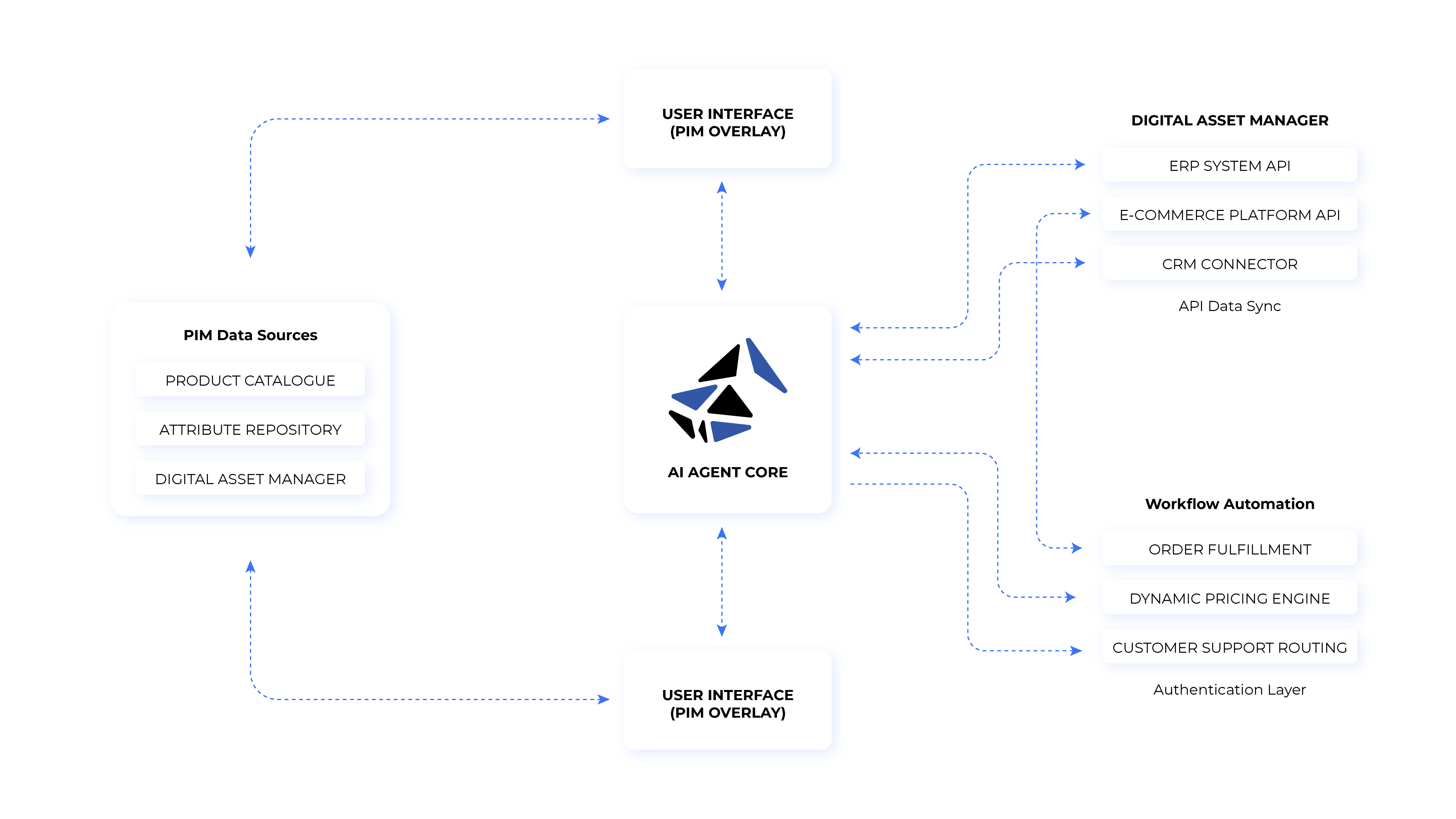
A composable commerce stack is built from independent, best-of-breed components that communicate through APIs.
API-first, headless PIM software is what makes this architecture work for product data. If your PIM can't exchange data with your ERP, CMS and marketplace connectors through well-documented endpoints, it becomes the bottleneck in a stack designed to avoid bottlenecks. Being headless is what stops that bottleneck from reappearing as your stack grows: no new integration should ever need special, UI-only access that the rest of your stack doesn't have.
Composability also means you can swap or add components without rebuilding. Need to add a new marketplace? Connect it to the PIM's public API. Migrating e-commerce platforms from Magento to commercetools? The PIM integration layer stays the same. Your product data model doesn't change because a downstream system changed.
Bluestone PIM is built for this architecture: headless, API-first and MACH-certified by the MACH Alliance, it connects to ERPs (SAP, Microsoft Dynamics), e-commerce platforms (Shopify, commercetools), and any system with a REST API. The Extension Hub provides pre-built connectors. Custom integrations use the same documented API that powers the pre-built ones, and the same automation rules run regardless of which client is calling them.
Going deeper into MACH and product data? The MACH-Based PIM Ultimate Guide explains how MACH-based, headless PIM supports composable commerce in practice.
Download free e-book
MACH-Based PIM: The Ultimate Guide
Going deeper into MACH and product data? This e-book explains how MACH-based PIM supports composable commerce in practice.
Why Does API Coverage Determine What AI Agents Can Do With Your PIM?
Most enterprise software was built UI-first. API endpoints were added later, and they typically expose somewhere between 60% and 80% of what the UI can do. For traditional integrations, that gap is manageable. For AI agents, it's a hard ceiling, and it's the practical difference between a PIM that's merely API-capable and one that's genuinely headless.
When an AI agent operates a PIM, it doesn't log in and click. It calls endpoints. If the endpoint for triggering an approval workflow doesn't exist, the agent can't trigger that workflow. If bulk attribute updates require navigating a UI import tool, the agent can't execute them without a human stepping in. Every operation that lives only in the UI is an operation your AI investment can't reach, and every one of those gaps is a piece of automation your team is still doing by hand.
The PIM market is now splitting along this line. The table below shows where vendors currently land on the agentic maturity scale.
What Level Is Your PIM At?
| Level | What It Means | How Agents Behave |
|---|---|---|
| L1: Manual PIM | Spreadsheets, manual enrichment | Agents cannot act; no API |
| L2: AI-assisted PIM | GenAI buttons inside the UI | Agents assist humans inside the interface |
| L3: AI-suggesting PIM | Detects gaps, suggests fixes; human clicks "apply" | Agents recommend; humans execute |
| L4: AI-acting PIM | Natural-language conversations execute work in-platform | Agents act inside the platform |
| L5: Agent-native PIM | External AI agents act on the catalogue via MCP; full UI/API/agent parity | Agents operate end-to-end, 24/7, without human intervention |
Most enterprise PIM systems currently stand at L2 or L3. The level required to win agentic commerce is L5, and L5 is only reachable on a genuinely headless architecture: you can't give an agent parity with a human user if the human user still has UI-only capabilities the agent doesn't.
Bluestone PIM is designed for L5. Full UI/API/agent parity means every operation available to a logged-in user is equally available to an AI agent via API. MCP is live in production, not on the roadmap. Task-level, granular endpoints give agents the precision to act on individual fields, trigger specific automation, and validate single records, without requiring coarse bulk operations that are too imprecise for reliable agentic execution.
This is relevant for your evaluation today because architecture decisions in a PIM selection lock in for years. A platform at L2 or L3 can add AI features to the interface, but it can't retrofit headless architecture underneath them. Reaching L5 requires rebuilding the API layer from the ground up. The platforms already at L5 have a multi-year head start.
The practical test during evaluation:
Ask your vendor whether an external AI agent, running outside their platform entirely, can perform a complete product workflow from enrichment through validation to publishing, through the API alone, with no UI interaction at any step. The answer tells you where the platform actually sits on the maturity scale, regardless of how it is marketed.
Start With the API Documentation
Most PIM evaluations start with a sales demo. The better approach is to start with the API docs. If the vendor won't share them before a contract conversation, that tells you everything you need to know about how API-first, and how genuinely headless, the product actually is.
Bluestone PIM makes technical evaluation straightforward, with clear API documentation and support from the team to help your developers assess fit, integration options and implementation requirements.
Book a technical demo to test Bluestone PIM's headless, API-first architecture and automation capabilities against your integration requirements.
Retail & ecommerce
 API-first PIM Software