
 AI
AI
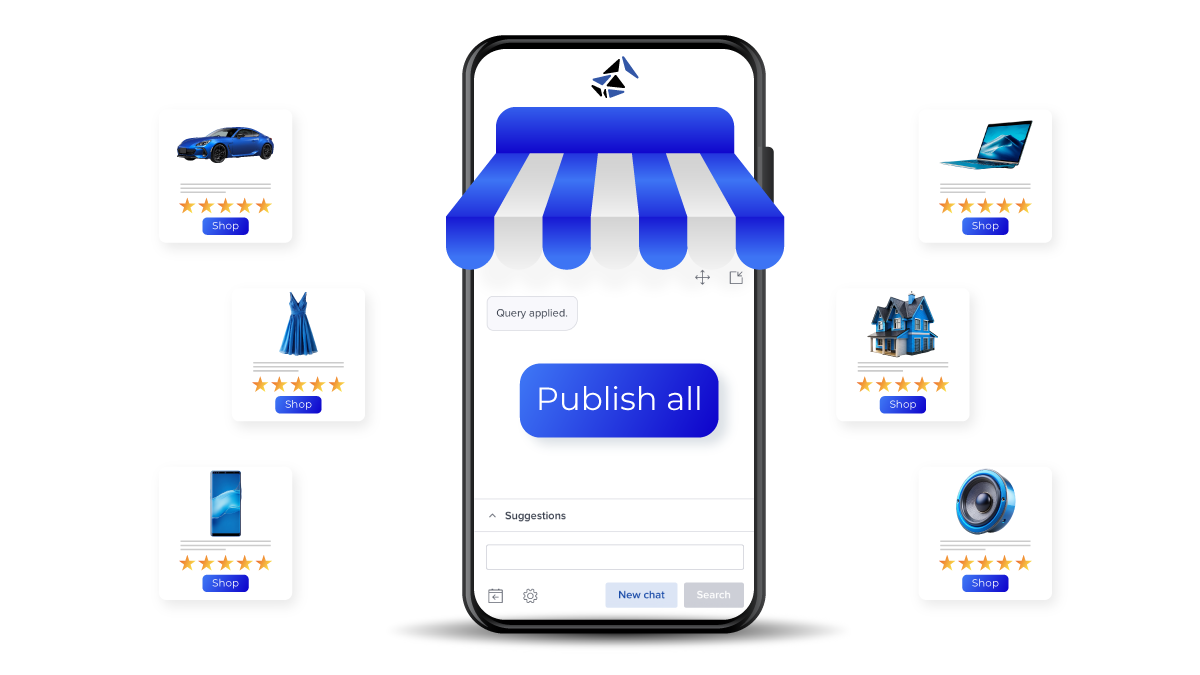
In May 2026, Google introduced the Universal Cart at I/O and called it the foundation for agentic commerce.
Shoppers (in selected pilot countries) can now add products to one cart while searching, chatting with Gemini, or watching YouTube, and an agent can complete the purchase for them.
If you run product data for an enterprise catalogue, that announcement is your warning shot.
The reason is simple. When an AI assistant answers "what is the best espresso machine under £300 for a small kitchen?", it does not read your homepage the way a person does.
It assembles an answer from structured product facts it can trust.
If your catalogue is full of marketing prose and empty specification fields, the AI skips you and recommends a competitor that gives it cleaner data.
This guide is for e-commerce managers and digital leads at retailers running thousands or millions of SKUs across multiple markets. It explains what GEO actually is, how generative search engines pull product data, and what to fix so AI systems can find, understand, and recommend your products.
What Is GEO for E-Commerce?
GEO for e-commerce is the work of structuring product data, content, and feeds so generative AI systems can read your catalogue and recommend your products. The term stands for Generative Engine Optimisation. Where classic SEO aims to win a ranking position, GEO aims to win a citation inside an AI answer.
The real change is that shoppers are starting to ask AI tools for direct product recommendations instead of browsing search results page by page. Shoppers ask ChatGPT, Google Gemini, and Perplexity for recommendations, comparisons, and shortlists. The AI returns a direct answer, and increasingly an action: add to cart, compare, buy. Your product either appears in that answer or it does not.
For an enterprise managing millions of SKUs across different channels, the manual approach of the past cannot keep up. You are no longer optimising a single storefront. You are governing a data ecosystem that has to be legible to machines across every surface at once.
Bluestone PIM helps e-commerce teams meet that bar with a headless, agent-first product data platform: the same API that runs Bluestone PIM's own interface also lets AI agents enrich, validate, and distribute clean, structured data to every connected channel.
Download free e-book
AI Visibility Guide for Retailers
Learn how to structure product data so AI can find, cite, and recommend your products. Covers GEO, agentic commerce, and 30+ data fields.
Is SEO Still Relevant for Generative AI Search?
SEO is still relevant, and GEO depends on it. The technical foundations of strong SEO are the same foundations GEO needs: structured data, clean URLs, descriptive headings, fast pages, and schema markup. A retailer with a healthy SEO setup already has a head start on GEO.
The difference is what each one rewards:
-
SEO rewards a page that earns a click.
-
GEO rewards a product fact that an AI can lift and cite with confidence.
GEO vs. SEO: What's the Difference?
| SEO | GEO | |
|---|---|---|
| Main goal | Rank a page in search results | Get product facts cited in an AI answer |
| What wins | The web page | The individual product attribute |
| Who reads it | A person clicking a link | An AI model assembling an answer |
| What it rewards | Keywords, backlinks, page speed | Structured, complete, consistent product data |
| Typical output | A blue link the shopper clicks | A recommendation, often with no click |
| Data source it reads | Mostly your website | Every channel your product data appears on |
How Do Generative Search Engines Actually Work?
Generative search engines work by retrieving information, then generating an answer from it. When a shopper asks a question, the system searches its index and connected sources, pulls the most relevant and trustworthy data, and writes a response grounded in what it found. This pattern is often called retrieval-augmented generation.
Before AI recommends a product, it looks for a few trust signals:
-
Attribute match: does the product fit the exact question?
-
Data freshness: has the product information been updated recently?
-
Price and stock accuracy: is the offer still valid?
-
Verifiable claims: can the product details be checked and trusted?
Generative engines prioritise machine-readable truth. They favour discrete, structured facts over persuasive copy, because facts are what they can verify and cite without risk. A beautiful product story tells the model very little. A complete, consistent spec sheet tells it everything.
This is also why consistency across channels carries so much weight. The AI cross-references your product on your website, your Amazon listing, and your Google Shopping feed. If the name, price, or attributes differ, it detects the conflict and lowers trust in every source.
Bluestone PIM removes that risk by event-based product data automation, distributing one validated version of each product to every channel, so the AI always sees the same truth.

Download free e-book
Automation in Product Information Management
This e-book explains how automation works in product information management, which catalogue workflows can be automated today, and how an event-based architecture creates the foundation for the agentic PIM.
How Do You Apply GEO to E-Commerce Product Data?
You apply GEO to e-commerce by moving factual information out of marketing prose and into structured, complete, consistent fields. Strong product descriptions still matter for the human reader, but the facts that win AI citations have to live in attributes, not adjectives.
Start with your decision-making attributes: the fields a shopper actually compares before buying. Then add structured Q&A, intent fields, and trust markers.
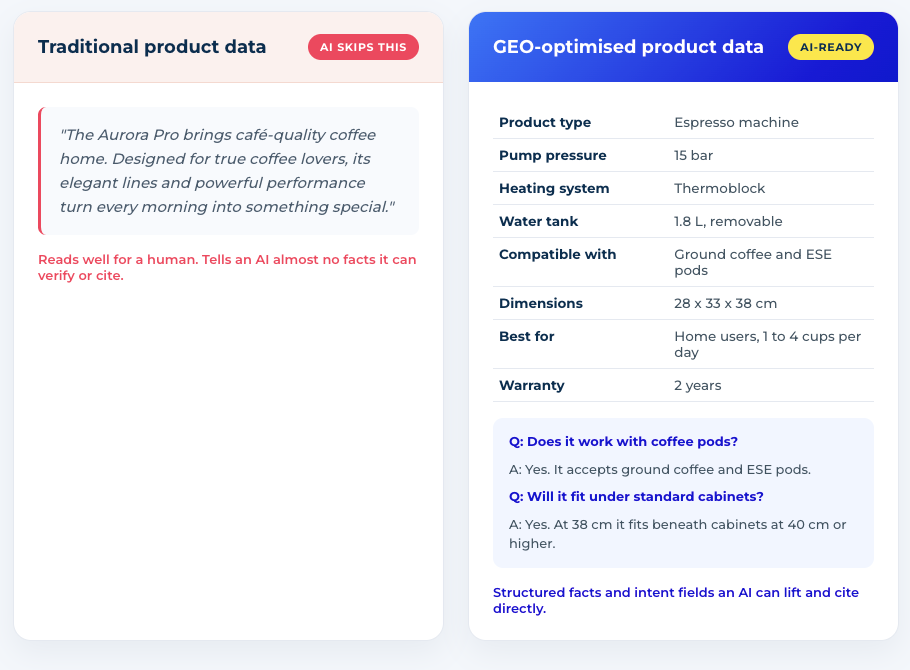
Here is what traditional product data vs GEO-optimised product data looks like in practice. A marketing description like "The Aurora Pro brings café-quality coffee home" tells a human everything and an AI almost nothing. The GEO-optimised version replaces that with facts: pump pressure, heating system, water tank size, compatible pods, dimensions, and a "Best for" field, plus two structured Q&A pairs, "Does it work with coffee pods?" and "Will it fit under standard cabinets?"
For retailers selling across regions, GEO also depends on localised product data being structured and consistent in every market. A spec that is complete in English and half-empty in German costs you AI visibility in Germany. Bluestone PIM handles this with structured data modelling for market-specific attributes and AI translation that keeps terminology consistent across every market: Zeeman cut its localisation cycle from six weeks to one week this way, the same consistency that keeps a spec legible to AI across languages.
This is the same data foundation that improves your AI visibility overall. GEO, feed quality, and marketplace accuracy are not separate projects, they run on one clean catalogue.

Download free e-book
The GEO Checklist for Retailers: Will AI Recommend Your Products?
AI tools can only cite product information they can read and trust. Use The GEO Checklist for Retailers to find data gaps, improve your product pages, and make your catalogue easier for AI systems to interpret.
What Are the Best GEO Tools for E-Commerce?
The best GEO tools for e-commerce fall into three groups, and most teams need more than one. Knowing which job each tool does saves you from buying a tracker when the real gap is in your data.
-
The first group tracks AI visibility: tools that monitor whether ChatGPT, Gemini, and Perplexity mention your brand or products, and against which competitors. Useful for measurement, but they report a problem rather than fix it.
-
The second group handles on-page structure: schema generators, content optimisation tools, and feed validators that check your markup and formatting. These improve how a single page or feed is read.
-
The third group is the foundation: the product data layer that feeds every other tool. A PIM software gives that layer structure, governance, and a single source of truth. No amount of schema tooling helps if the underlying attributes are missing, inconsistent, or trapped in 40 spreadsheets.
How Bluestone PIM Supports GEO
Bluestone PIM strengthens the GEO foundation with three capabilities that decide whether an AI cites your products or skips them:
- Complete every product record at scale: Bluestone PIM enriches product data with AI, generating structured attributes and content from your existing data and images across thousands of SKUs at once. Empty fields stop being a manual backlog, and AI systems get the discrete facts they need to recommend you.
- Stay citable in every market you sell in: Bluestone PIM translates and standardises product data across locales, so a spec that is complete in English stays complete and consistent in German, French, and every other language. AI assistants cross-reference markets, and that consistency is what earns their trust.
- Catch the gaps before an AI does: Bluestone PIM scores data completeness and applies validation rules that flag missing required fields before anything goes live. A product missing its weight or compatibility gets caught in the workflow, not when a shopper asks ChatGPT and your product never appears.
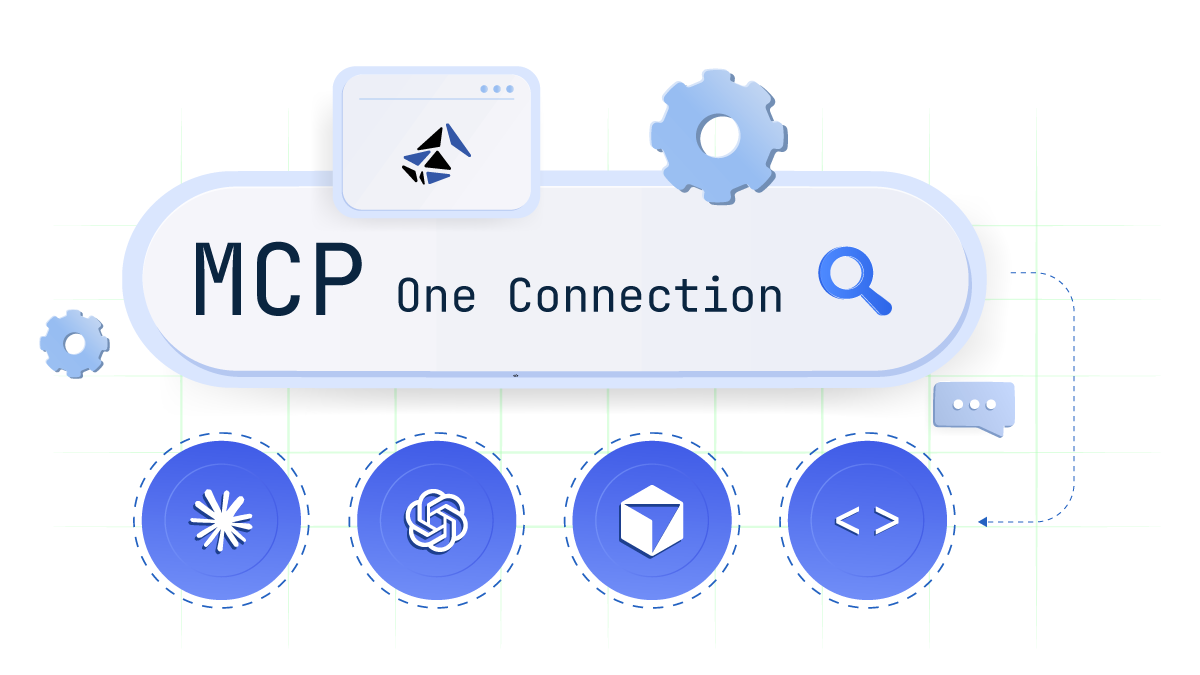
Bluestone PIM is also the only major enterprise PIM with full UI/API parity: its own interface runs on the same 700+ task-level API that customers and AI agents use, with no separate admin-only layer hiding underneath. That architecture is what makes its native Model Context Protocol (MCP) server possible. MCP lets AI agents query and act on product data through a standard interface, agent-first by design rather than retrofitted for agentic shopping.
Bluestone PIM is also recognised by Gartner® in the 2025 Market Guide for PIM Solutions, with AI flexibility being one of the differentiators the team consistently hears about in evaluations.
Download free e-book
Gartner® Market Guide for Product Information Management Solutions
The 2025 Gartner® Market Guide for Product Information Management is a trusted resource for business and tech leaders who want to make a confident decision about their PIM solution.
How Do You Prepare for Agentic Commerce?
You prepare for agentic commerce by making your catalogue agent-readable before the agents arrive. Agentic commerce is the model where an AI agent searches, compares, and buys on a shopper's behalf, within limits the shopper sets. Google's Universal Cart, the Universal Commerce Protocol (UCP), and the Agent Payments Protocol (AP2) are the early infrastructure for it.
The practical task is the same one GEO asks of you, taken one step further. An agent cannot recommend, add to cart, or buy a product it cannot understand. It needs current price, live stock, complete specifications, and verifiable claims, all available through a clean interface. A messy catalogue is invisible to an agent in the same way it is invisible to an AI answer.
Three moves get you ready:
-
Fix your structured attributes first. Start with the decision-making fields on your highest-traffic products.
-
Keep price and stock data accurate. Stale commerce data gives agents a reason to skip your products.
-
Expose product data through a standard interface. Agents need to query your data without custom development.
Bluestone PIM supports each step: governed structured data, automatic distribution to every connected channel, and an API-first architecture with MCP for agent access.
Ready to see what AI assistants can and cannot find in your catalogue today? Book a demo with Bluestone PIM.