












Advanced Data Modeling & Governance for Enterprise PIM
Bluestone PIM enables enterprises to model, govern, and scale complex product data for any ecosystem. Build a robust, auditable, and context-aware data foundation with flexible structures, advanced governance, and automated data quality control.


TRUSTED BY SYSTEM INTEGRATORS


Mirror reality
Context where it counts

Govern with confidence
Flexible Product Data Modeling for Every Team
Empower every role to create and maintain the data model in the way they work best. Every aspect of the model can be managed in two modes, giving your teams true flexibility.

Visually
Through an intuitive, graphic user interface designed for business users to manage complex data without requiring IT support.

Headlessly
Programmatically via the comprehensive APIs, allowing your developers to automate data modeling and integrate it seamlessly into your existing data pipelines.
Model Your Entire Product Universe
Define the core entities and the relationships between them in a single, centralised platform.
Products
Manage singles, Variant Groups, and Variants with full enrichment, assets, relations, and history from one panel.
Categories & Catalogues
Apply Category-Level Attributes (CLA) to standardise and propagate values throughout the entire product hierarchy.
Product Relations
Create meaningful connections, such as accessories or spare parts, with configurable, attributable relationships.
Assets
Seamlessly manage and link internal and external assets, such as images, documents, and videos, to products.
Building Blocks of Enterprise Data Modeling in Bluestone PIM
This is the toolkit that provides the unrestricted freedom to handle any product portfolio, no matter how complex.
Manage Complex Product Structures
Natively model all kinds of product types to accurately represent your entire portfolio.
SINGLE
Standalone products with a unique set of attributes and data.
VARIANT
Different versions of a product, such as varying colours or sizes. Manage variants within a single product record, and easily keep track of all the different versions of a product. A variant can only be related to one group at a time.
VARIANT GROUP
Used in relation to variants. A variant group allows adding data that is common to all variants and can be set up to be inherited by variants.
BUNDLE
Products that are sold together, e.g. a computer and a monitor. Products in a bundle have a quantity attribute, which defaults to 1. Bundles can consist of single and variant product types.
Easily define how products interact
Create one-way relationships for accessories and two-way relationships for compatible models. This allows you to build the sophisticated comparison and recommendation engines that drive modern commerce.
“The flow from the start of the product to the end product is easier and faster. We provide better quality products to our customers. With Bluestone PIM, we can easily integrate with other platforms and now we work better between different parts of the organization to provide better quality data.”
Thomas Fehn,
Chief Digital Information Officer at St. Gobain Distribution Nordics
“After having evaluated over 40 different suppliers we believe that Bluestone PIM... is the one most capable of providing the flexibility needed for our product data and business requirements.”
Viktor Lövgren,
IT Project Manager at Starboard
“Isola selected Bluestone PIM due to its functionality, platform flexibility, and a rich portfolio of additional Apps that makes it easy to expand our solution on demand.”
Christine Øvrum Halvorsen,
Web Editor at Isola
"Bluestone PIM: User-Friendly And Cost-Effective! The system has met our needs and we are satisfied with the service and support provided by Bluestone PIM. We would recommend it to other businesses looking for a reliable and efficient Product Information Management solution."

Construction Industry
IT Manager
"Great Solution For Delivering Product Information In Multiple Channels. Ease of use for the user. Developer accessibility and ease of use of the API endpoints to plug into other apps and deliver experiences."

Manufacturing Industry
Head of IT and ecommerce
"A Fantastic Tool That Is Scalable, Affordable And Fits Well Into The Market. This is a fantastic scalable tool that fits our services well. Scalability, flexibility and they take responsibility in the industry."

Transportation Industry
Digital Marketing Manager

ONE-WAY
In a one-way relationship, only one of the related products has a link to the other.
This relationship is useful when a product is related to many other products.
Example: A camera accessory links to the camera it is compatible with, but the camera does not link back to the accessory

TWO-WAY
In a two-way relationship, related products have a link to each other.
This relationship is useful when both products need to be related.
Example: A smartphone manufacturer has several models of the same smartphone with slightly different features – different storage capacities or colours. By creating a two-way relationship between these models, you can easily offer a comparison to customers who are researching the product.

Rich & Flexible Attributes
Enrich your data with a comprehensive set of 16 attribute types—designed for every scenario and detail—from Matrix to Compound. Leverage Category- and Variant-Level Attributes to manage inheritance and specificity at scale.
Place Attributes Where They Belong
✔ On Products: Primary enrichment surface, with easy UI or MAPI bulk edits.
✔ On Categories (CLA): Define standards that products inherit for catalog-wide consistency.
✔ On Relations: Add metadata like priority or date ranges directly to the relationship.
✔ On Assets: Manage asset-specific data for powerful filtering and organization.
✔ Query Builder & Dictionaries: Keep inputs clean and consistent across teams, ensuring high data quality from the start.

Multi-Dimensional Contexts — One Product, Infinite Variations
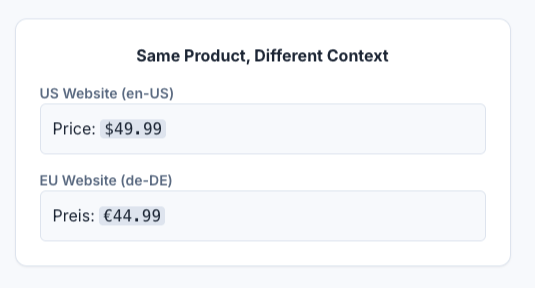
Deliver perfect information, everywhere. Use Contexts to tailor product data for different languages, sales channels, and markets—without duplicating products.

✔ Localise for Global Audiences
Manage names, descriptions, and rich text for any locale, like en-US or de-DE.
✔ Optimise Channel-Specific Copy
Vary titles, bullets, and image sets for your D2C site vs. a Marketplace.
✔ On Relations: Add metadata like priority or date ranges directly to the relationship.
✔ Adapt to Market Rules
Display specific regulatory text or pricing for Retail vs. B2B markets.
✔ Streamline Workflows: Run imports, exports, and dashboard widgets scoped to a chosen context for local teams.
Enforce Control with Enterprise Governance
A flexible model needs firm guardrails. Bluestone PIM gives you the levers to keep product data accurate, approved, and auditable — across teams, markets, and channels.
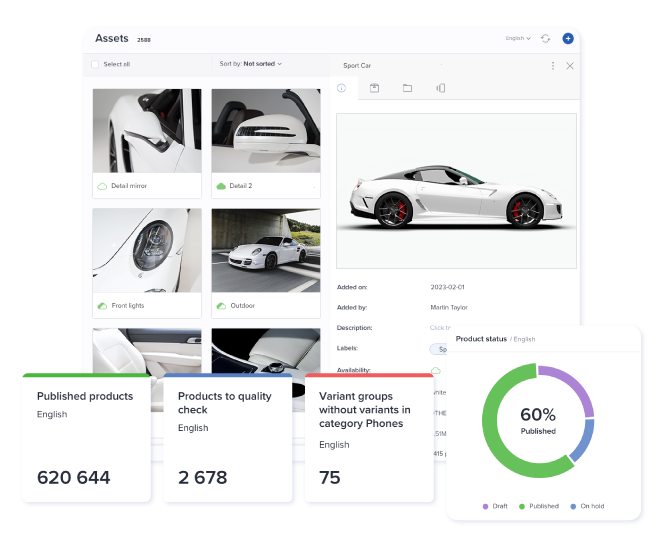
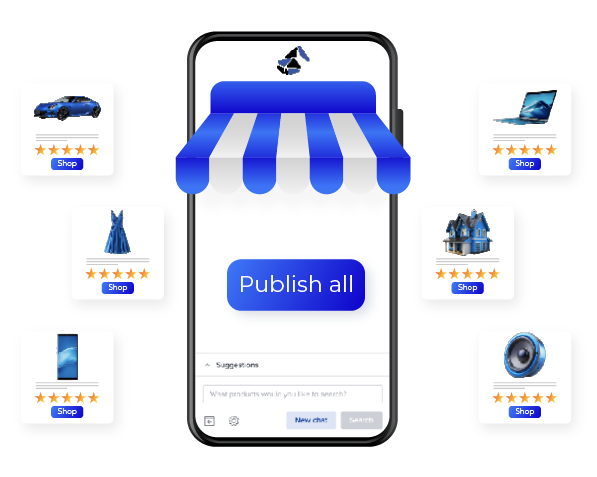
✔ Statuses & Publishing: Work in Draft, then Publish when ready. Only Published products surface to channels and APIs, so nothing leaks before approval.
✔ Full Auditability & Version Control: Track every change at the attribute level – who, what, when – and restore prior values instantly for compliance or rollback.
✔ Centralised Data Quality: Turn quality into policy with Completeness Score rules. Automatically validate required attributes, assets, and relations before anything can be published.
✔ Global Attributes for Consistency: Lock down critical fields (e.g., manufacturer part number) as context-independent values to keep core data consistent everywhere.
✔ Multi-Organisational Design: Support complex structures with segmented and secure data for divisions or brands — all within one centralized platform.


An Evolving Model Without the Migrations
With reusable attribute definitions, powerful inheritance (VLA/CLA), metadata on relations, and an API-first architecture, Bluestone PIM lets you evolve your data model without disruption. Whether you’re adding new sales channels, expanding into new countries, or launching entirely new product lines, your foundation is built to adapt and grow with your business.
Extensions that accelerate your data model
Data modeling in Bluestone PIM isn’t just about entities and attributes — it’s about how quickly you can design, populate, validate, govern, and evolve that model. These extensions plug directly into that lifecycle so your structure stays clean while your team moves fast.
Product Configurator
Bundle Configurator
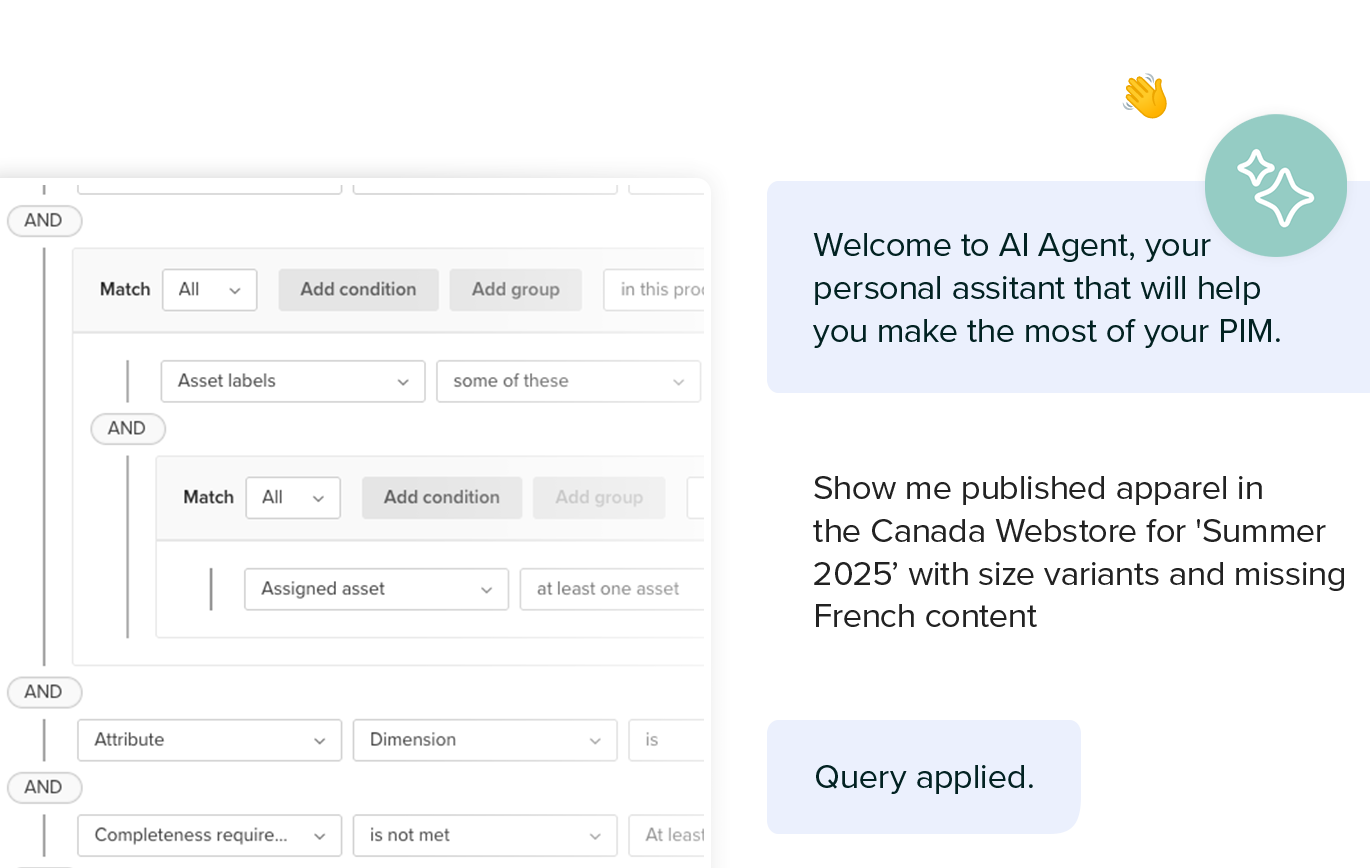
AI Analyst
Product Configurator
Tame product complexity. Define clear, enforceable rules for complex products with numerous variants, all while keeping your core data model clean and streamlined.
Read more about Product Configurator →Bundle Configurator
Master product relationships. Formally structure kits, bundles, and sets as distinct product types with their own defined components and attributes for clear, consistent management.
Read more about Bundle Configurator →AI Analyst
Go beyond manual checks. Our AI Analyst automatically finds and fixes data quality issues, fills in missing attributes, and harmonizes inconsistent values to ensure a pristine and trustworthy dataset.
Read more about AI Analyst →Ready to Build on a Smarter Foundation?
Let's have a strategic conversation about your architectural goals.
See how a PIM built on a true composable foundation can help you reduce technical debt, accelerate your teams, and transform your IT department into the growth engine for your business.
Book an Technology Session
We're here to help. A direct, technical conversation about your specific challenges and goals.
What Makes AI Analyst Stand Out

✦ End-to-End Solution
From detection to resolution, it offers a complete and fast workflow.
✦ Seamless Integration
Work where your product data already lives – with instant implementation and the intuitive interface you expect from Bluestone PIM.
✦ Human-Centric Design
Clear reasoning and control make every suggestion easy to understand and act on.
✦ Supports Various AIs
Optimise quality, cost, and use case flexibility.
Explore Practical Use Cases
for AI Analyst
Discover how AI Analyst solves product data challenges – from onboarding to campaign readiness and global scale.
See How It Fits Into Your Business Story:
- Retail & eCommerce – Accelerate seasonal updates
- Manufacturing – Optimise ERP content for sales channels
- Wholesale & Distribution – Standardise supplier data
- Global Brands – Keep product data consistent and structured across massive catalogues