

 Best Practices
Shoppers are already asking ChatGPT for product recommendations. When the AI answers, it pulls from structured product data, not from banner ads or paid placements. If your catalogue data is incomplete, inconsistent, or buried in marketing copy, the AI skips your products entirely.
AI visibility is the measure of how findable and citable your product data is across AI platforms like ChatGPT, Google Gemini, and Microsoft Copilot. For retailers managing thousands of SKUs across multiple channels, this is becoming a serious commercial question: are your products showing up when AI answers a shopper's query?
What Is AI Visibility and Why Should Retailers Care?
AI visibility refers to how easily AI systems can find your products, understand what they are, and include them in recommendations to shoppers. When a consumer asks ChatGPT or Google Gemini for a product suggestion, the AI evaluates structured data from product feeds, website content, and marketplace listings. Products with complete, consistent data get recommended. Products with gaps get ignored.
This is a different problem from traditional search rankings. SEO helps your product page appear in Google results. AI visibility determines whether your product gets cited in a conversational AI response, with or without a link back to your site.
Here's the thing: the AI does not read your website the way a human does. It cross-references product information across every channel where your data appears. If your product name, price, or specifications differ between your website, Amazon listing, and Google Shopping feed, the AI detects that inconsistency and reduces trust in all sources.
For e-commerce teams managing product data across multiple markets and channels, this raises an operational question that sits squarely within the product data function.
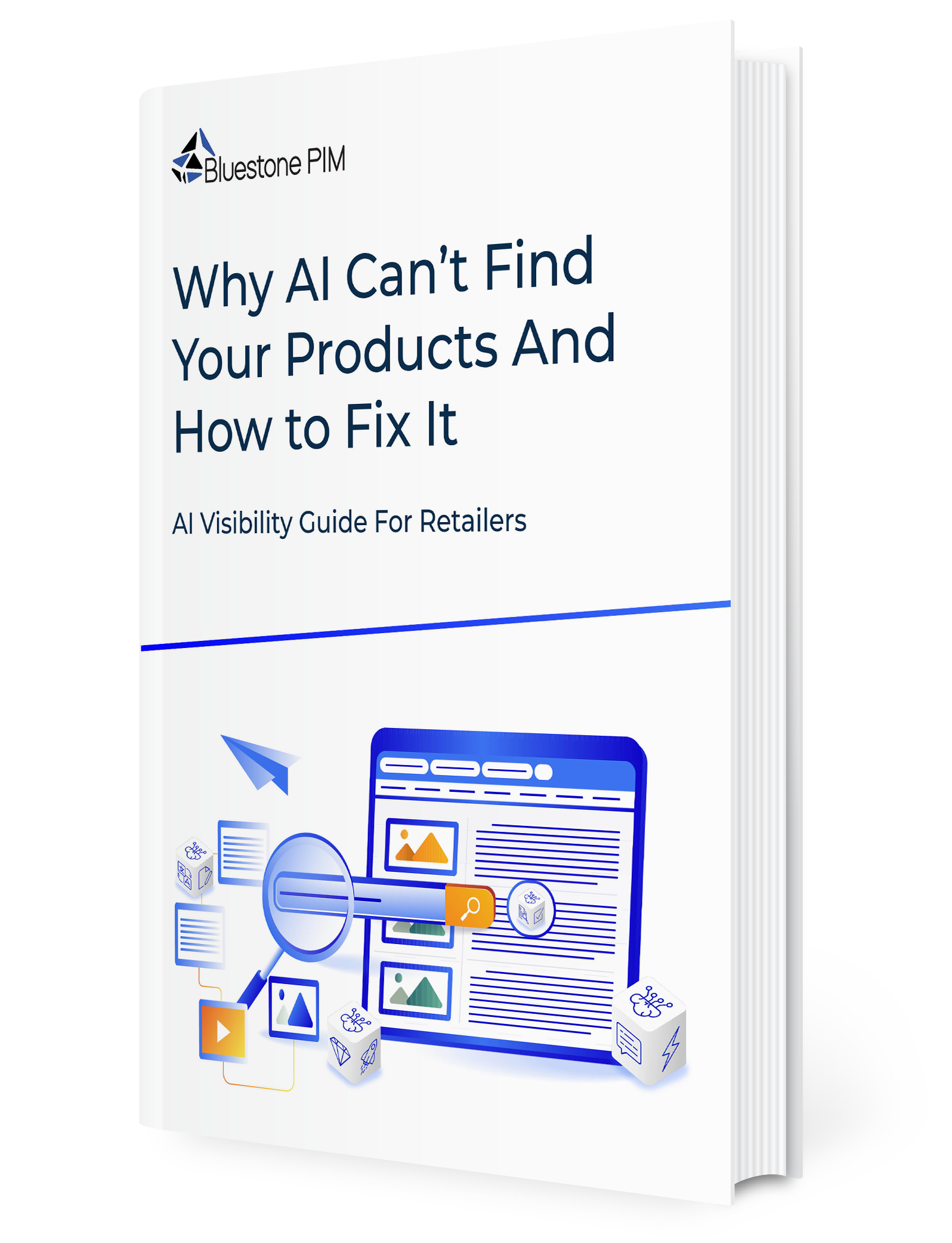
Download free e-book
AI Visibility Guide for Retailers
Learn how to structure product data so AI can find, cite, and recommend your products. Covers GEO, agentic commerce, and 30+ data fields.
Where Do Most Product Catalogues Fall Short?
The most common mistake retailers make is embedding factual product information inside marketing descriptions. A paragraph about how a jacket is "built for adventure" tells a human reader something about the brand. It tells an AI nothing about waterproof rating, weight, or intended use conditions.
AI systems need facts in structured, discrete fields. A waterproof rating of 15,000 mm in a dedicated specification field is directly comparable. The same number buried in the third sentence of a product description is invisible.
Three areas cause the most problems:
Missing Specification Fields
Every empty field is a shopper query your product cannot match. Products with complete specification data consistently outperform those with gaps in AI search results.
Lack of Q&A Content
AI assistants produce answers in question-and-answer format. Products with structured Q&A blocks give the AI exactly what it needs to cite directly. Without them, the AI has to guess, and it usually picks a competitor that gave it a clearer answer.
Inconsistent Data Across Channels
If your product appears with different attributes on your website, marketplace listings, and product feeds, AI notices. That inconsistency reduces trust across every source.
Every gap in your product data is a gap AI fills with its best guess. Or worse, it fills it with a competitor's data.
What Does AI Actually Evaluate Before Recommending a Product?
Before an AI shopping assistant recommends a product, it runs through a reasoning phase. Every signal it evaluates is one your team can influence, if the data exists.
- Natural language understanding: the AI parses what the shopper is actually asking for and matches it against your product attributes.
- Freshness: is the price current? Is the product in stock? Stale commerce data causes the AI to skip the product entirely.
- Text relevance: do the product attributes match the query? Structured key-value pairs outperform prose descriptions here.
- Trust signals: verified reviews with structured schema, named certifications, and a last-verified date all contribute. Unverifiable claims actively work against you.
- Contextual relevance: does the product fit the described use case? Intent-based fields like "who is it for" and "best use cases" answer this question directly.
Bluestone PIM supports each of these signals by providing structured data fields for intent attributes, specifications, Q&A blocks, and trust markers. Completeness scoring flags missing required fields before publication, so gaps are caught during enrichment rather than after the AI has already excluded your product.
How Does a PIM System Improve AI Search Visibility?
A PIM (Product Information Management) system is the infrastructure layer that makes AI-ready product data possible at scale. Managing structured specifications, Q&A blocks, localised content, and trust signals across thousands of products and multiple markets is not a job for spreadsheets.
Here is what changes when product data is managed in a dedicated PIM:
Single Source of Truth
Every product attribute is defined, validated, and maintained in one governed environment. When a specification changes, it updates everywhere: your website, marketplace listings, product feeds, and AI commerce platforms.
Built-In Validation
Completeness checks flag missing fields before anything goes live. A product missing its waterproof rating, weight, or intended use case gets caught in the workflow, not when a shopper asks ChatGPT and your product does not appear.
Automatic Channel Distribution
Update once, and changes propagate to every connected channel. No manual sync between your Shopify store, Amazon listing, and Google Shopping feed. This directly addresses the cross-channel consistency problem that erodes AI trust.
AI-Powered Enrichment
Bluestone PIM includes native AI capabilities that generate product descriptions from attributes, translate content at scale, and flag data quality issues. For teams managing large catalogues, this shifts the bottleneck from data entry to strategy.
API-First Architecture
Bluestone PIM is MACH-certified with 700+ API endpoints, allowing to perform over 700 actions. When new AI feed standards arrive in your market, connecting to them does not require custom development work.
The practical result: the same data infrastructure that improves your AI visibility also improves your Google Shopping feed quality, marketplace listing accuracy, and product page completeness. These are not separate projects.
What Should Your Team Prioritise First?
If you are starting from scratch, begin with your highest-traffic products. Audit which specification fields are empty. Then work through these priorities in order:
Specifications first. Fill in every structured specification field: materials, dimensions, weight, compatibility. Use key-value pairs, not prose. This has the highest immediate impact on AI matching.
Q&A blocks second. Pull the most common customer questions from your support inbox, live chat logs, and product reviews. Answer them in plain language and add them as structured Q&A to your product pages and feeds.
Trust signals third. Prompt customers to leave reviews. Make sure reviews use structured schema so AI can read and cite them. Add named certifications with verifiable details.
Cross-channel consistency last. Pick one product and check how it appears across three different channels. If the name, price, or specifications differ, fix that before anything else.
This is entirely achievable manually at a small scale. The problem comes when you need to manage hundreds or thousands of products across multiple markets. That is where dedicated infrastructure like Bluestone PIM becomes a practical necessity rather than a nice-to-have.
What Is GEO and How Does It Connect to AI Visibility?
GEO (Generative Engine Optimisation) is the practice of structuring content so AI systems can cite it when answering a question. Traditional SEO optimises for ranking in search results. GEO optimises for citation in AI responses.
The good news: these two disciplines are not in conflict. The technical foundations of strong SEO, including structured data, clean URLs, fast pages, and descriptive headings, are the same foundations GEO depends on. The gap is usually in depth and structure, not in intent.
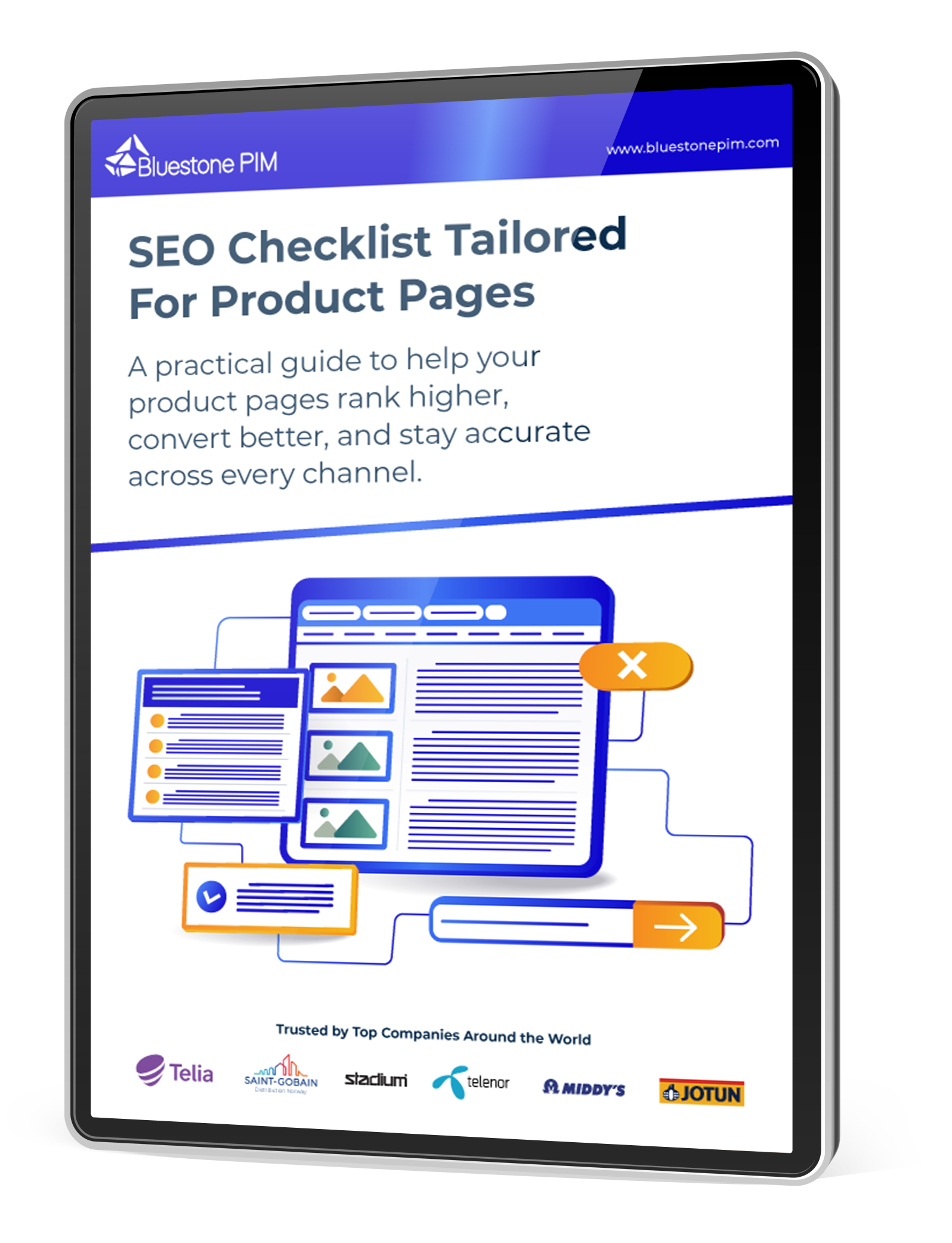
Download free e-book
SEO Checklist for Product Managers
A practical checklist to help you optimise product pages at scale. Cover SEO, AEO, and GEO essentials, keep product data accurate, and improve visibility without manual work.
For retailers, GEO extends beyond how the website is written. Your product data must be structured consistently across every channel where products appear. AI systems cross-reference all of them. Schema markup on your product pages tells AI exactly what each piece of information means. Without it, the AI has to guess.
Bluestone PIM helps retailers build this consistency by governing product data across every output channel from a single environment. Data validation ensures completeness. Automatic distribution ensures consistency. AI enrichment ensures scale.
Book a demo with Bluestone PIM to see where your product data stands today, what AI shopping assistants can and cannot find in your catalogue, and what a structured approach to fixing it looks like in practice.
Best Practices
 Best Practices
19 Oct 2026
3 Best Practices For PIM Implementation
 Product Information Management