
 AI
AI
By 2030, McKinsey expects agentic commerce to move between $3 trillion and $5 trillion in global sales. Most product catalogues were built for people browsing websites, not for AI agents querying API endpoints. That gap is the real reason agentic commerce readiness now belongs on every PIM evaluation checklist.
A PIM is the upstream control point for whether AI agents can find, trust, and recommend your products. Pick the wrong one and you inherit a catalogue that AI skips silently, with no signal in your funnel to tell you why sales never arrived.
In this guide, you will learn:
-
What agentic commerce readiness actually means for a PIM
-
How automation and MCP get you there
-
The five questions that separate an agent-ready platform from a legacy one
-
What a strong vendor answer sounds like, and what a weak one sounds like
Download free e-book
AI Visibility Guide for Retailers
Learn how to structure product data so AI can find, cite, and recommend your products. Covers GEO, agentic commerce, and 30+ data fields.
What Does Agentic Commerce Readiness Mean for a PIM?
Agentic commerce readiness means a PIM can deliver product data that AI agents can find, understand, trust, and act on without a human in the loop. The shopper no longer browses your category pages. An AI agent reads your product feed and APIs, compares options across retailers, and in some cases completes the purchase.
This shift is already measurable. Adobe reported a 393% year-on-year rise in generative-AI referral traffic to US retail in the first quarter of 2026. Gartner forecasts that 15% to 20% of revenue will flow through machine customers by 2030. The traffic is arriving faster than most catalogues can serve it.
Agents inherit the same filter human shoppers apply, only at machine speed. Research shows that almost half of shoppers abandon a purchase when product information is missing or inconsistent. An agent does not abandon politely. It moves to the next product and you never see the lost sale in your reporting.
| Worth noting: full AI checkout inside a chat interface is not yet widely available in Europe. Standardised feed formats such as the Agentic Commerce Protocol launched first in the United States, and Google Shopping feeds remain the most widely usable structured format European retailers can act on today. The infrastructure is being built now, which is exactly why readiness is an evaluation question and not a wait-and-see one. |
A PIM either prepares your product data for this or leaves gaps that AI fills with its best guess. The five questions below test which one a vendor is selling you.
5 Questions to Ask Every PIM Vendor
Use these five questions in any vendor evaluation. Each one targets a capability that decides whether agents can use your catalogue. Ask for a live demonstration of each capability, not a slide.
Question 1 - Is your product data structured for machines to read?
Product data structured for AI agents is complete, consistent, and machine-readable at the attribute level, not just presentable on a page. A human shopper forgives a missing dimension or a vague material field. An agent reading your feed treats that gap as a reason to skip the product entirely.
Ask the vendor how the platform enforces structure across attributes, variants, and units of measure. Decision-making attributes matter more here than marketing descriptions: an agent matching "cabin bag under Ryanair's size limit" needs exact dimensions, not adjectives.
A strong answer describes attribute-level validation, structured variant logic, and consistent data across every connected channel. A weak answer talks about rich product pages and digital shelf presentation, which solve a human-facing problem, not an agent-facing one.
Question 2 - Do You Expose Task-Level APIs That AI Agents Can Call Directly?
Task-level API endpoints let an agent perform one precise action, such as enriching a single product ID, without touching anything else. This is the difference between a platform an agent can operate safely and one where every change risks overwriting good data with a blunt bulk call.
Most legacy PIM systems were built around bulk import and export. That suited overnight batch jobs. It does not suit an agent that needs to read live stock, update one attribute, and trigger a republish in real time.
Ask how many endpoints the platform exposes, whether the API covers everything the interface can do, and whether agents can act on a single record. Bluestone PIM was built API-first for ten years and exposes 700+ API endpoints with full UI and API parity, so an agent can do anything a person can do in the interface.
A strong answer names granular, task-level endpoints and full UI and API parity. A weak answer points to a handful of bulk endpoints and a roadmap promising more.
Question 3 - Is the Platform MCP-Native So AI Agents Can Operate It?
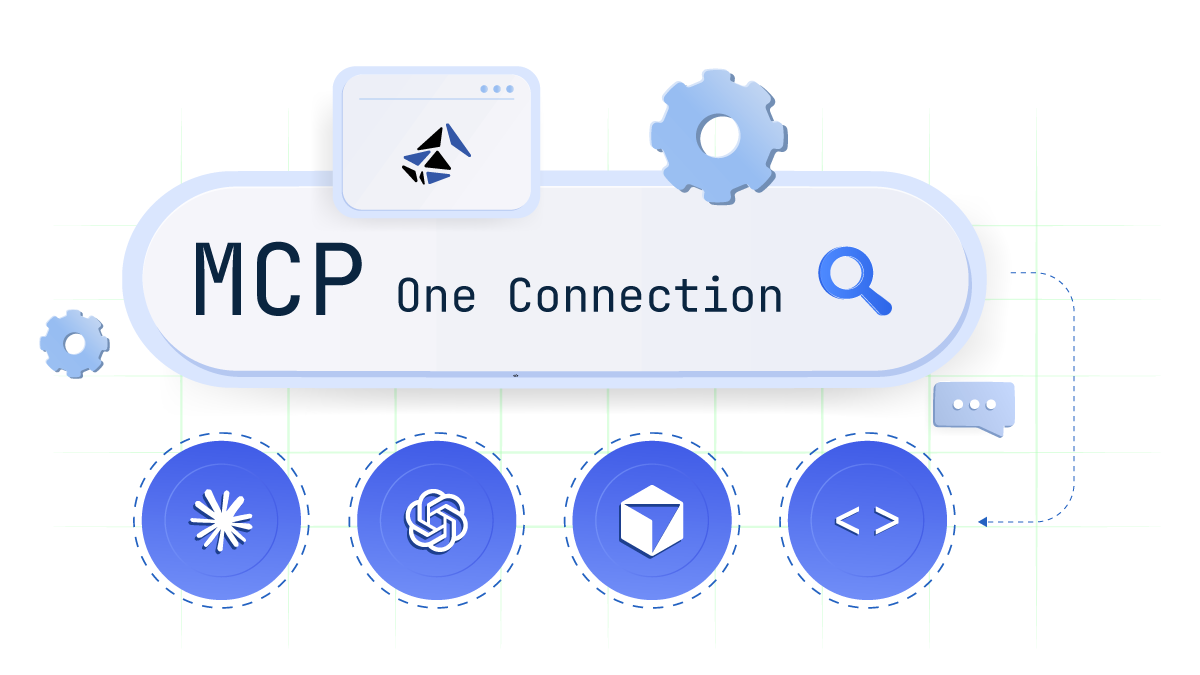
MCP-native means the PIM speaks the Model Context Protocol, the open standard that lets AI agents call a system as a tool. Without it, you are left building custom integrations to connect agents to your product data, which adds technical debt at exactly the moment you need to move quickly.
Open standards crossed enterprise viability across 2025 and 2026: MCP for tool access, agent-to-agent (A2A) for coordination, and emerging payment and commerce protocols on the channel side. Architecture decisions made now lock in for the next decade, so a vendor's protocol position is a long-term bet, not a checkbox.
Bluestone PIM is MCP-native, which means AI agents can query product data and execute tasks against the platform directly, rather than through bespoke middleware.
A strong answer explains how the platform supports MCP and how an agent invokes it as a tool. A weak answer describes an embedded AI assistant that automates tasks inside fixed workflows: that is AI as a helper, not a platform an external agent can operate.
Question 4 - How Do You Keep Product Data Accurate Before an Agent Acts on It?
Accurate data before action comes from continuous validation: the platform enforces data quality the moment information enters, not as a clean-up job afterwards. When an agent acts on bad product data, your brand pays the price at machine speed, across every channel at once.
A human merchandiser catches an obvious pricing error before it does damage. An agent does not pause to sanity-check. If your PIM lets incomplete or contradictory data through, the agent publishes it, recommends it, or sells against it before anyone notices.
Ask how the platform handles validation rules, completeness scoring, and governance. Bluestone PIM applies validation continuously and scores completeness so product information is enforced as correct before it reaches any downstream system or agent surface.
A strong answer covers continuous validation, completeness scoring, role-based permissions, and an audit trail. A weak answer treats data quality as a periodic report you run, rather than a rule the platform enforces in real time.
Question 5 - How Quickly Can You Turn Supplier Data into Agent-Ready Products?
Time-to-channel measures how fast a vendor turns raw supplier data into structured, validated, agent-ready products. This is where agentic commerce readiness becomes a number on your business case, because supplier feeds arrive as PDFs, spreadsheets, and inconsistent files that take weeks to clean by hand.
The bottleneck is rarely the channel. It is the onboarding work upstream: mapping, enrichment, translation, and validation. A PIM that automates that work moves you from product launches measured in quarters to workflows that run at machine speed, with people supervising rather than typing.
Bluestone PIM uses native AI for enrichment, translation, and data quality so teams move from manual data entry to oversight. Supplier onboarding time drops as a result.
A strong answer shows automated onboarding with concrete time savings on real supplier files. A weak answer quotes a services engagement and a timeline measured in months.

Download free e-book
Automation in Product Information Management
This e-book explains how automation works in product information management, which catalogue workflows can be automated today, and how an event-based architecture creates the foundation for the agentic PIM.
How to Score Agentic Commerce Readiness
Score each of the five questions from 0 to 2, then add the results together for a total score out of 10.
Use this scale:
- 0 points: The capability is absent.
- 1 point: The capability exists, but is limited.
- 2 points: The vendor demonstrated the capability live.
Here’s how to read the final score:
- 8 to 10: Agentic-ready. The vendor can support AI agents today.
- 5 to 7: Partial. The platform is usable for early pilots, but there are gaps to close.
- 0 to 4: Not ready. The PIM is built for human users and needs major work before agents can use it properly.

Download free e-book
Bluestone PIM Template: RFP Template for PIM Evaluation
Choosing the right PIM system starts with asking the right questions. This RFP template helps you structure your vendor evaluation, define your business and technical requirements, and compare PIM platforms more clearly.
Ready to See What an Agent-Ready Catalogue Looks Like?
Agentic commerce is moving real money, and the product data underneath most catalogues was structured for human shoppers who no longer do the browsing. The PIM you choose decides whether AI agents can find, trust, and recommend your products, or skip them silently.
Bluestone PIM was built API-first, is MACH-certified and MCP-native, and applies continuous validation so your product data is ready for human and agent shoppers alike. That combination is what turns agentic commerce readiness from a roadmap promise into something you can demonstrate.
Ready to see what this looks like for your catalogue? Book a demo with Bluestone PIM.