

 Best Practices
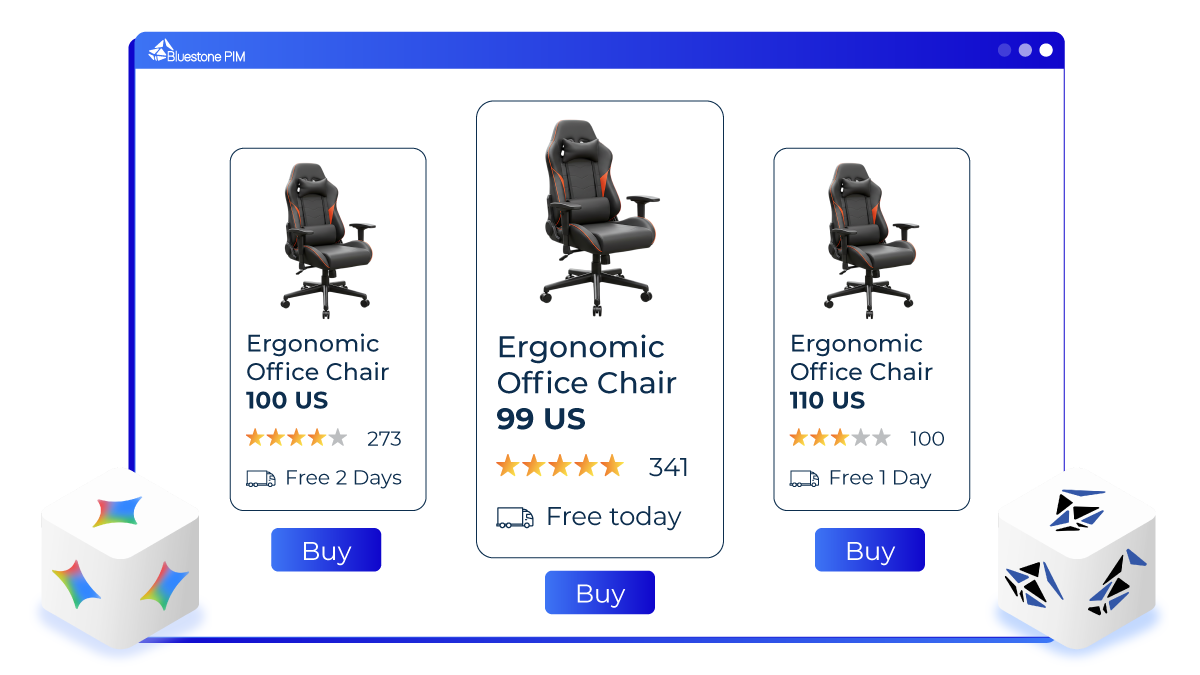
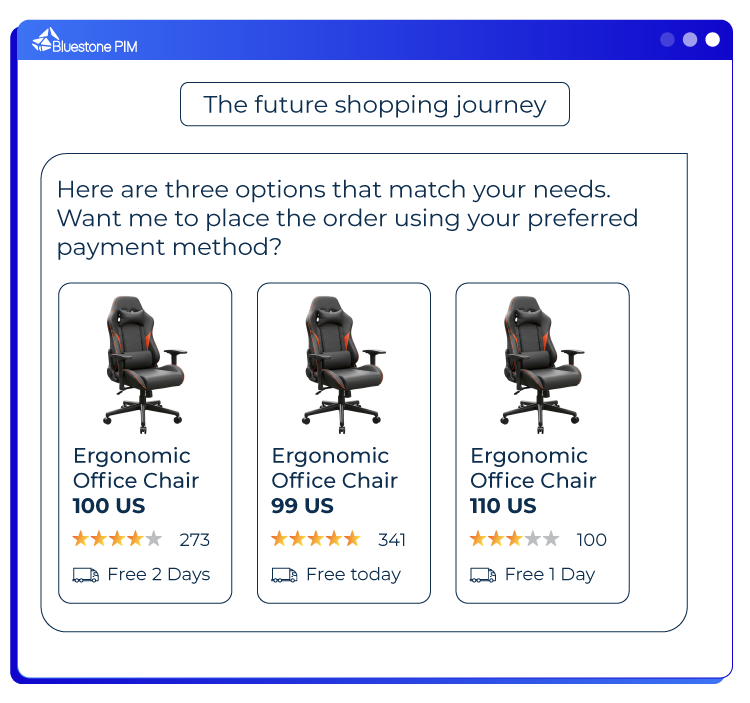
In 2026, buyers will start shopping with AI.
Instead of browsing categories and filters, buyers will ask AI directly:
“Find a cabin bag that fits Ryanair’s size limits”
Buyers do not want a list of links. They want the AI to recommend the right product, confirm it is in stock, and get them to checkout fast.
That is why Google introduced the Universal Commerce Protocol (UCP), a new open-source standard designed to make AI-driven shopping work smoothly from discovery to checkout.
In this article, you will learn:
- what UCP is (in plain language)
- how it could affect your product discovery, conversions, and checkout journeys
- the product data foundations AI shopping depends on, and how to get ready before your competitors do
Let’s break it down.
What Is the Universal Commerce Protocol (UCP)?
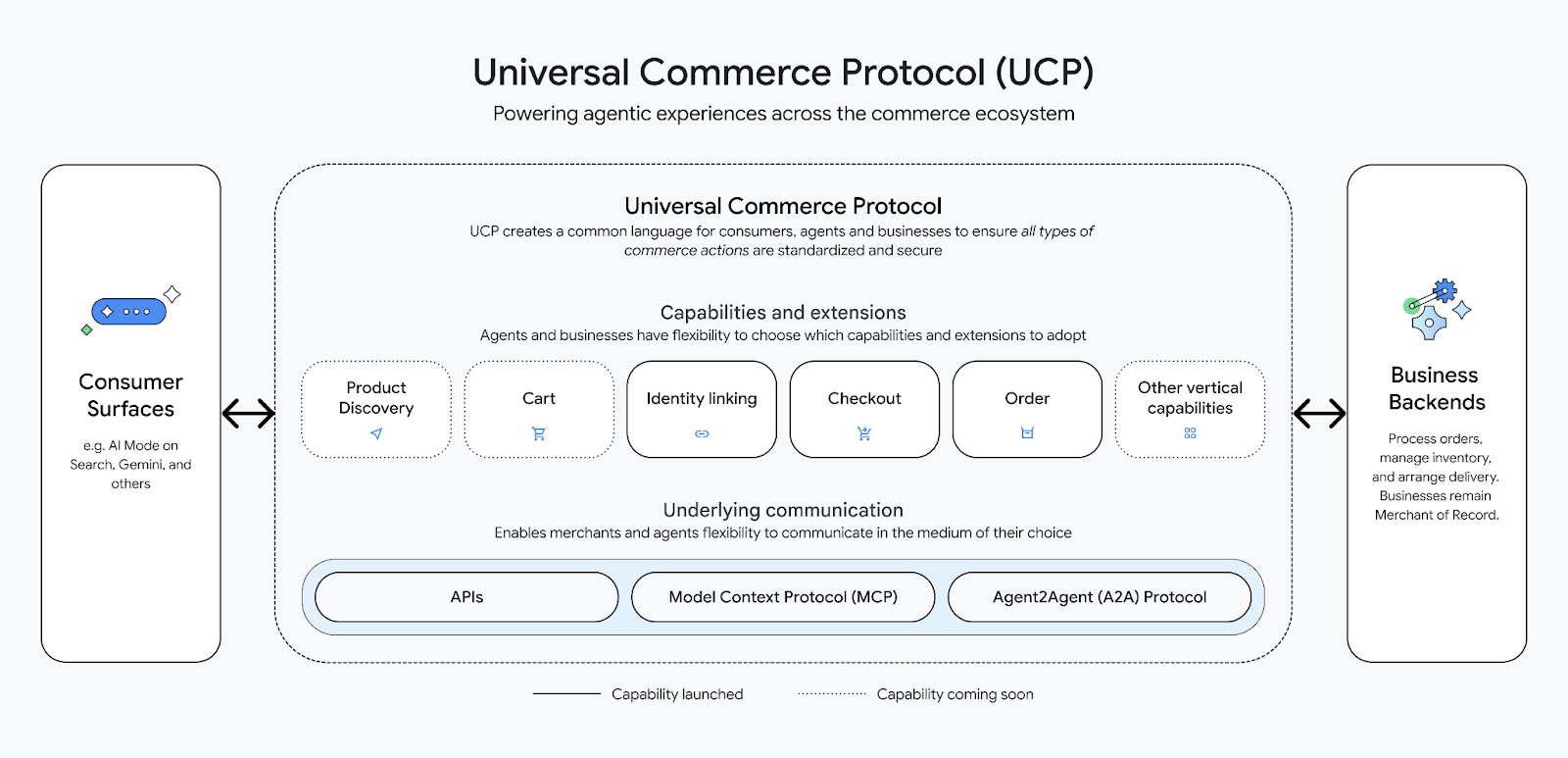
The Universal Commerce Protocol (UCP) is a new open-source standard from Google that helps AI assistants connect to retailers in a predictable, structured way, so they can support the full shopping journey, not just product discovery.
In plain language: UCP is like a universal “commerce connector” for AI.
It lets an AI assistant understand:
- what products you sell
- what actions it can take (like checkout)
- what payment options are available
…without building a custom integration for every new AI shopping surface.
For example: A customer asks an AI assistant: “Find a cabin-size suitcase that fits Ryanair rules.”
Without a standard like UCP, the AI can only:
- show links
- summarise product pages
- send the customer to your site and hope they finish the purchase
With UCP, the AI can do something much more useful:
- discover your product catalogue
- check what you support (for example checkout, discounts, fulfilment)
- start a checkout session
- apply a discount code
- guide the customer to purchase
UCP turns your store from “a website an AI can browse” into a system an AI can interact with, safely and consistently.
That is what makes agentic commerce possible.
UCP and MCP both depend on structured, event-ready product data. See the automation foundation that makes a catalogue agent-ready in the free e-book.

Download free e-book
Automation in Product Information Management
This e-book explains how automation works in product information management, which catalogue workflows can be automated today, and how an event-based architecture creates the foundation for the agentic PIM.
Why Did Google Introduce Universal Commerce Protocol?
Google introduced the Universal Commerce Protocol (UCP) to make AI shopping actionable, not just informational.
Today, most AI assistants can help customers research products, but they still get stuck at the most important part: actually buying the product.
Universal Commerce Protocol changes that by giving AI assistants a standard way to interact with a retailer’s commerce systems.
This also solves a growing problem for retailers: integration overload.
Every new shopping surface usually requires a new custom connection, and AI will multiply those surfaces fast.
Google calls this the N x N integration bottleneck:
- there are many retailers (N)
- there are many shopping surfaces (N)
- and every surface needs a custom integration with every retailer
The result is an ecosystem that becomes slow and expensive to scale.
Universal Commerce Protocol is Google’s attempt to fix this by creating one common standard. Instead of building a new integration every time, retailers can expose their commerce functions in a consistent way, and AI systems can connect to them more easily.
What Does The Universal Commerce Protocol Enable? (The Simple View)
With UCP, AI assistants will be able to interact with your commerce systems through something called capabilities.
A UCP capability is a standard action an AI assistant can perform with your store.
Think of it like a set of clear “buttons” the AI can press, through a structured connection, such as:
- “Search products”
- “Start checkout”
- “Apply discount”
- “Choose delivery”
- “Complete the order”
Instead of the AI guessing how your store works, your online store tells the AI:
“Here’s what you can do, and here’s how to do it.”
5 Steps to Get Ready for the Universal Commerce Protocol
Once AI shopping becomes mainstream, e-commerce businesses will need to answer one key question:
Can an AI agent understand your product catalogue well enough to recommend the right product and complete a purchase?
The answer depends on whether your product information is:
- Structured (key attributes are stored in fields, not hidden in descriptions)
- Consistent (variants, categories, and naming follow clear rules across the catalogue)
- Governed at scale (data quality stays high through validation, completeness checks, and controlled processes)
If those foundations aren’t in place, AI shopping will either fail, or worse, recommend the wrong products.
To do this across thousands (or even millions) of products, leading e-commerce brands use composable PIM software like Bluestone PIM to model product data properly, apply rules consistently, and roll out bulk updates fast.
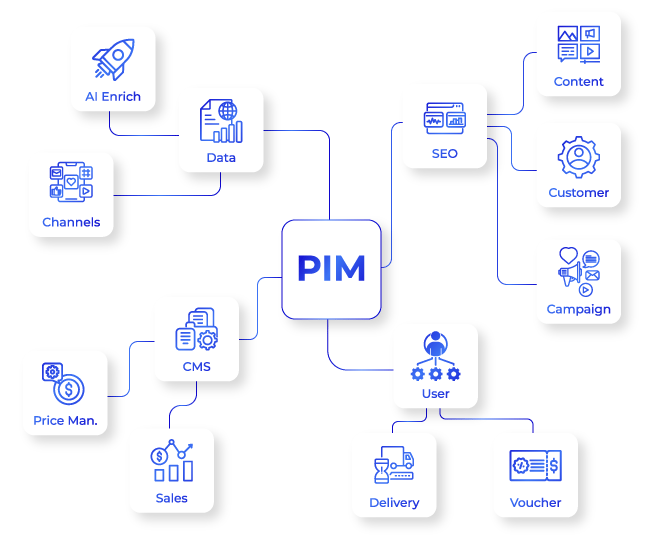
Here are the practical steps to get ready for the Universal Commerce Protocol:
Step 1: Fix the “decision-making attributes” first (not the descriptions)
Most product catalogues have plenty of copy, but AI agents need structure.
Start by listing the top 10–20 attributes that influence buying decisions for each category.
Examples (retail):
- suitcase: dimensions, weight, material, wheel type, expandable (yes/no)
- shoes: size system, fit, material, heel height, waterproof (yes/no)
- electronics: voltage, compatibility, power consumption, warranty
Examples (manufacturing):
- spare parts: compatibility, part number, machine model, certifications
- components: tolerances, dimensions, materials, operating temperature
What to do next:
- Pick 3 high-impact categories first (not your whole catalogue)
- Define required attributes per category
- Ensure values are stored in structured fields, not only descriptions
- Align units (cm vs mm, kg vs g) and formats
This is how you move from “product pages humans can read” to “product data AI can trust”.
Download free e-book
AI Visibility Guide for Retailers
Learn how to structure product data so AI can find, cite, and recommend your products. Covers GEO, agentic commerce, and 30+ data fields.
Step 2: Clean up variant logic so AI can recommend the right SKU
AI shopping breaks quickly when variant logic is messy.
Example: If “Cabin Suitcase” exists as 12 separate products instead of 1 product with variants, the AI may compare them incorrectly or recommend the wrong one.
This is where strong data modelling pays off.
What to fix:
- Define a clear parent/child structure for all variants
- Standardise how variant attributes are stored (colour, size, pack size)
- Remove duplicate SKUs created by messy imports
- Make sure every variant has the key decision attributes populated
Step 3: Make pricing and availability trustworthy (and updateable in bulk)
UCP is built for real-time commerce. That means your pricing and availability must be accurate and easy to maintain.
To prepare, you need:
- A clear “source of truth” for price and stock
- Rules for market-specific pricing (currency, taxes, tariffs)
- The ability to update many products at once without breaking consistency
Practical goal: If you need to increase prices for 2,000 SKUs due to a supply chain change, you should be able to do it fast and safely. Check out this article to learn how retailers can update prices fast when tariffs hit.
Step 4: Add governance rules so quality stays high over time
Even if you clean up product data once, it will drift again unless you control it.
To prepare for AI-driven commerce, do the following:
- Define completeness requirements per category
- Set validation rules (for example, dimensions must include units)
- Introduce roles and permissions (who can edit what)
- Track changes and approvals so you know what changed and why
This is what keeps your catalogue “AI-ready” month after month, not just during a one-time clean-up project.
Bluestone PIM supports strong data governance through: validation rules, completeness scoring, edit history and accountability, permissions and control across teams.
Step 5: Make your product data API-ready (because UCP is built for APIs)
UCP is designed for a world where commerce is API-driven.
That means AI shopping agents will not “read” your website the way humans do. They will rely on structured data and integrations to access product information, availability, pricing, and checkout actions.
So to prepare for the Universal Commerce Protocol, your product data needs to be ready to flow between systems, quickly and reliably.
So preparation is also technical:
- Your product data should be accessible through APIs
- Your systems should support fast syndication to external surfaces
- Your stack should be ready to serve structured data at scale
Bluestone PIM helps you make product data API-ready by giving you a scalable foundation for: API-first distribution. Bluestone PIM is API-first, which means product information is built to be shared across systems programmatically, not manually.
Your Next Steps to Prepare for AI Shopping in 2026
The Universal Commerce Protocol is still new, but it signals a clear shift:
AI agents are becoming part of how people discover and buy products.
To prepare, e-commerce businesses should make product data AI-ready.
That means:
- standardising attributes and taxonomy
- improving completeness across the catalogue
- structuring variants and relationships properly
- keeping pricing and availability reliable
- investing in a scalable product information foundation
Bluestone PIM supports this work by helping retailers and manufacturers centralise product information and keep it clean, consistent, and ready to distribute.
If you want to see what “AI-ready product data” looks like for your catalogue, Bluestone PIM team can show you a few practical examples based on your product structure, variants, and channels.
Best Practices
 Best Practices
19 Oct 2026
3 Best Practices For PIM Implementation
 Best Practices