
![How to Write an RFP for a PIM System [Template for Enterprises]](https://www.bluestonepim.com/hubfs/The-Best-PIM-Software-for-Retailers-2.png) Product Information Management
Product Information Management
Agentic commerce is no longer a future concept to keep an eye on. Starting from 2026, it will shape how products are discovered, evaluated, and bought. At first not everywhere and not for everything, but yet enough to change the rules for retailers that rely on digital channels.
This is why preparation matters now. The foundations you put in place during 2026 will decide whether your products are visible, trusted, and purchasable when agents start doing the shopping.
What is Agentic Commerce and What It Means for Retailers
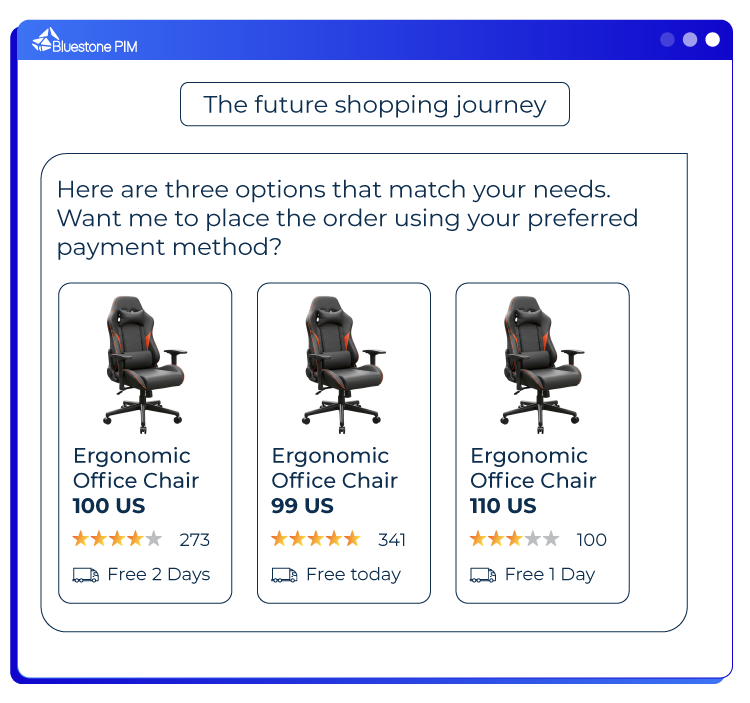
Agentic commerce describes a model where AI agents act on behalf of consumers to discover products, compare options, and complete purchases. Instead of shoppers manually searching, filtering, and checking out, they give an agent a goal and a set of rules. The agent handles the rest.
Example: A customer instructs an agent to “Find a replacement boat part under £50, available this week, from a reliable supplier.”
The agent:
- searches relevant catalogues
- compares specifications, availability, and price history
- checks reviews and fulfilment reliability
- completes the purchase once conditions are met
In the near future this will not be limited to research. Agents will execute transactions independently, using delegated payment authority and predefined policies.
Bluestone PIM's AI Visibility Guide covers exactly which fields to prepare:
Download free e-book
AI Visibility Guide for Retailers
Learn how to structure product data so AI can find, cite, and recommend your products. Covers GEO, agentic commerce, and 30+ data fields.
Where Does Agentic Commerce Stand Right Now? (March 2026 Update)
Six months ago, agentic commerce was a credible projection. It is now in production.
Google's Universal Commerce Protocol (UCP) launched on January 11, 2026, at the National Retail Federation conference, co-developed with Shopify, Target, Walmart, Etsy, and Wayfair, and endorsed by over 20 industry partners.
As of March 2026, UCP checkout is in early access for select US merchants. Full commercial rollout, global expansion, and additional capabilities are planned for later in 2026.
OpenAI's Agentic Commerce Protocol (ACP), with its first specification published in September 2025, has taken a different turn.
Rather than building checkout infrastructure directly inside ChatGPT product listings, OpenAI has shifted to an app-based model: merchants integrate into the ChatGPT platform through dedicated apps, and Instant Checkout moves to that layer.
The reason is practical: the complexity of transactions (reconciling stock status, sales tax, and pricing in real time) proved better handled through individual merchant integrations than through a single centralised checkout flow.
⮕ What this means for you: The pace of protocol development is not slowing down. Building a tight integration with any single protocol is a short-term solution. The right architecture handles new protocols without touching your core commerce systems. More on this below.
How Agentic Commerce Differs from Traditional E-commerce
Traditional e-commerce is built for human behaviour. Pages, banners, filters, and promotions are designed to capture attention and influence choice.
Agentic commerce removes much of that surface layer. Decisions happen before a product is ever presented to a person. AI agents prioritise:
-
Structured, machine-readable product data
-
Proven reliability over time
-
Stable pricing and accurate availability
-
Clear fulfilment and return terms
For retailers, visibility shifts away from who tells the best story on a page and towards who provides the most reliable product data.
What Agentic Commerce Means for Retailers in 2026
Agentic Commerce introduces three structural changes.
1. AI Agents Become a Primary Buying Interface
Retail systems must expose products, pricing, availability, and order actions through agent-ready APIs.
2. Control Shifts Closer To the Consumer
Agents manage reordering, subscriptions, and card-on-file payments. Merchants compete to be selected by agents, not persuaded by shoppers.
3. Trust Replaces Persuasion
Agents optimise for predictability. Suppliers that perform consistently are favoured over those that rely on short-term tactics.
By 2026, many buying decisions will be filtered before a human ever sees the options. If your product data does not pass the agent’s checks, your product never makes the shortlist.
What Is the Difference Between ACP and UCP?
ACP and UCP are the two primary live commerce protocols retailers need to understand right now. They take fundamentally different architectural approaches to the same problem: how do AI agents discover, evaluate, and buy products on behalf of users?
The practical difference:
| ACP | UCP | |
|---|---|---|
| Discovery model | Push — merchants submit feeds to OpenAI | Pull — agents read your /.well-known/ucp manifest |
| Covers full lifecycle | Checkout and fulfilment; post-order not specified | Yes — discovery, checkout, fulfilment, and returns |
| Currently live | US only, approved partners | US early access, select merchants |
| Published by | OpenAI + Stripe |
The common mistake is treating these as competing options and preparing for only one. The underlying product data and API requirements are nearly identical. A retailer with clean, structured product feeds, fast API endpoints, and accurate pricing and inventory is positioned for both and for whatever comes after.
💡 Pro tip: Bluestone PIM's API-first architecture with 700+ endpoints means your product data can be distributed to any protocol layer without batch exports or manual processes creating lag. When a new protocol arrives, the product data side is already handled.
Product Data Is How Agents See Your Catalogue
Agents do not browse websites the way people do. They consume structured data.
This puts product feeds at the centre of agentic commerce. Feeds built from Product Information Management systems become the main output channel into AI models. They describe products in a way machines can read without guessing.
For retailers with thousands of products, variants, languages, and compliance rules, a dedicated PIM software becomes the backbone. It provides one source of truth, keeping product data consistent across every channel and interaction.
Without that, you risk the same problem shoppers already complain about on low-trust marketplaces: not knowing what will actually arrive after the purchase.
What “Agent-Ready” Really Means in Practice
By 2026, preparing for agentic commerce will go far beyond product discovery. Retailers will need to become agent-addressable.
This means AI agents can:
- query product data
- validate pricing and stock
- check delivery and return terms
- trigger transactions reliably
At the centre are agent-ready API endpoints. Partial coverage or inconsistent responses break agent workflows.
An API-first architecture matters because it exposes the full data model and business logic for automation from day one. Bluestone PIM follows this approach, with over 700 API endpoints that allow agents and downstream systems to interact with product data without workarounds.
Interoperability matters just as much. Shared protocols reduce friction and allow new agents to enter the ecosystem without custom integration projects.
For retailers, the takeaway is simple. If your PIM and commerce stack are not API-first, your ability to participate in agent-driven buying journeys will be limited. If they are, you are far better positioned for what comes next.
Find out where your PIM sits on the five-level agentic maturity ladder, and what closing the gap to Level 5 (full UI, API and agent parity) actually takes.

Download free e-book
Automation in Product Information Management
This e-book explains how automation works in product information management, which catalogue workflows can be automated today, and how an event-based architecture creates the foundation for the agentic PIM.
How Fast Do Your APIs Need to Be for Agentic Commerce?
When an agent proceeds to purchase a product, your system needs to do several things simultaneously:
1. Retrieve delivery options from your shipping provider
2. Calculate taxes
3. Verify inventory in your fulfilment system
4. Process a payment token
The emerging industry benchmark for agent-facing API endpoints is under 200 milliseconds for product discovery.
Slow endpoints do not just degrade performance: they reduce how often agents recommend your products in the first place.
Most current tech stacks were not built to this standard. Caching layers, front-end buffers, and UI loading tricks work for human shoppers who tolerate a two-second page load. Agents make no such allowance.
Start here: map every API endpoint involved in a product query and checkout sequence. Test response times individually and end-to-end. The weakest link is where your agentic transactions will fail.
What Retailers Can Do Now To Prepare For Agentic Commerce
Preparation starts with fixing the basics and building from there. These steps give retailers a practical way to move towards agentic commerce without overengineering too early.
1. Audit Your Product Data Honestly
Look at where your product information actually lives today. Spreadsheets, supplier PDFs, ERP exports, CMS fields, shared drives. Map the gaps, the duplicates, and the inconsistencies. If a human struggles to tell which version is correct, an agent will not trust it.2. Create One Source of Truth for Product Information
Bring core product data into a single PIM system that controls attributes, variants, languages, and updates. This is how you avoid confusion, mismatches, and last-minute fixes.3. Structure Your Product Data
Product titles, attributes, pricing, availability, and identifiers need to be clean and structured. If a model has to infer meaning, you lose reliability.4. Make Feeds a Priority
Treat product feeds as primary channels. Keep Google Shopping feeds accurate and complete. Track emerging AI-focused feeds and standards. By 2026, feeds will decide whether agents can even see your products.5. Start Building Toward a Protocol-Agnostic Architecture
Three commerce protocols have launched since September 2025. More are coming. Building a direct integration with each one means every new protocol becomes a new project and protocol logic accumulates across systems that are hard to change.
The better approach: a single layer above your core stack that handles all protocol communication. New protocols plug into that layer. Your catalogue, order management, and checkout never need to know they changed.
The practical starting point: check whether your commerce platform and PIM already have protocol-ready integrations, and avoid embedding protocol logic anywhere it will be painful to move later.
6. Stabilise Pricing and Trust Signals
Reduce artificial pricing patterns that only work on humans. Focus on reviews, availability accuracy, and fulfilment reliability. Agents optimise for predictability and confidence.7. Use AI to Plan, Not Just to Produce
Run structured research on your own setup using AI. Ask how agentic commerce could affect your category, margins, and channels. Refine the prompts until the output reflects your reality. Treat this as groundwork, not a one-off exercise.Retailers that take these steps now will not need to scramble later. Their products will already be easy for machines to understand, compare, and buy.
If you want to see what “agent-ready” product data looks like in practice explore how a modern PIM can help you prepare your catalogue for AI-driven commerce.
Start with your data. The rest follows.