
 Product Information Management
Every time a shopper asks ChatGPT, Gemini, or Microsoft Copilot to find a waterproof jacket or compare two ergonomic office chairs, AI shopping agents evaluate your product catalogue against a specific checklist.
This article shows the 34 specific fields AI shopping agents evaluate before recommending products. Use it as a checklist for your next product catalogue audit.
Who this is for: e-commerce leads, product data managers, and CTOs at mid-market and enterprise retailers who want AI shopping agents to recommend their products instead of their competitors'.
What Product Data Fields Do AI Shopping Agents Read?
When a shopper asks an AI assistant a product question, the AI does not scan a website the way a human does. It pulls from three sources at once:
- Crawled data from your website. Indexed during model training. You have limited direct control and the data is often stale.
- Structured product feeds and API endpoints. This is where you have the most influence, and where most retailers underinvest.
- Live website data. Real-time pricing, stock status, and promotions the AI checks at query time.
The product feed is the new front of the store. It is the file AI shopping assistants read when deciding what to recommend.
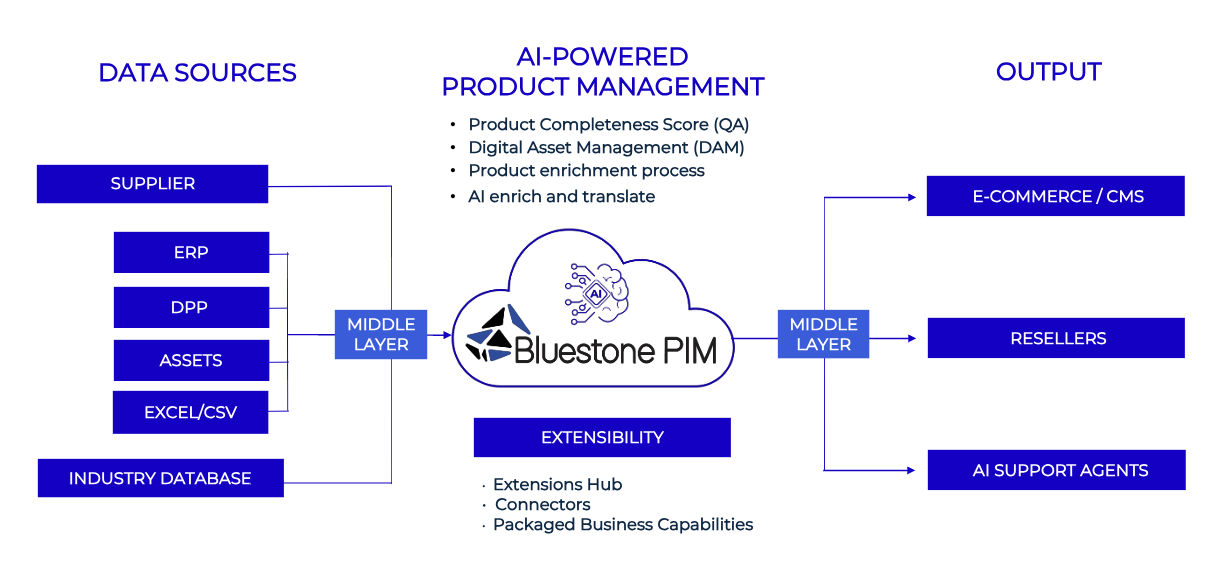
The challenge is keeping that feed accurate, complete, and consistent across every channel at once. That is a data management problem, and it is exactly what a PIM is built to solve.
Bluestone PIM is a cloud-based product information management (PIM) platform built for retailers. It gives you a single system to manage every product detail and distribute that data across marketplaces, retail partners, and digital channels. With 700+ API endpoints, structured product data flows to the right places in the right format. Set a field once, and every connected channel reads the same version.
How Does AI Decide Whether to Cite Your Products?
Before an AI recommends a product, it runs a quick but rigorous evaluation. It asks three questions:
| Signal | What AI is asking |
|---|---|
| Understand | Who is this product for, what problems does it solve, and what are the best use cases? |
| Compare | How does this product measure up against alternatives? Requires machine-readable specifications in key-value format, not prose. |
| Trust | Is the product what it claims to be? Verified reviews, named certifications, and a last-verified date all contribute. |
If your data cannot answer all three, your product is not on the shortlist.
The answer to all three is the same: having the right product fields filled in.
Download free e-book
AI Visibility Guide for Retailers
Learn how to structure product data so AI can find, cite, and recommend your products. Covers GEO, agentic commerce, and 30+ data fields.
Which Product Fields Do AI Shopping Agents Actually Read?
The fields split into six categories. Priority tags:
- Essential: without it, AI cannot evaluate your products
- High Impact: directly improves visibility and matching
- Recommended: adds depth and trust
1. Core Commerce Controls (7 Fields)
Specific to agentic commerce. These fields decide whether AI can include the product in a recommendation at all. Stale pricing or missing stock data gets the product skipped before any content evaluation happens.
availability_status(Essential)inventory_quantity(Essential)price(Essential)currency(Essential)product_status(Essential)region_availability(High Impact)enable_search(High Impact)
These typically live in your ERP or OMS. Bluestone PIM connects to both and distributes the live values to every AI feed and commerce platform.
2. Structured Product Understanding (10 Fields)
Applies to GEO and agentic commerce.
💡 GEO (Generative Engine Optimisation) is about making sure AI systems like ChatGPT, Google Gemini, and Microsoft Copilot can find your products, trust what they read, and include them when answering a shopper’s question.
These intent-based fields tell AI who the product is for and what it solves. This is where most retail catalogues have the biggest gaps.
product_name(Essential)brand(Essential)category(Essential)short_description(Essential)who_it_is_for(High Impact)problems_it_solves(High Impact)best_use_cases(High Impact)operating_environment(Recommended)performance_conditions(Recommended)exclusions(Recommended)
An example of the pattern. who_it_is_for should say "Hikers and trail runners needing packable waterproof protection," not "outdoor enthusiasts." The first one gives AI a match. The second one is marketing filler.
3. Comparison-Ready Specifications (8 Fields)
Mostly agentic commerce, with GEO benefit when AI cites specific attributes. Machine-readable specifications are essential for product comparisons and purchase recommendations.
technical_specifications(Essential)feature_list(High Impact)material(High Impact)dimensions(High Impact)weight(High Impact)compatibility(High Impact)size_variants(High Impact)colour_variants(Recommended)
The rule: key-value pairs only. "Waterproof rating: 15,000 mm" is comparable. "Exceptionally waterproof design" is not. Never embed specs in free-text descriptions. AI cannot extract them.
4. Trust and Authority Signals (6 Fields)
Applies to GEO and agentic commerce. Trust signals influence both whether AI cites your product and whether it recommends it for purchase.
product_review_count(High Impact)average_rating(High Impact)verified_reviews(High Impact)review_sentiment_summary(High Impact)certifications(High Impact)last_verified_date(High Impact)
Named certifications matter. "bluesign® certified" or "Fair Trade Certified" is citable. "Sustainable materials" is not. Unverifiable claims like "our product is the best" actively work against you.
5. Structured Q&A Blocks
Primarily applies to GEO. This one is not a single field but a block of paired questions and answers, ideally pulled from real customer support queries. Products with more Q&A consistently dominate AI search results because Q&A pairs are already formatted as AI assistants produce them.
Priority topics to cover:
- Sizing and fit
- Compatibility
- Care and maintenance
- Usage guidance
- Performance in specific conditions
- Sustainability credentials
Check your customer service inbox, live chat logs, and product reviews for the questions real shoppers already ask. Answer them in plain language and add them to each product page as a structured Q&A block.
6. Image Intelligence (3 Fields)
Applies to GEO and agentic commerce. Descriptive image metadata lets AI understand what an image shows and use it as supporting evidence for product claims.
alt_text(High Impact) — "Navy waterproof hiking jacket with reinforced elbows and adjustable hood," not "jacket image"image_object_metadata(High Impact) — ImageObject schema with correct type and attribute fieldsfeature_highlight_tags(Recommended)
Complete fields get you noticed once. Event-based automation keeps them accurate every time a product changes. See how in the free e-book on PIM automation.

Download free e-book
Automation in Product Information Management
This e-book explains how automation works in product information management, which catalogue workflows can be automated today, and how an event-based architecture creates the foundation for the agentic PIM.
Why Do Most Catalogues Fall Short?
The mistake most catalogues make is burying the facts inside the marketing story, where AI cannot extract them.
Take a watch product page as an example.
The marketing text says:
"A watch built for midnight deals and dangerous charm. Polished steel."
The AI sees nothing it can structure.
The same product in structured fields:
"Men's automatic watch. Stainless steel case, black dial. Sapphire crystal. Water-resistant 100 m. 42 mm case."
The AI can cite every one of those facts.
Keep the marketing copy. Just pull the specifications into their own fields as well. The description converts; the structured fields get you cited.
Why this matters: 78% of shoppers in a recent Bluestone PIM survey said they now use AI to research or find products to buy. Getting these 34 fields right is no longer optional.
For context on how this fits the wider shift: see the guide on how to prepare for agentic commerce and the Universal Commerce Protocol breakdown.
What Should You Do Next?
Start with your top 20 products, not the whole catalogue. Audit which fields are empty and fill them in order of impact: Essential fields first, then High Impact, then Recommended.
A practical order of operations for the first week:
- Fill every empty
technical_specificationsfield in key-value format - Write
who_it_is_for,problems_it_solves,best_use_casesfor each product - Add a Q&A block of 4–6 question-answer pairs pulled from customer support
- Replace every superlative with a named fact or certification
- Check your
alt_text: it should describe the product, not say "jacket image"
This is achievable in a spreadsheet at a small scale. The problem comes when you need to manage thousands of products across multiple markets and dozens of channels. That is where manual processes break down and a dedicated PIM becomes necessary.
Bluestone PIM is built for this at scale.
- One of Bluestone PIM's customers manages 2M+ SKUs across 7,000+ stores and 90+ languages in a single governed environment.
- Zeeman cut localisation cycles from 6 weeks to 1 week on Bluestone PIM.
- Stadium replaced a legacy PIM and doubled its B2B revenue on the same headcount.
![How To Scale SKU-Heavy Catalogues Without Duplication [Guide For Retailers]](https://www.bluestonepim.com/hubfs/How-To-Scale-SKU-Heavy-Catalogues-Without-Duplication-1.png)