
 Product Information Management
An ERP connector gives your PIM and ERP a way to exchange product data. In practice, there are two common approaches: using a packaged ERP connector or building a tailored integration.
Both move data between systems, but they work differently. A packaged ERP connector follows a predefined structure and is usually faster to configure. A tailored integration is mapped around the fields, hierarchies and business rules already used in your ERP.
This guide explains how both approaches work and what to look at before choosing between them. It covers ERP configuration, catalogue size, data flows, implementation time and long-term maintenance.
What's the Difference Between a Packaged ERP Connector and a Tailored Integration?
A packaged ERP connector is a pre-built integration you configure rather than build from scratch. It works best when the target system has a fairly consistent data model from one customer to another.
Commerce platforms and marketplaces are good examples: you install the connector, map the required fields and can often start moving data within days.
A tailored ERP integration starts with your actual system. It maps the fields, hierarchy and rules your business already uses instead of trying to fit them into a predefined template. That takes more work upfront. It can make more sense when your ERP has been heavily configured over time and no longer resembles a standard installation.
Neither approach is automatically the right one. They suit different system setups and integration requirements.
How Do You Choose the Right ERP Connector Approach?
You can narrow the decision down considerably before you even speak to a vendor. Start with four questions.
How Customised Is Your ERP Already?
If your ERP is still close to its original configuration, a packaged ERP connector may cover what you need.
The calculation changes once company-specific fields, hierarchies and workflows have accumulated over time. At that point, there may be little “standard” left for a generic connector to work with.
This is common in manufacturing, where ERP systems often evolve around production processes and internal data structures over many years.
What's Your Data Volume and Catalogue Complexity?
A few hundred SKUs with simple attributes can often move through a lighter setup, including scheduled imports.
Tens of thousands of SKUs with deep attribute hierarchies or frequent price and stock changes need faster synchronisation. Otherwise, downstream systems can be working with old data within hours.
What's Your Timeline and Budget?
A packaged ERP connector can be quicker to configure where the mapping already exists and your requirements fall within the supported model.
A tailored integration takes longer because the mapping has to reflect your ERP setup. That work becomes more relevant when the data model includes custom fields, internal rules or relationships that a standard connector does not cover.
Who Maintains the ERP Connector Once It's Live?
With a vendor-maintained ERP connector, updates are largely handled for you. That model works well as long as your implementation stays within the boundaries the connector expects.
A tailored integration needs a clear owner. That may be an internal developer or an implementation partner. Whoever owns it needs to know the mapping well enough to adjust the integration when your ERP, catalogue or processes change.
If you're still weighing whether you need a PIM at all alongside your ERP, start with the basic distinction between the two systems before you get into integration options.
Why Doesn't a Generic ERP Connector Fit Every System?
Commerce platforms and marketplaces are relatively standardised, which makes packaged connectors easier to build and maintain.
ERP systems are different: they reflect how each business works, including its product hierarchy, approval rules, warehouse structure and custom fields. That is where generic ERP connectors often struggle. Once they reach company-specific parts of the data model, teams start adding manual fixes and workarounds.
Bluestone PIM separates these two use cases. Standardised platforms can connect through ready extensions in the Extension Hub. ERP, MDM and other internal systems can use the Connectivity Suite, with integrations mapped to the company’s fields and business rules using patterns already applied in SAP, Oracle and Microsoft Dynamics projects.
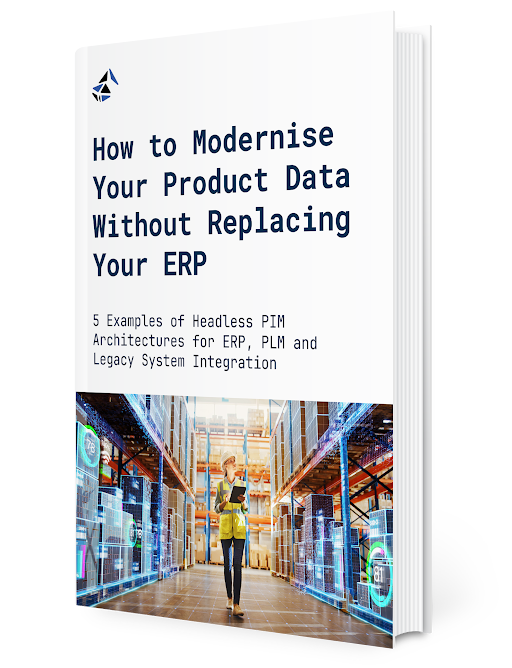
Want to see how this works for manufacturers? Bluestone PIM's e-book, How to Modernise Your Product Data with Workflows and Automation, covers five examples of manufacturers connecting ERP, PLM and legacy systems.
Download free e-book
How to Modernise Your Product Data with Workflows and Automation
See how five manufacturers connect ERP, PLM and legacy systems to modern digital channels with a headless PIM, without replacing the systems they already rely on.
When Does a Packaged ERP Connector Work Best?
A packaged ERP connector earns its place when the target system is standardised and your requirements are close to what everyone else on that system needs. That covers most commerce platforms, most marketplaces and most DAM systems.
| Factor | Packaged ERP connector | Tailored integration |
|---|---|---|
| Best fit | Standardised systems and common data models | ERP, MDM and company-specific internal systems |
| Data model | Predefined or shared | Mapped to your specific fields and hierarchy |
| Time to live | Often days | Weeks, depending on scope |
| Customisation | Limited to supported configuration | Built around business rules |
| Maintenance | Usually handled by the vendor | Owned by your team or an implementation partner |
| Problems appear when | Your setup moves outside the standard model | Requirements or mappings change |
Bluestone PIM's Extension Hub follows this model. It includes pre-built connectors for commercetools, Adobe Commerce and Shopify, along with marketplace and DAM integrations and industry accelerators with pre-built taxonomies. Extensions go through the same QA process for security and performance before being listed. Pre-built, in this case, doesn't mean untested.
Comparing PIM vendors more broadly, not just the integration layer? Run them through this vendor evaluation checklist before you sign anything.
When Do You Need a Tailored ERP Integration Instead?
You need a tailored integration the moment your ERP data doesn't map cleanly to a generic template, which, for most enterprise manufacturers and distributors, is immediately.
The ERP implementations are rarely identical from one company to the next. Custom fields alone can change the mapping substantially. Add company-specific product hierarchies and approval rules, and a standard connector has to make a lot of assumptions.
Bluestone PIM's Connectivity Suite supports bidirectional synchronisation with SAP, Oracle and Microsoft Dynamics using mappings based on your fields and business rules.
Every function in Bluestone PIM is available through an API. This means an integration does not have to wait for a packaged connector release to support a new requirement. Your internal team or implementation partner can build the required flow using patterns already established across ERP and MDM projects.
For more detail on the data flow itself, including one-way, bidirectional and event-triggered integrations, see how PIM and ERP share data.
How Does Bluestone PIM Keep ERP Connectors and Tailored Integrations in Sync?
Packaged ERP connectors and tailored integrations use the same underlying event-driven model.
When relevant data changes in Bluestone PIM, the platform can trigger an event immediately. More than 19 predefined webhook events cover product and pricing changes, including stock-level updates. These events are delivered through enterprise message queues rather than waiting for the next scheduled batch.
Connected systems can then react to the events they need. An ERP may respond to one type of update; a partner portal may listen for another. There is no need to poll constantly or wait for an overnight job to discover that something changed.
See how Bluestone PIM webhooks work and how to subscribe to them.
Can You Replace a Packaged ERP Connector With a Tailored Integration Later?
Yes. Starting with a lighter ERP connector does not prevent you from moving to a tailored integration later.
Both approaches use the same event-driven foundation in Bluestone PIM. Changing the way the ERP connects does not mean changing the PIM itself.
For a largely standard setup, a packaged ERP connector can make sense. If your ERP has years of company-specific processes and custom fields behind it, a tailored integration gives you more control over how the systems exchange data.
The right choice depends on how closely the integration needs to match the ERP you already have.
![How To Scale SKU-Heavy Catalogues Without Duplication [Guide For Retailers]](https://www.bluestonepim.com/hubfs/How-To-Scale-SKU-Heavy-Catalogues-Without-Duplication-1.png)