![How to Write an RFP for a PIM System [Template for Enterprises]](https://www.bluestonepim.com/hubfs/The-Best-PIM-Software-for-Retailers-2.png) Product Information Management
Product Information Management
Ever tried ordering food in a foreign country, armed with nothing but a phrasebook and a hopeful smile? Multiply that a thousand times, and you get a glimpse of what it's like for a customer trying to buy from a website that doesn't speak their language.
If you manage product data for a retailer or manufacturer selling into more than one market, multi-language product data management is already your problem. Getting it right means matching tone and context to each language you sell in.
Customers need to understand your product. That means adapting your message to their language and culture. Don't just translate words: build trust by understanding their values and buying habits.
Multilingual product catalogues bridge that gap, but managing them well is hard without a Product Information Management (PIM) system built for it. Here's how PIM and AI make multi-language product data management work at scale.
What are Multilingual Product Catalogues?
Multilingual product catalogues, also called multi-language product data, are marketing collateral that present key details about your products (descriptions, dimensions, usage, technical specifications, pricing and more) translated into different languages. They help customers get a clear picture of what you're offering and make well-informed buying decisions.
Why is Multilingual Product Catalogue Management Essential for Global Expansion?
The global marketplace is exploding. Cross-border sals are a critical trend in online commerce, with the global B2C market projected to reach a staggering $7.9 trillion by 2030, a substantial leap from approximately $785 billion in 2021. This growth presents a massive opportunity for businesses ready to navigate the complexities of multilingual product catalogues.
A significant hurdle for international expansion is translating product descriptions.
Studies show that 87% of non-English speaking customers prefer websites in their own language. This highlights the absolute necessity of providing product information in multiple languages to capture a broader audience. While generative AI offers a promising avenue for accelerating translations, it's crucial to consider the entire process of managing multilingual product data.
Consider these statistics: 55% of global shoppers buy from international retailers with 80% of social media shoppers making at least one cross-border purchase per month. These figures emphasise the huge potential of international markets and the growing willingness of consumers to buy from companies abroad.
Expanding into international markets presents huge opportunities — new customers, increased revenue, and a stronger competitive position. However, success in global markets depends on more than just reaching new audiences; it requires effectively communicating product information in their language.
This is where multilingual product catalogues play a critical role. Without a well-managed approach to localisation, businesses risk losing potential customers due to unclear or inconsistent product data.
How Does PIM Manage Multilingual Catalogues?
A Product Information Management (PIM) system such as Bluestone PIM is a central hub for all your product data, ensuring consistency and accuracy across all channels and languages. It provides a single source of truth, meaning that no matter where your product information appears — on your website, in a catalogue or on a marketplace — it remains reliable and up-to-date.
When dealing with multiple languages, a PIM system simplifies the process of translating and localising product descriptions, specifications, and digital assets (such as images, videos, and manuals) to suit different markets.
Enterprises need more than just translation; they need full localisation. A PIM with integrated AI features ensures smooth operations through:
-
Centralised multilingual product data: stores all language versions of product information in one place, preventing duplication and inconsistencies.
-
Automated translation workflows: integrates with AI and external translation services to streamline and speed up localisation efforts.
-
Consistent formatting and structure: standardises product descriptions, attributes, and specifications across all languages to ensure clarity.
-
Version control and audit tracking: keeps a history of edits and updates, ensuring that changes in one language don’t disrupt other versions.
-
Product data gap analysis: identifies missing translations and incomplete product descriptions, ensuring that every market has access to complete product information.
-
Multi-channel distribution support: synchronises multilingual product data across websites, e-commerce platforms, and marketplaces like Amazon and eBay, ensuring seamless customer experiences in every region.
-
Collaboration and approval workflows: enables teams across different regions to review, refine, and approve product content before publication, maintaining quality and cultural relevance.

Download free e-book
Automation in Product Information Management
This e-book explains how automation works in product information management, which catalogue workflows can be automated today, and how an event-based architecture creates the foundation for the agentic PIM.
How to Manage Multilingual Product Catalogues with AI in PIM?
AI in PIM manages multilingual product catalogues by handling translation, data quality and enrichment automatically inside Bluestone PIM, while people review and approve the result before anything goes live.
Let's explore how AI can address key challenges.
Translate Catalogues Using AI Linguist
Imagine having a tireless translator dedicated to your product catalogue. That's AI Linguist.
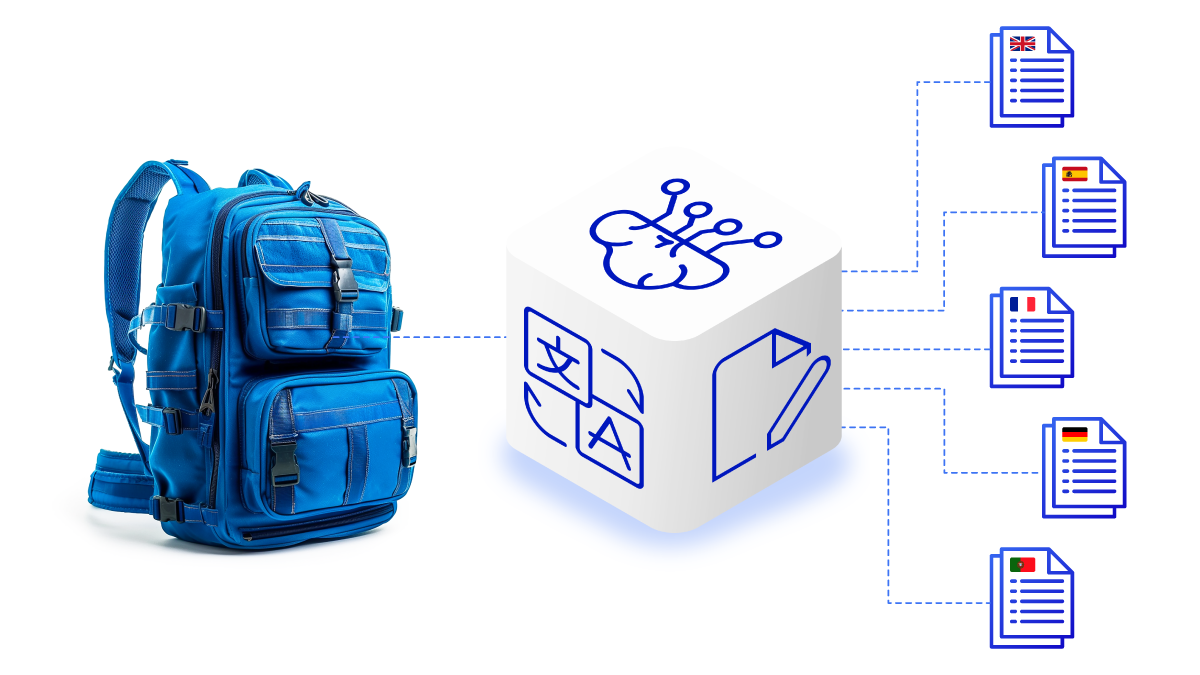
It seamlessly translates product information from one language to another, directly within your Bluestone PIM system. No more exporting and importing files; simply select the attributes or fields you want translated, choose a prompt (or use a standard one), and the system gets to work, translating your data in bulk.
And because it's integrated with Bluestone PIM, the AI understands the context of your existing product data, ensuring more accurate and nuanced translations. Plus, it handles the finishing touches with built-in spell-checking and text improvement capabilities.
Press play to see how AI translates and localises product data.
Maintain Data Quality with AI Analyst
Maintaining accurate and consistent product data is absolutely essential, especially when dealing with multiple languages.
AI Analyst automatically identifies and fixes product data issues. This saves you valuable time and resources while ensuring your translated product information is built on a solid foundation of accurate data.
Watch the video to see AI Analyst instantly transform your data.
Enrich Product Information with AI Enrich
The AI Enrich feature automatically writes and improves product descriptions using your existing attributes and labels, ensuring everything is comprehensive and spot-on. No more staring at a blank page wondering what to write.
Find out how one click can supercharge your product description.
Add The Essential Human Touch
AI handles the heavy lifting, but human oversight is still essential. Think of AI as a powerful tool: it improves efficiency, but it still needs skilled guidance. That matters most for translations, where context, cultural nuance and tone are easy to get technically right and still get wrong.
A human review step protects your brand voice and keeps messaging consistent across every language. Bluestone PIM supports that with review workflows: your team checks and approves AI-suggested changes and keeps full control over the final content.
Ready to Expand Globally?
AI-driven features give companies a practical toolkit for managing multilingual product catalogues. Processes move faster and errors drop, which adds up to a better customer experience in every market.
By combining AI efficiency with human oversight, you can ensure high-quality product information across all channels and languages.