


 Headless PIM
Manufacturers rarely rethink their product data architecture just because they want a new PIM. It usually starts with a new ERP, market, or increasingly complex data flows.
After working with dozens of manufacturers, the Bluestone PIM team has seen these challenges repeatedly. As businesses grow, so does the complexity of managing product data across systems and channels.
In this guide, we share real-world use cases and examples of how manufacturers can simplify these data flows with a headless PIM approach, without replacing the systems they already rely on.
Why Are Manufacturers Rethinking Their Product Data Architecture?
Manufacturing tech stacks grow more complex over time. Companies use CAD and PLM for engineering, ERP for operations, and other systems to manage product information across channels.
As companies grow, they add new systems, markets, and channels. Each brings new integration needs. Point-to-point integrations can work at first, but as the network grows, they become harder to maintain. A change to one product attribute can affect multiple systems and exports.
A headless PIM introduces a governed product data layer between source systems and the applications that consume product information. Manufacturers can manage customer-facing content in one place while allowing different channels to access the information they need.
The result is an architecture that can support new business requirements without repeatedly changing the underlying ERP integrations or product data model.
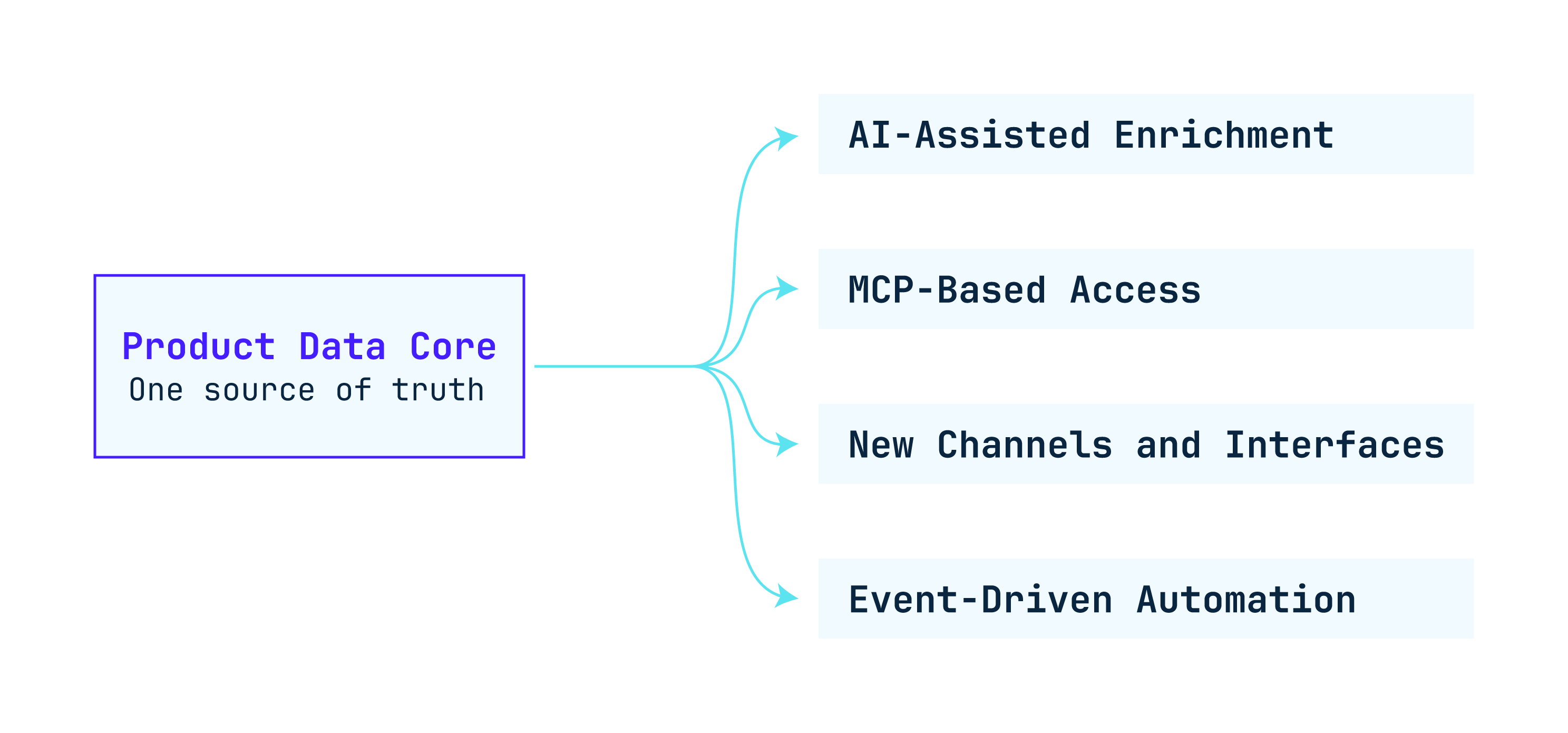
The goal is to let manufacturers add new digital capabilities without redesigning the systems that run their operations.
What Can Manufacturers Learn From The Building Company?
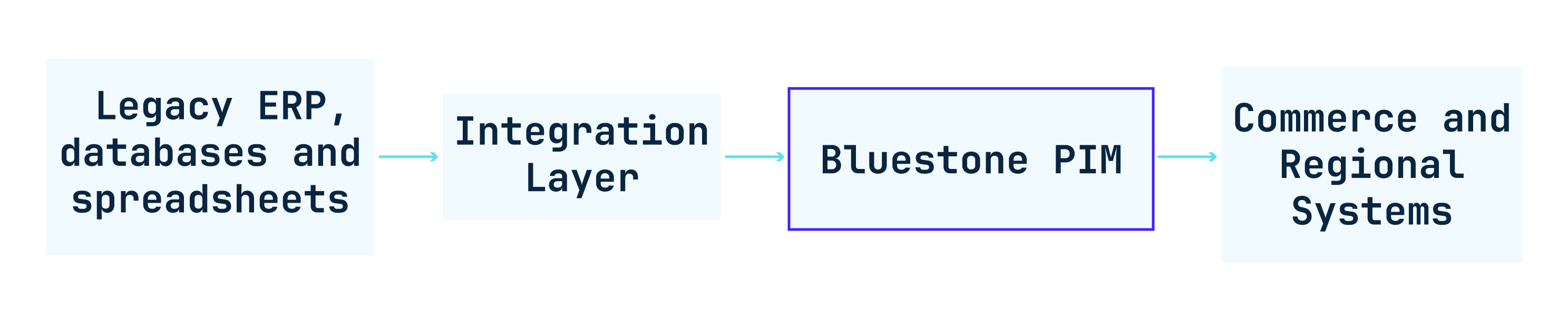
The Building Company, a Bluestone PIM customer, managed product data across a legacy ERP, spreadsheets and databases. Its catalogue covers products such as timber, masonry and tools, with different attributes and category structures.
The company built an integration layer that creates products and attributes in Bluestone PIM in bulk. Another connection sends governed product information to commerce and regional systems.
As Mark Arrow, E-commerce Manager at The Building Company, explains:
“Bluestone PIM’s API coverage and detailed documentation made it possible for our team to build and maintain the ERP integration layer in-house. We can create complete product lines in bulk, including their attributes, directly from ERP into Bluestone PIM and keep the integration aligned with our own data structure.”
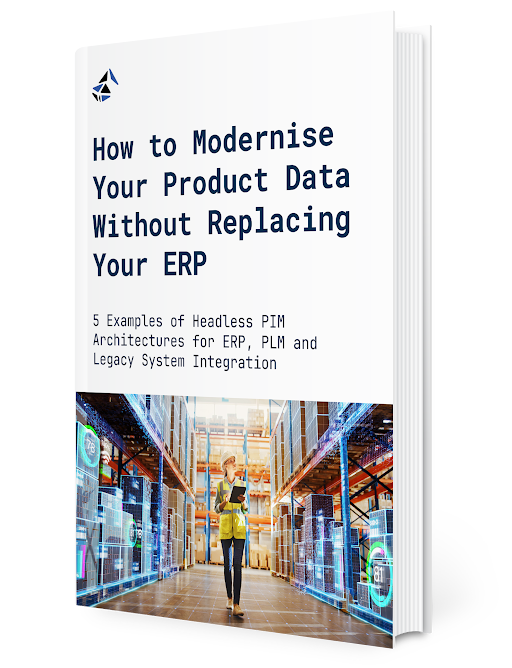
This setup lets manufacturers build integrations around their own product structures when standard connectors do not fit. Bluestone PIM’s latest e-book includes five real-world examples of headless PIM architectures used in manufacturing.
Download free e-book
How to Modernise Your Product Data with Workflows and Automation
See how five manufacturers connect ERP, PLM and legacy systems to modern digital channels with a headless PIM, without replacing the systems they already rely on.
Why Are Manufacturers Moving Customer-Facing Product Data Out of ERP?
ERP manages production, inventory, purchasing, orders and pricing. Customer-facing product content needs different workflows and permissions.
Descriptions, translations, images, certificates and product relationships often need input from several teams. Keeping this work in ERP can tie routine content updates to operational processes.
PIM gives teams a separate place to prepare, review and distribute customer-facing product content. With clearly defined roles for ERP and PIM, ERP keeps operational records while PIM manages the content used by customers and distributors.

How Does This Work in an Industrial Manufacturing Environment?
One industrial and scientific instruments manufacturer uses Bluestone PIM to keep operational data and customer-facing content separate.
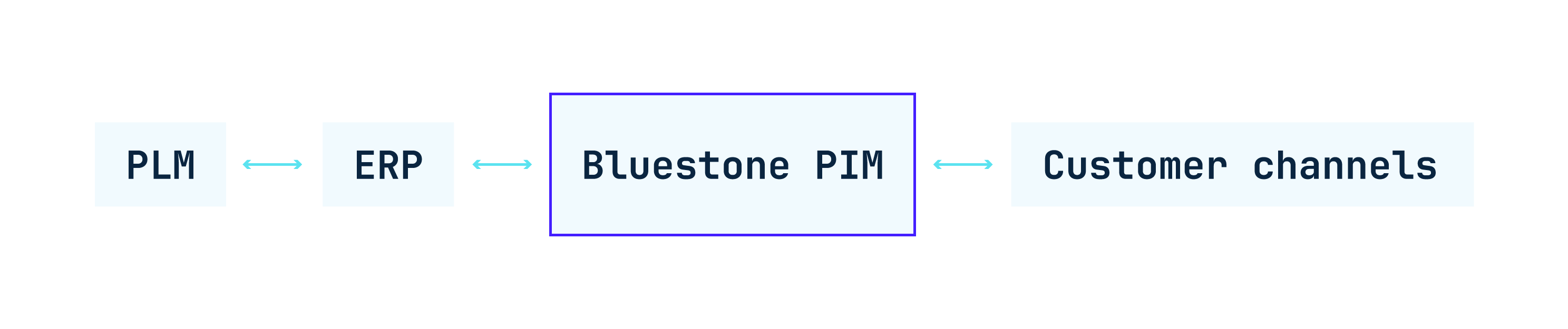
ERP owns pricing and operational records, while product information moves from engineering systems through ERP into PIM for enrichment.
Connected applications can combine data from both systems. Each field has one owner, so teams do not have to maintain competing versions of the same information.
Why Does Headless Architecture Make It Easier To Add New Channels?
A headless PIM separates product data from the interfaces that use it. E-commerce sites, dealer portals, internal applications and partner systems can all access the same governed information.
When a manufacturer adds another channel, the new application can use existing product information instead of creating another place where descriptions, specifications and assets need to be copied and maintained.
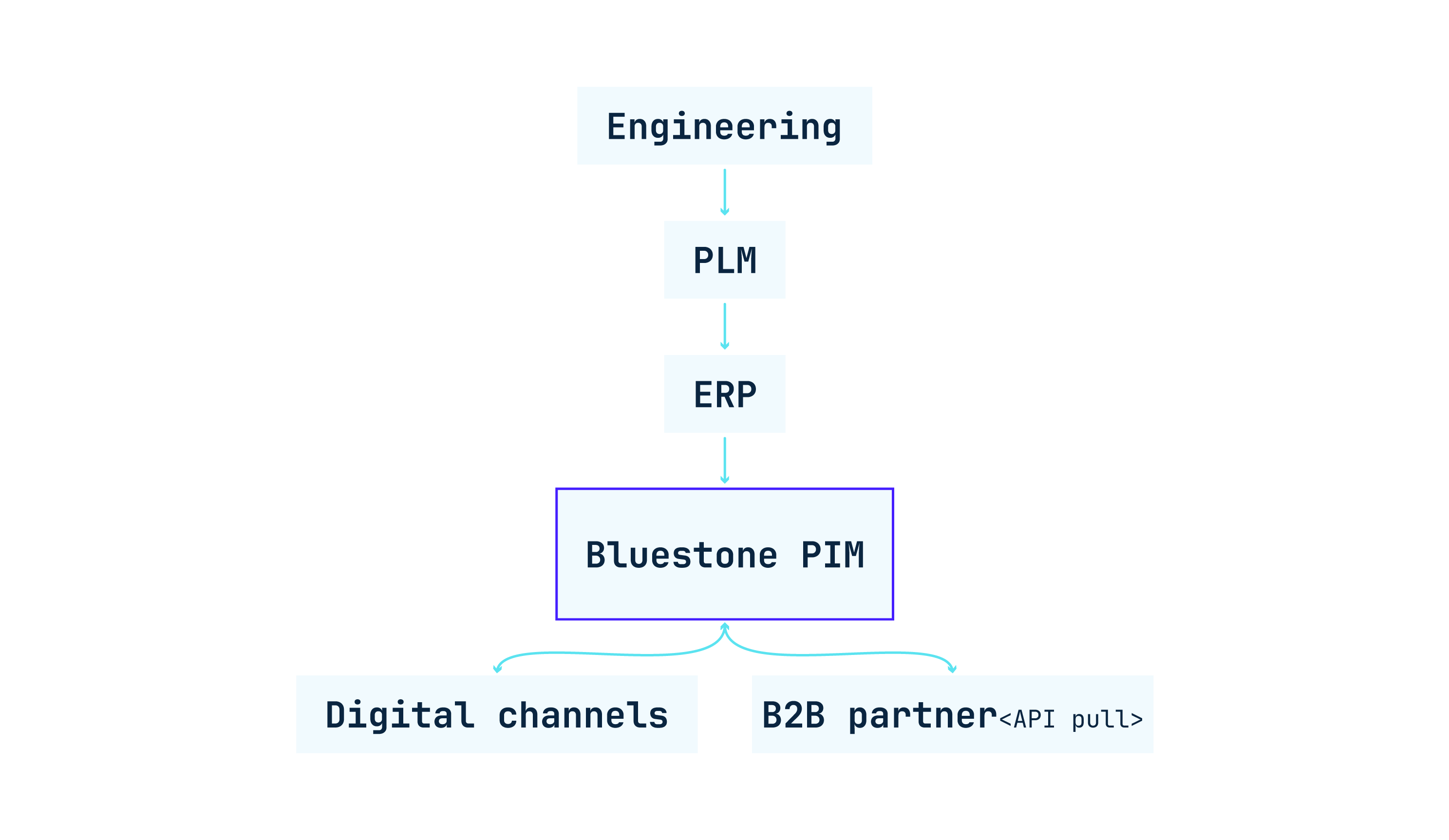
Example: A playground equipment manufacturer moved from Excel exports to this model. A major B2B partner now retrieves the approved catalogue through Bluestone PIM's public API, while commerce, search and content applications use the same source.
How Can Manufacturers Modernise Without Replacing Every ERP?
Manufacturers often operate several ERP systems with different data models and regional processes. Replacing them all at once can take years.
A headless PIM creates a shared product content model while the existing ERP systems stay in place.
Example: A global bicycle manufacturer uses Bluestone PIM across six regional ERP environments. Each region still controls local SKU assignment, inventory and B2B pricing.
Bluestone PIM provides one global product content model. During migration, the legacy back office remains connected in both directions, so individual regions and product lines can move in stages without interrupting downstream channels.
For manufacturers planning an ERP transformation, this approach makes it possible to improve product data management without waiting for every operational system to be replaced.
What If Different Applications Need Different Product Data?
With a headless architecture, applications do not all have to access product data in the same way. Some can connect directly to PIM; others can use an additional data layer.
Example: A home improvement manufacturer needed to supply around 20,000 SKUs and 2,500 attributes to search, commerce, PDF and 3D asset systems.
Direct queries to the core PIM API did not suit the required volume and access pattern. An implementation partner therefore built a custom data layer that combines product information from Bluestone PIM with operational data.
Downstream applications query this layer, which also handles processes such as unit conversion.
Bluestone PIM remains the governed source of customer-facing product information. The additional layer prepares that data for applications with different performance or query requirements.
How Does Bluestone PIM Support Headless Automation and Customisation?
Headless architecture lets manufacturers automate product data workflows and build tailored applications outside the standard PIM interface.
Bluestone PIM provides more than 700 API endpoints and full UI/API parity, so actions available in the interface can also run through APIs. Teams can automate specification updates, approvals, publishing and technical document workflows, or build tailored interfaces for dealer content and technical product data.

Download free e-book
Automation in Product Information Management
This e-book explains how automation works in product information management, which catalogue workflows can be automated today, and how an event-based architecture creates the foundation for the agentic PIM.
Business rules, AI workflows and agents can handle validation, error detection, description enrichment and translation. More advanced workflows can use agents and MCP tools, with permissions and approvals controlling changes.
What Should Manufacturers Consider Before Moving to Headless PIM?
Start by mapping how product information moves between ERP, PLM, spreadsheets and downstream channels. Look for duplicate data, manual handovers and integrations that are difficult to change.
A headless PIM is most useful when manufacturers want to improve these flows without replacing their operational systems. The same product data layer can then support new channels, integrations and automated workflows.
Bluestone PIM manages the core platform, while manufacturers can build integrations and extensions around their own architecture.
See five headless PIM architectures in practice.
Download How to Modernise Your Product Data with Workflows and Automation.
Or talk to our team about your ERP, PLM and product data setup.
Headless PIM