
![How To Scale SKU-Heavy Catalogues Without Duplication [Guide For Retailers]](https://www.bluestonepim.com/hubfs/How-To-Scale-SKU-Heavy-Catalogues-Without-Duplication-1.png) Product Information Management
Product Information Management
If you're looking at Informatica Product 360 alternatives, the decision usually comes down to one thing: whether you need a governance system or a product data system that moves at commerce speed.
Informatica Product 360 (P360) is built for master data governance. Bluestone PIM is built for product experience: getting accurate product data onto every channel fast, and keeping it that way as requirements like the Digital Product Passport change what "accurate" means.
This guide is for e-commerce leaders, product teams, and IT decision-makers weighing a P360 replacement, or deciding whether a dedicated PIM belongs alongside Informatica IDMC.
What Is The Core Difference Between Informatica And Bluestone PIM?
Informatica P360 sits inside a broader data strategy built around the Intelligent Data Management Cloud (IDMC), where the priority is integration, master data management, and enterprise-wide governance. PIM has become a smaller part of that story over time. P360 remains a legacy product with limited new development.
That creates a gap for teams that need a faster, more flexible way to manage product data specifically. Bluestone PIM doesn't compete with Informatica's governance strengths. It fills the gap next to them, as a dedicated product data layer for teams that need to move faster than a governance-first system allows.
The distinction plays out in two different starting points:
-
Informatica P360 is governance-first. It's designed to control and standardise data across multiple domains, including customer, supplier, and product, with data quality and consistency as the priority.
-
Bluestone PIM is commerce-first. It structures, enriches, and distributes product data across e-commerce platforms, marketplaces, and other digital touchpoints. The priority is getting product information usable, accurate, and adapted for each channel.
Informatica starts with control. Bluestone PIM starts with getting products ready to sell. In practice, that means Informatica manages data across the whole business, while Bluestone PIM helps teams actively work with product data and move it into market.
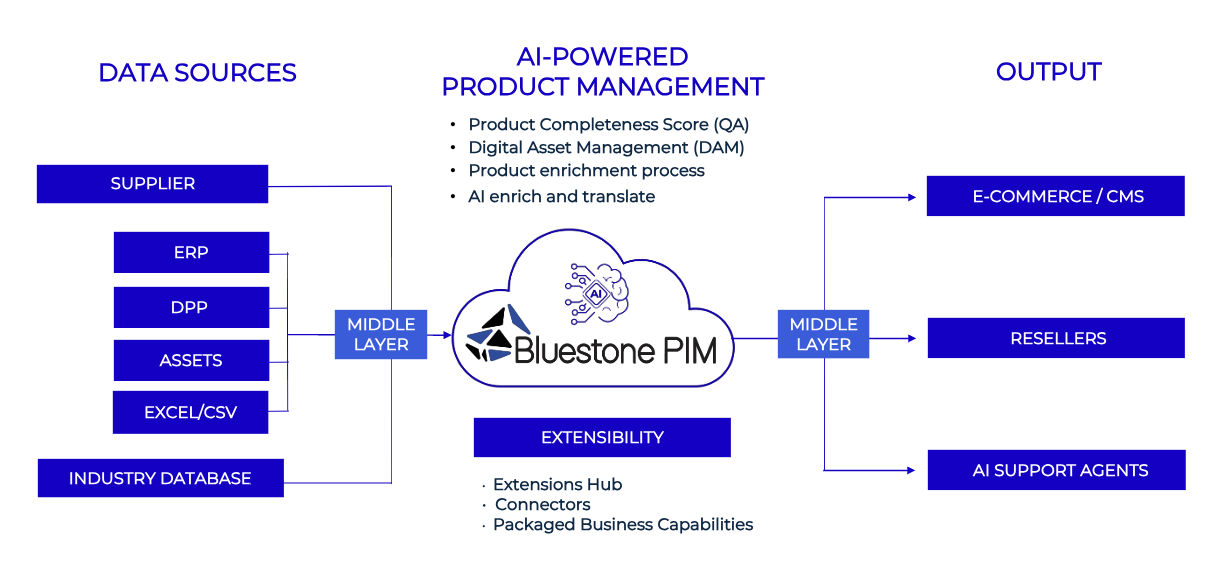
Bluestone PIM helps teams replace slow, IT-dependent product workflows with something business users can run themselves. See how the architecture supports that.

Download free e-book
5 Signs You Need a PIM System
Stop guessing. See the red flags teams miss until product data starts slowing growth. A quick, practical guide for e-commerce, marketing, and product teams.
Informatica P360 vs Bluestone PIM: Feature Comparison
| Feature | Informatica Product 360 | Bluestone PIM |
|---|---|---|
| Architecture | MDM-driven platform, with a centralised data model and API-first capabilities for integration | Headless, agent-ready. API-first for over a decade, with 700+ task-level endpoints and full UI/API parity |
| Deployment | On-premise or single-tenant | Multi-tenant SaaS |
| Main Users | Data stewards, IT teams | E-commerce, marketing, product teams |
| Strength | Cross-domain governance | Product data workflows and speed |
| Usability | Complex, requires training | Intuitive, business-user friendly |
| AI Capabilities | CLAIRE (governance-focused AI) | Built-in AI suite supporting product content, localisation, and data quality, with AI-driven workflows, AI-powered DAM and rules engine, and an AI-agnostic model evolving towards agentic PIM |
| Integration | Suite-based ecosystems | Pre-built connectors plus a full API layer for custom integrations |
| Innovation Pace | Limited in PIM | Continuous product development |
How Do The Architectures Differ?
Informatica Product 360 follows a centralised, suite-based architecture.
It is designed to manage data across multiple domains within a controlled environment, with a strong focus on governance and consistency. This approach works well for organisations that prioritise standardisation, but it can make change slower, especially when new channels, data models, or integrations are required.
| Strategic Pillar | Informatica P360 (The Generalist) | Bluestone PIM (The Specialist) |
|---|---|---|
| Architectural Origin | Evolutionary SaaS: A mature, platform-centric evolution of an enterprise monolith; stable but carries legacy "suite" logic. | Native MACH: Purpose-built as a Microservices, API-first, Cloud-native, and Headless (MACH) ecosystem. |
| API & Connectivity | Coarse/Orchestrated: High-volume "batch" APIs designed for ERP synchronization and complex data "payloads." | Atomic/Choreographed: 700+ fine-grained APIs and event-driven webhooks for real-time storefront updates. |
Bluestone PIM is built on MACH architecture (Microservices, API-first, Cloud-native, Headless) which forms a foundation for composable commerce.
That means each part of the system can evolve independently, integrate easily, and scale without disrupting the whole setup.
In practice, this gives you:
- Faster integrations with tools like Shopify, commercetools, or CMS platforms
- Headless capabilities, allowing you to deliver product data to any frontend or channel
- The ability to plug in best-of-breed components across your commerce stack
- Less dependency on vendor-controlled upgrades
- The freedom to build, adapt, and evolve your own tech stack over time
Download free e-book
MACH-Based PIM: The Ultimate Guide
Going deeper into MACH and product data? This e-book explains how MACH-based PIM supports composable commerce in practice.
The key difference is how change is handled:
- Informatica is built to control and standardise data across the organisation.
- Bluestone PIM is built to adapt product data quickly to new business needs, channels, and systems.
When Should You Replace Or Complement Informatica With Bluestone PIM?
Most organisations evaluating Informatica vs Bluestone PIM are not starting from scratch. They are usually in one of two situations:
-
Still using Informatica Product 360 (P360) and considering a replacement
-
Using Informatica IDMC and looking for a dedicated PIM layer
Each scenario leads to a different decision path:
Scenario 1: Replacing Informatica P360 With Bluestone PIM
Replacing Informatica Product 360 typically starts with frustration around speed, usability, and cost.
P360 is a legacy system. It was originally developed by Heiler and later acquired by Informatica. The architecture reflects that history. It was not built for modern, fast-moving commerce environments.
Why Teams Move Away From P360
In daily work, the limitations show up quickly:
- Product onboarding takes too long
- Enrichment workflows depend on IT or complex processes
- Updates are difficult to manage across multiple channels
- The interface is not designed for business users
Even when moving to a hosted or single-tenant setup, the core system remains the same. The experience does not change, but the cost often increases significantly.
For many companies, this creates a gap between what the business needs and what the system can deliver.
What Changes With Bluestone PIM
Bluestone PIM replaces that setup with a system designed for how product teams actually work.
Instead of adapting your processes to the system, the system supports your processes.
In practice, this means:
- Faster product onboarding and enrichment
- Real-time collaboration across teams
- Built-in localisation without duplication
- Easy distribution across e-commerce platforms and marketplaces
AI supports these workflows directly. Teams can generate product descriptions, translate content, and identify missing data inside the platform, without switching tools.
The shift is clear: from a system that stores product data to one that actively prepares and delivers it.
What About Migration Risk?
This is often the main concern.
Bluestone PIM is designed to integrate with existing systems, including ERP, DAM, and even Informatica components where needed. That allows a phased transition rather than a full “big bang” replacement.
You can migrate product data in stages, validate workflows, and move teams gradually.

Download free e-book
Complete Guide to PIM
This free guide walks you through everything you need to know about modern Product Information Management (PIM) and how to use it as a foundation for growth.
Scenario 2: Complementing Informatica IDMC With Bluestone PIM
For organisations already using Informatica IDMC, the conversation is different.
The question is not “replace or not”. It is “are we trying to use MDM as a PIM?”
Where IDMC Works Well
Informatica IDMC is strong in:
- Master data governance
- Data integration across systems
- Creating a unified data backbone
It is built to manage data across the organisation, not to prepare it for commerce.
Where The Gaps Appear
When teams try to use IDMC for product data workflows, limitations become clear:
- No dedicated tools for product enrichment
- No structured support for localisation
- Limited usability for marketing and e-commerce teams
- High effort required to adapt data for each channel
This often leads to workarounds: spreadsheets, manual processes, and disconnected tools start to fill the gaps.
How Bluestone PIM Complements IDMC
Bluestone PIM adds a dedicated product data layer on top of IDMC.
Each system keeps its role:
- IDMC manages core data and governance
- Bluestone PIM manages product data workflows and distribution
They connect through API endpoints, allowing data to flow seamlessly between systems.
This gives you:
- Clean, governed master data from Informatica
- Fast, flexible product workflows in Bluestone PIM
Why This Setup Works Better
Trying to extend IDMC into a PIM usually leads to:
- Complex configurations
- High development costs
- Long delivery timelines
In many cases, this approach costs significantly more than adding a dedicated PIM.
Bluestone PIM solves this by focusing on one job: making product data usable, complete, and ready for every channel.
Choosing Between Replacement And Complement
The right call depends on how your current setup handles product data today, and where it starts to slow you down.
If Informatica P360 is your product data system, replacement is usually the next step. It wasn't designed for modern commerce workflows, and over time that creates friction around speed, usability, and cost. Moving to Bluestone PIM lets you reset how product data is managed, with enrichment, localisation, and omnichannel distribution built in from day one.
If Informatica IDMC is your data backbone, complementing it makes more sense. IDMC stays strong at governance and integration. Bluestone PIM adds the layer that handles day-to-day product workflows, without disrupting the architecture you've already built.
Many organisations end up doing both over time: adding Bluestone PIM alongside IDMC first to fix product workflows, then phasing out legacy tools like P360 once the new setup proves itself. This step-by-step path reduces risk and lets teams see value early, while modernising the product data foundation underneath everything else.
Talk To Bluestone PIM About Your Setup
Every organisation is in a slightly different position, and the best path forward depends on your current systems, data complexity, and business goals.
A short session with the Bluestone PIM team can help you:
- Assess whether replacement or complement makes more sense
- Map your current product data flows and identify bottlenecks
- Understand how Bluestone PIM fits into your existing architecture
- See how quickly you can improve product data workflows