![How To Scale SKU-Heavy Catalogues Without Duplication [Guide For Retailers]](https://www.bluestonepim.com/hubfs/How-To-Scale-SKU-Heavy-Catalogues-Without-Duplication-1.png) Product Information Management
Product Information Management
Choosing the best PIM software is a high-stakes decision. The wrong platform locks your team into rigid workflows, slow integrations, and mounting technical debt. The right one becomes the foundation for how product data moves across every channel, language, and market you operate in.
This is not a ranked list of PIM vendors. Ranked lists rarely help enterprise buyers because the "best" PIM depends on your architecture, your SKU volume, and how your team actually works with product data day to day.
Instead, this guide breaks down the evaluation criteria that matter most in 2026, compares leading PIM solutions across those criteria, and gives you a framework for making a confident decision.
What Makes PIM Software the Best in 2026?
The best PIM software centralises product information (descriptions, specifications, images, pricing, compliance data) and distributes it to every sales channel from a single source of truth. That definition has not changed. What has changed is the baseline expectation for how a PIM platform should work. In 2026, enterprise buyers expect four things from any PIM on their shortlist:
-
Headless by design. The PIM runs behind an API, not behind a fixed set of screens. Every function, from supplier onboarding to publishing, is callable the same way a person, a partner system, or an AI agent would call it.
-
Agent-first architecture. AI agents do the daily work: supplier onboarding, enrichment, validation, and publishing. People set the brief and check the output. A chatbot bolted onto a legacy core doesn't make a PIM agent-first.
-
No native UI to defend. Most PIM vendors split engineering time between the API and the screens built on top of it. When the vendor's own interface runs on the same public API a customer would use, 100% of development goes into the API surface, and customers can build the interface their team actually needs.
-
Compliance capability. EU regulations, including the Digital Product Passport (DPP) under ESPR, require structured sustainability and materials data at the product level. A PIM that cannot collect, validate, structure, and publish this data will create a compliance gap within the next 18 months.
Download free e-book
AI Visibility Guide for Retailers
Learn how to structure product data so AI can find, cite, and recommend your products. Covers GEO, agentic commerce, and 30+ data fields.
How Should You Evaluate PIM Solutions?
PIM evaluation works best when you score vendors against a consistent set of criteria rather than comparing feature lists. Feature lists are marketing documents. Evaluation criteria reflect how the platform will perform once your team is using it.
These seven criteria cover what matters most for enterprise and mid-market buyers in 2026.
DOWNLOAD THE CHECKLIST
PIM Vendor Evaluation Checklist
This checklist will help you dig deeper into what really matters: flexibility, scalability, support, and future-proofing.
Download the checklist1. Architecture
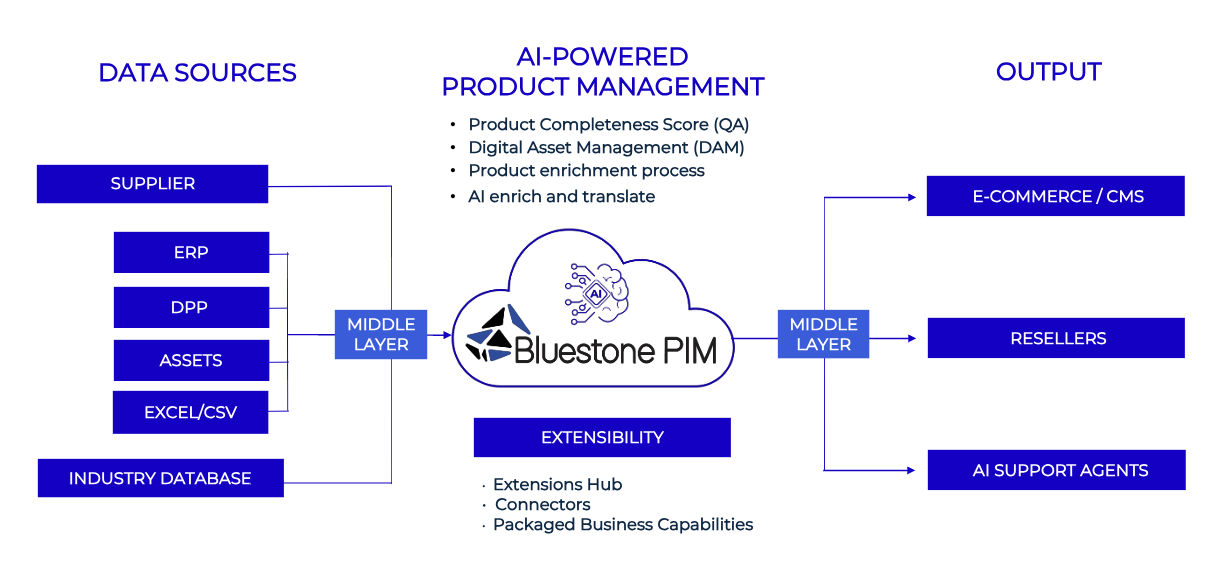
Ask whether the PIM is headless by design, or whether APIs were retrofitted onto a legacy core after the fact. One test: does the vendor's own interface run on the same public API a customer would use? If the answer is no, the vendor is maintaining two separate products, and your integration will hit the seams eventually. Check how many task-level API endpoints the platform exposes, and whether they're included in your licence or charged separately. MACH certification is a reasonable box to tick, but it's a baseline, not a differentiator by 2026.
2. AI Capabilities
Check whether AI features are built into the platform or sold as paid add-ons. Ask which AI models the platform supports: is it locked to a single provider, or model-agnostic? The most useful AI capabilities for product data teams in 2026 are bulk content generation, multilingual translation, automated image tagging, data quality scoring, and an AI agent that can execute PIM actions from natural-language prompts.
For teams building their own AI workflows, check whether the platform's functions are exposed as MCP tools. MCP tools let an agent operate at the same depth a developer would; a plain REST API doesn't.
3. Scalability
Test with your actual data volume. A PIM that performs well with 5,000 SKUs may struggle at 500,000. Ask for performance benchmarks at your target scale, and confirm whether pricing increases as SKU volume grows.
4. Ease of Use
The people using the PIM every day are product data managers and e-commerce teams, not developers. If business users cannot manage data models, set validation rules, and publish to channels without raising an IT ticket, the platform will become a bottleneck rather than a solution.
5. Integrations
Count the connectors. Check whether the vendor offers ready-made integrations for your commerce platform (Shopify, commercetools, Magento), your ERP (SAP, Microsoft Dynamics), and your key marketplaces. Ask what happens when you need a custom integration: is it a configuration task or a development project?
6. Total Cost of Ownership
Request a three-year cost projection that includes licence fees, implementation, training, API usage charges, channel fees, and any per-user or per-SKU pricing tiers. Some PIM vendors offer transparent SaaS pricing with predictable monthly costs. Others use opaque enterprise pricing models where the real cost only becomes clear after contract negotiation.
Download free e-book
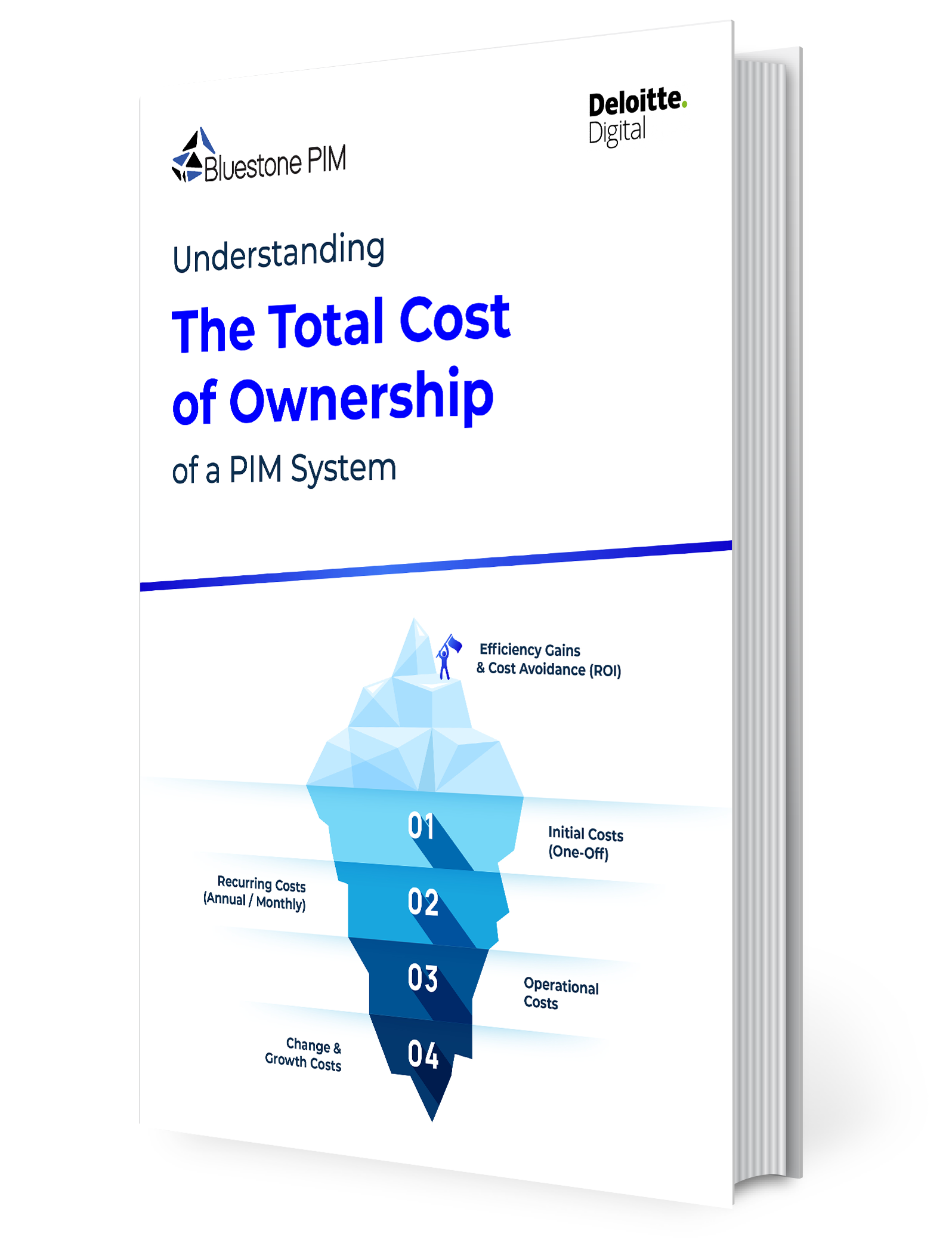
Total Cost of Ownership: Thinking about investing in a PIM system? The Total Cost of Ownership
This e-book breaks down the true cost of a PIM system: upfront, hidden, and long-term so you can make a confident, informed decision. Get the clarity you need before making a decision.
7. Compliance Readiness
Ask specifically about Digital Product Passport support. Can the PIM collect sustainability attributes from suppliers, validate them against ESPR requirements, and generate DPP-compliant data exports? This is not a future consideration: ESPR timelines are already in motion.

Download free e-book
How to Create a Digital Product Passport
From 2026, the regulation will begin to apply to selected product groups, requiring companies to provide structured, detailed information about theproducts they place on the EU market.
How Do the Leading PIM Platforms Compare?
The table below compares five of the most evaluated PIM platforms in 2026 across the criteria outlined above.
| Criteria | Bluestone PIM | Akeneo | Inriver | Pimberly | Pimcore |
|---|---|---|---|---|---|
| Architecture | Headless by design, agent-first by architecture. The same public API powers Bluestone PIM's own interface, customer-built UIs, and AI agents. | MACH-certified, but built on a legacy core. | MACH-certified since 2023; on-premise origins. | API-first; standard integrations with major e-commerce platforms. | Modular monolith, API-first capable. |
| AI capabilities | Built-in AI for content generation, translation, data quality scoring, and an AI Agent that runs natural-language commands. LLM-neutral: bring your own model. MCP tools expose the same 700+ operations to agents." | AI features available; primarily content generation. | AI content tools (Inspire) sold as add-on bundles; tied to specific models. | AI features (CopyAI, ImageAI, Product AI) available as separate paid add-ons. | AI Copilot in Enterprise Edition only. |
| Scalability | Enterprise-grade, tested at millions of SKUs. | Handles enterprise volume; complex data modelling has reported limitations. | Performance concerns reported at very high volumes. | Users report slowdowns with large imports and bulk operations. | Scalable depending on hosting and implementation. |
| Ease of use | Clean UI designed for business users. No-code workflows. | Intuitive for standard use cases; steeper learning curve for advanced data models. | Complex UI and data model; slower time to value reported. | Accessible for mid-market teams; bulk operations may require extra steps. | Requires developer resources for most configurations |
| Integrations | 700+ public API endpoints. Ready-made extensions plus custom extension framework. | Growing app marketplace; some integration limitations. | Restricted APIs; extra fees for advanced API access. | API-first with standard connectors; complex multi-system setups require additional effort. | Developer-led, custom integrations. |
| Total cost of ownership | Transparent, predictable SaaS pricing. No hidden channel fees. | Premium pricing; costs can escalate with add-ons. | Complex channel-based pricing; surprise costs reported. | Four tiers; AI, Data Sheets, Catalogue Publishing, and Content Distribution are paid extras. | Free Community Edition, but significant dev/ops and hosting costs. |
| Compliance (DPP) | DPP-ready with structured data collection for ESPR. | DPP support developing. | Limited DPP-specific features. | No current DPP-specific support. | Possible with custom development. |
Data reflects publicly available information as of April 2026. Verify directly with each vendor for current capabilities and pricing. For a side-by-side breakdown of each vendor, see our Akeneo alternative comparison, inRiver alternative comparison, and Pimberly vs Bluestone PIM comparison.
What Can Bluestone PIM Do That Other Platforms Cannot?
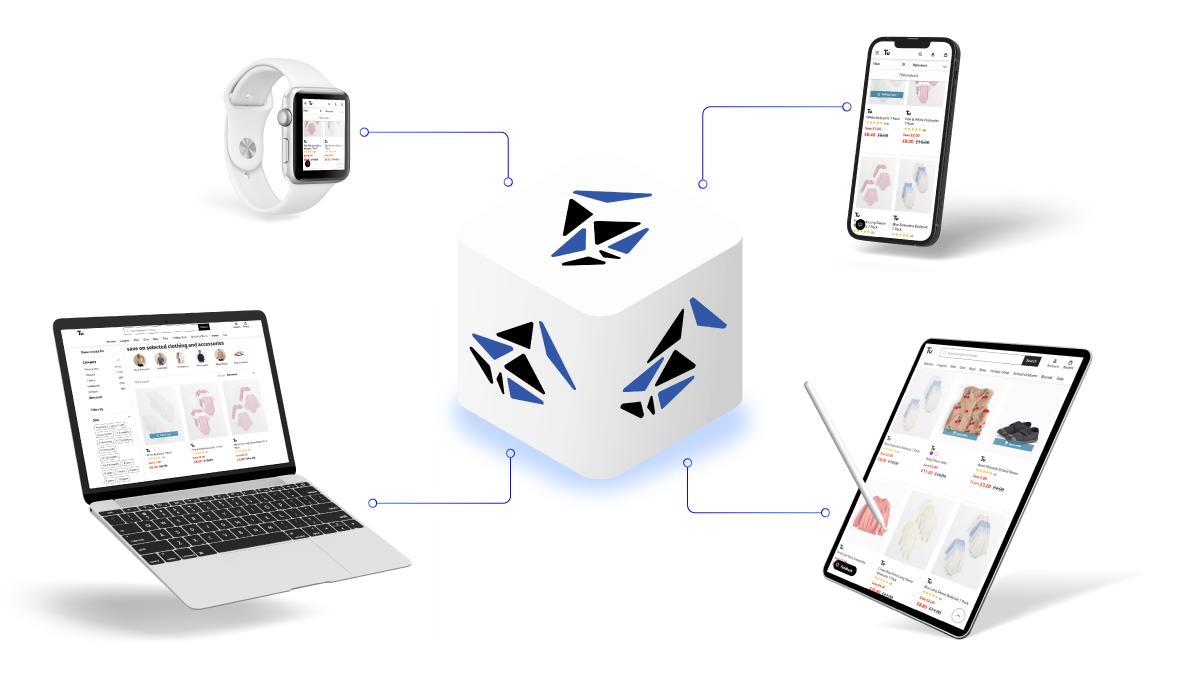
Bluestone PIM was built as a composable, MACH-native platform from day one. That distinction matters because it determines how quickly the platform integrates with your existing systems and how much flexibility you retain as your needs change.
Three capabilities stand out for enterprise buyers evaluating Bluestone PIM against alternatives:
Stadium replaced Inriver with Bluestone PIM and grew B2B revenue 2X with the same headcount, driven by the automation this architecture makes possible rather than a larger team.
Ready to see how Bluestone PIM handles your product data? Book a demo and bring your real evaluation criteria. No generic slide deck: a working walkthrough with your use case.
How Do You Choose the Right PIM for Your Business?
Choosing the best PIM software requires matching the platform to your organisation's specific operating context. A retailer managing 200,000 SKUs across five European markets has different requirements from a manufacturer distributing technical specifications to 30 distributors.
1 / Start with your data.
Map the number of SKUs, the number of attributes per SKU, the number of languages, and the number of output channels. This determines the minimum performance and scalability threshold for your shortlist.
2 / Involve your technical team early.
The CTO or solutions architect should review the vendor's API documentation and architecture before the first demo. A PIM that looks excellent in a sales presentation may not fit your composable commerce stack.
3 / Request a technical proof of concept.
Ask shortlisted vendors to demonstrate the platform with a representative sample of your actual product data. Generic demos show the best-case scenario. Your data will reveal the real-world experience.
4 / Compare total cost of ownership over three years.
Include implementation, training, licence fees, API charges, channel fees, and ongoing support. The cheapest licence is rarely the cheapest solution.
5 / Check G2 and peer reviews from your industry.
PIM performance varies by use case. A platform rated highly for fashion retail may underperform for industrial manufacturing. Filter reviews by company size and industry.
What Are the Essential Features of PIM Software?
PIM software should include, at minimum, the following capabilities. Any platform missing these in 2026 is not competitive for enterprise use.
-
Centralised product repository. A single source of truth for all product data: descriptions, specifications, images, documents, pricing, and compliance attributes.
-
Omnichannel publishing. The ability to distribute product content to e-commerce platforms, marketplaces, POS systems, print catalogues, and distributor portals from one system.
-
Bulk editing and automation. Update thousands of products at once. Automate repetitive tasks like attribute mapping, data validation, and content generation.
-
Digital asset management (DAM). Store, organise, and link product images, videos, PDFs, and technical documents directly to SKUs.
-
Collaboration and workflow. Assign tasks, set approval workflows, and invite suppliers, translators, or agencies to contribute to product data with role-based permissions.
-
Data quality and validation. Completeness scoring, validation rules, and automated checks that prevent incorrect or incomplete data from reaching channels.
-
Localisation. Manage product content in multiple languages and adapt it for different markets and regulatory requirements.
-
AI enrichment. Generate, translate, tag, and score product data using built-in AI tools rather than external applications.
Bluestone PIM includes all of these capabilities as standard, with extensions available for advanced use cases like Digital Product Passport data collection and AI-powered analytics.
Ready to evaluate Bluestone PIM against your requirements? Schedule a free demo and walk through your evaluation criteria with a product specialist.