

 Retail & ecommerce
Great product descriptions do one job: turn a browser into a buyer. But increasingly, that browser might be an AI shopping agent reading your product page before a human ever sees it, and persuasive copy alone won't get you recommended if the facts inside it aren't structured enough for AI to extract.
Below are four real examples that do it well, plus the seven-step formula behind them, so you can write your own for a single listing or scale it across thousands of SKUs, in a way that works for both a human shopper and an AI one.
This guide is for e-commerce managers and product teams. It answers the questions people ask most:
- What should a product description include?
- How long should a product description be?
- How do you optimise a product description for SEO?
- How do you optimise a product description for GEO, so AI shopping tools can find and recommend?
- Can AI write product descriptions that convert?
Why Are Product Descriptions Essential for E-Commerce Success?
Product descriptions are essential for e-commerce. They:
- Help customers understand what the product does
- Showcase benefits that differentiate your product
- Improve search engine rankings when optimised properly
An effective product description is concise, benefit-driven, and easy to scan. It acts as a mini sales pitch, especially vital in the absence of physical interaction.
If you want the deeper dive in the AI Visibility Guide for Retailers covers how to structure product data so AI systems can find, cite, and recommend it, and GEO Checklist for Product Managers walks through the SEO, AEO, and GEO essentials for product pages at scale.
Download free e-book
AI Visibility Guide for Retailers
Learn how to structure product data so AI can find, cite, and recommend your products. Covers GEO, agentic commerce, and 30+ data fields.
What Should a Product Description Include?
Every high-converting product description contains these elements:
| Element | Why it Matters |
|---|---|
| Keyword‑optimised product title | Your title should clearly describe the product and incorporate key search terms without overstuffing them. A balanced title improves readability and search visibility. |
| Features and specifications | Technical items (laptops, appliances) need detailed specs like dimensions and battery life, while simpler products can focus on material, fit and design. |
| Benefits and value proposition | Go beyond features and explain how the product solves a problem or improves customers’ lives. This section is where you answer the “so what?” for every feature. |
| High‑quality visuals | Clear images from multiple angles and lifestyle shots help shoppers imagine using the product. |
| Social proof | Reviews, testimonials and ratings reduce hesitation and build trust. |
| Transparent pricing and shipping info | Provide clear pricing and shipping details, including return policies, at the end of your description. |
What Are the 7 Golden Rules for Writing a Product Description?
Before you begin writing, it’s helpful to follow a few proven guidelines. These principles will help you write descriptions that are clear, compelling, and conversion-focused, whether you're creating one listing or scaling across thousands of SKUs. Check the best practices for writing product descriptions
#1 Keep Your Audience in Mind
Before you start writing your product description, you need to know who your target audience is. If you have well-defined personas in your marketing strategy, return to their descriptions.
What are your audience's pain points? What features of your product will appeal to them? Knowing your audience will help you tailor your product description to their specific needs and interests.
#2 Talk About the Benefits of Your Product
When talking about the best example of storytelling, many marketers love to invoke Apple’s campaigns.
One of them is “1,000 songs in your pocket”, the famous slogan for the 1st Generation iPod Nano. This is an amazing copy that communicates what customers expect: benefits, not features.
Customers want to know how your product will benefit them, not just what features it has. Instead of listing features, explain how those features will make the customer's life easier or better. For example, if you're selling a vacuum cleaner.
instead of: “Powerful suction. Long cord.”
Try: “Spend less time cleaning, and reach every corner without unplugging.”
Tip: Use the “so what?” test after each feature to find its true benefit.
#3 Use Descriptive and Persuasive Language
Enhance your product description by using descriptive adjectives and language that create excitement and desire. Use persuasive language that instills a sense of urgency or scarcity to motivate customers to make a purchase.
For instance, instead of simply stating, "Our product is good for your skin," use language like "Our product will leave your skin feeling irresistibly soft, flawlessly smooth, and radiantly glowing."
When a description feeds the customer's imagination and does not sound pushy, sparingly, you can use some powerful words that sell, like:
- New — sounds fresh and exciting,
- Proven — builds credibility,
- Limited — creates a sense of urgency,
- Free — everyone loves free stuff,
- Easy — implies simplicity and convenience.
Want the fundamentals on modern product data management before you scale this across a full catalogue? The Complete Guide to PIM walks through what Product Information Management is and how to use it as a foundation for growth.
Download free e-book
Complete Guide to PIM
This free guide walks you through everything you need to know about modern Product Information Management (PIM) and how to use it as a foundation for growth.
#4 Use AI to Create Product Descriptions That Sell Faster
AI works best when it’s built into your PIM, not bolted on.
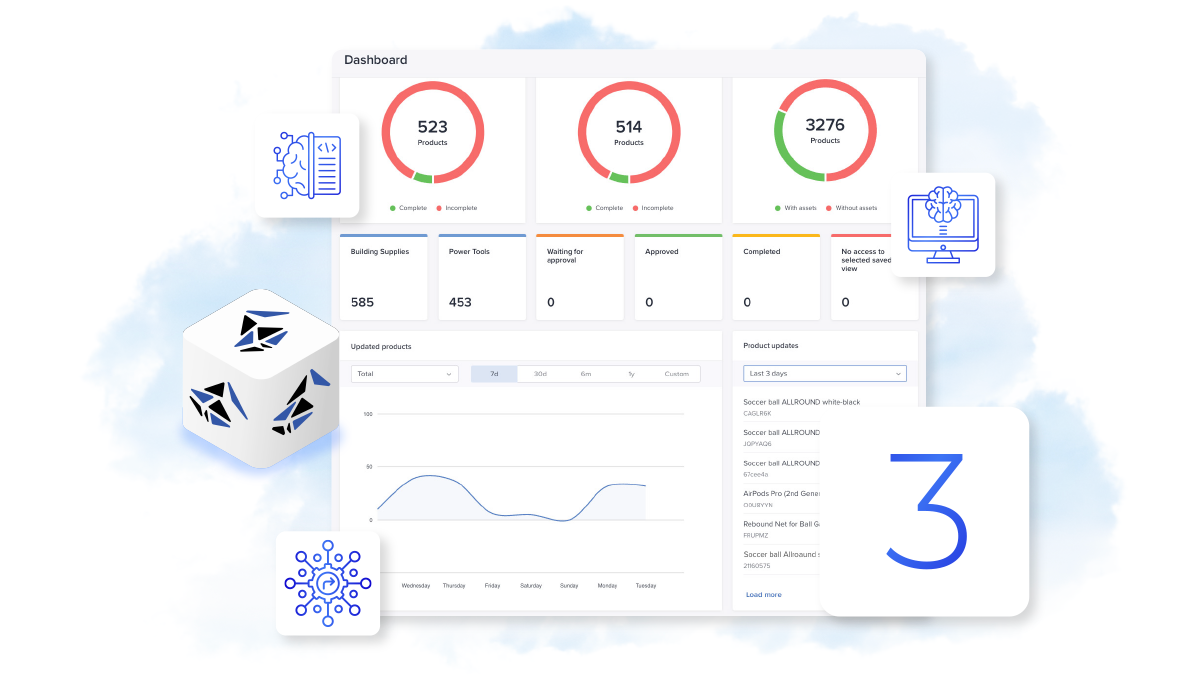
With Bluestone PIM, AI isn’t a separate tool you have to copy and paste between, it’s embedded directly in the platform where your product data already lives. That means your team can create, enrich, and translate product descriptions without leaving the workspace.
AI Enrich is like an extra copywriter who never gets tired. It can instantly draft or polish descriptions for hundreds of products at once. Just feed it the basics, choose the tone you want, friendly, technical, persuasive, whatever fits your brand, and watch it turn plain specs into clear, engaging text that makes people want to buy.
AI Linguist takes care of everything that happens after that first draft. It translates your descriptions into any language, checks grammar, smooths the tone, and keeps your brand voice consistent. So whether you’re launching in Germany or adding French content for a marketplace, it’s all done in minutes instead of days. Zeeman used this to cut localisation turnaround from six weeks to one week.
#5 Make It Easy to Read
Make it easier for the shopper to scan the product description by providing maximum readability in the text. Avoid walls of text, instead, add more space between paragraphs and subheaders.
Using bold and bullet points is a great way to highlight the most important features and benefits of your product. This makes it easier for customers to quickly understand what your product does and how it can benefit them.
Enliven the text with high-quality product images and graphics.
#6 Add a Pinch of Storytelling
Storytelling is a powerful tool that can create an emotional connection between your customer and your product. By sharing how your product has helped others in the past or by providing a scenario of how it can solve a problem, you can make your product more relatable and appealing.
For instance, if you're selling a fitness tracker, you can tell a story about how it helped someone improve their health and achieve their fitness goals. You can describe how the tracker motivated them to exercise regularly, keep track of their progress, and set achievable goals.
#7 Optimise for Both SEO and GEO
You wrote a fantastic product description; it would be a shame if only a small percentage of buyers, human or AI, ever saw it. As a last step, make sure your description is findable by search engines and by the AI answer engines and shopping agents increasingly standing between a shopper and your product page.
For SEO, research the keywords your target audience actually searches for, then work them naturally into the description. This helps your product's visibility in search engine results and attracts more potential customers.
GEO asks something slightly different of the same text. An AI answer engine or shopping agent isn't scanning for keyword density: it's pulling out discrete facts, material, size, compatibility, use case, and deciding whether your description answers a specific question well enough to cite or recommend. That means:
- State what the product is and who it's for in the first sentence, in plain terms, not buried under three sentences of brand voice first.
- Use the specific attribute values a buyer or an agent would search for ("waterproof running shoes for wide feet"), not vaguer marketing phrasing ("engineered for peak performance") that says less than it sounds like it does.
- Keep facts and structured attributes complete and consistent with the rest of your product data, since a description that contradicts your own spec table undermines both.
- Avoid making a shopper, or an agent, dig through persuasive copy to find the one fact they actually need.
A description written this way still converts a human reader. It just stops losing the AI-mediated share of that traffic in the process.
4 Inspiring Product Description Examples
One of the best ways to help you improve your product descriptions is to study examples of great ones. Here are a few exceptional examples to inspire your copywriting.
Apple, AirPods (3rd Generation)
Example of product description:
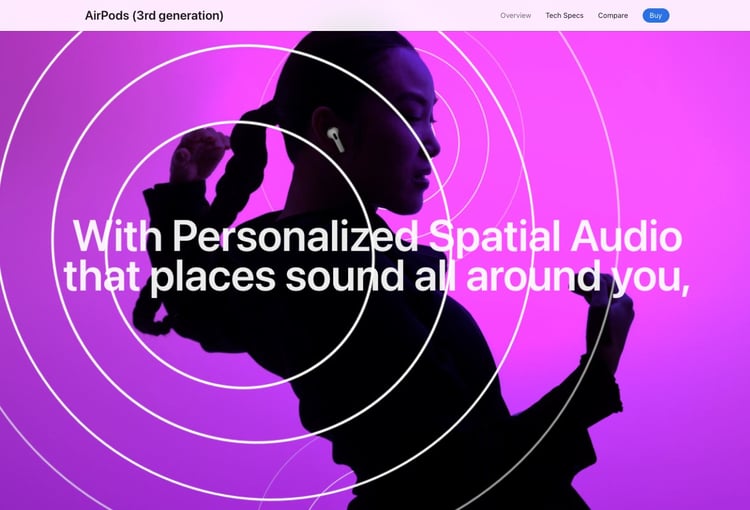
“With Personalized Spatial Audio that places sound all around you, Adaptive EQ that tunes music to your ears, and longer battery life that charges up in a snap. It shrugs off sweat and sprinkles, and delivers an experience that’s simply magical.”
Apple has mastered telling engaging stories and offering not only the product but the experience that the product brings. Just take a look at the brand’s product pages.
Source: Apple
They provide immersive product storytelling with stunning visuals, along with attractive and informative descriptions at the same time.
Why it works:
Succinct
Focuses on benefits and experience
Uses powerful, sensory words
Glossier., Milky Jelly Cleanser
Example of product description:
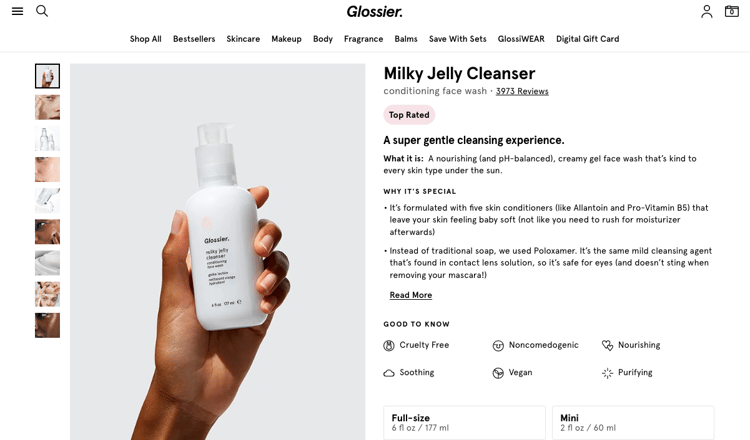
"A gentle yet effective creamy gel face wash for all skin types. Milky Jelly Cleanser is a pH-balanced daily cleanser that’s packed with five skin conditioners, including ultra-soothing rosewater. It removes all traces of makeup, grime, and dirt, leaving your skin soft, smooth, and perfectly clean."
Cosmetic descriptions are almost a separate category. The website of the American manufacturer Glossier. is a case of how to do it right. Here is an example of one of their bestselling products.
Source: Glossier.
Customer reviews are a type of social proof, a precious one on product pages that can have a significant impact on purchasing decisions.
Why it works:
Clear, scannable
Lists benefits and unique ingredients
Customer reviews add trust
KitchenAid, Pro Line® Series 7 Quart Bowl-Lift Stand Mixer
Example of product description:
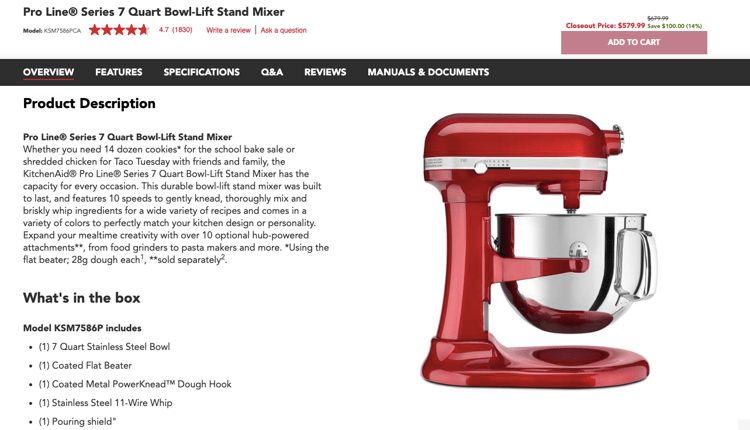
"Whether you need 14 dozen cookies* for the school bake sale or shredded chicken for Taco Tuesday with friends and family, the KitchenAid® Pro Line® Series 7 Quart Bowl-Lift Stand Mixer has the capacity for every occasion.
This durable bowl-lift stand mixer was built to last, and features 10 speeds to gently knead, thoroughly mix and briskly whip ingredients for a wide variety of recipes and comes in a variety of colors to perfectly match your kitchen design or personality.
Expand your mealtime creativity with over 10 optional hub-powered attachments**, from food grinders to pasta makers and more. *Using the flat beater; 28g dough each1, **sold separately2”
Beautifully designed KitchenAid mixers are the object of desire of many home chefs. The brand is able to neatly include all the advantages and benefits of this product in the description, which is complemented by high-quality photos, including 3D product images.
Source: KitchenAid
Why it works:
Concise, practical
Balances features with lifestyle benefits
Poo~Pourri, Before-You-Go Toilet Spray
Example of product description:
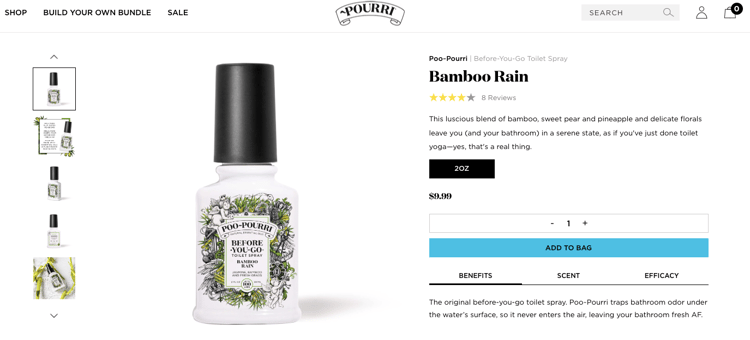
“Spritz the bowl before you go and no one else will ever know! Shop the famous before you go toilet sprays that have earned over 100,000 reviews.
Poo~Pourri is always formulated with essential oils and plant-based ingredients that eliminate bathroom odor before it begins, so you can leave the porcelain throne smelling better than you found it. P.S. Did you know you could filter by scent type? That’s stinkin’ cool!"
Pourri proves that such ordinary products as toilet spray can be distinguished not only by their smell but also by their charming packaging and funny product descriptions.
Source: Poo~Pourri
Why it works:
Humour and personality
Social proof with review count
Tools That Help You Write Product Descriptions Better and Faster
Writing a simple product description can be tough, and writing a great product description that can capture customers' attention is an even bigger challenge. Thankfully, there are several tools that can help get the job done.
Here are a few tools that you can use right away:
- AI Product Description Generator: speed up writing and scale descriptions for large catalogues (Bluestone PIM includes native AI features for this)
- Hemingway Editor: improve clarity and readability
- Grammarly: grammar and tone checker
- Yoast SEO: SEO optimisation for e-commerce
- Thesaurus.com: find strong, unique words
- Notion AI: draft templates, get instant copy suggestions
What Is Product Description Automation, and How Does It Work?
Product description automation is the process of generating, translating and publishing product descriptions through predefined rules and AI, instead of writing and updating each one by hand. Managing thousands of product descriptions across multiple channels is slow and error-prone if done manually, and it only gets harder as your catalogue grows.
Most PIM systems only check for changes on a schedule, so when a description changes after a product has already gone live, someone has to notice and update every channel by hand. Bluestone PIM works differently: it reacts the moment a product description changes and syncs the update to the front end automatically, so a fix made once doesn't stay unpublished on half your channels.
That only works if the underlying data is structured and complete first. Automation built on messy data doesn't fix the mess, it moves bad data faster and spreads it across more channels. Once the data foundation is in place, AI generates and improves descriptions within the rules your team sets, and a person still reviews and approves before anything goes live.
5 Steps to Automate Product Description Creation With Bluestone PIM
- Connect your product catalogue to Bluestone PIM.
- Set your structure and tone once, along with any compliance rules you need followed.
- Let agents draft and enrich descriptions straight from your product attributes, for one SKU or fifty thousand.
- Let agents translate and localise that output for every market you sell in, without a separate project for each language.
- A person reviews, approves, and publishes, all in one place. Agents do the repetitive work. Your team decides what goes live.
Tip: Automating this workflow saves hours per week, boosts consistency, and unlocks multi-language growth instantly.
Want the mechanics behind this kind of workflow in more detail? Automation in Product Information Management explains how automation works in product information management, which catalogue workflows can be automated today, and how an event-based architecture creates the foundation for agentic PIM.

Download free e-book
Automation in Product Information Management
This e-book explains how automation works in product information management, which catalogue workflows can be automated today, and how an event-based architecture creates the foundation for the agentic PIM.
Start Creating Product Descriptions That Sell
Crafting high-performing product descriptions is no longer a guessing game. With the right blend of proven copywriting techniques, automation, and AI-powered tools from Bluestone PIM, you can consistently deliver content that converts, scales, and supports your brand worldwide.
Retail & ecommerce
 Best Practices
 Best Practices
19 Oct 2026