


 Best Practices
Bluestone PIM is a Pimberly alternative built for enterprise retailers who need scalability and AI-powered enrichment included in the core platform, not billed as an add-on.
Choosing a Product Information Management (PIM) platform shapes how fast your team can launch products, scale catalogues, and keep product data accurate across every channel. If Pimberly is on your shortlist, or you're already using it and hitting limits, this comparison breaks down where each platform stands, and where Bluestone PIM offers a stronger foundation for enterprise retailers.
Why Are Retailers Looking for Pimberly Alternatives?
Pimberly has built a solid reputation among mid-market retailers. Users praise its ease of use and responsive customer support, according to reviews on G2 and Capterra. For smaller catalogues and straightforward e-commerce setups, it does the job.
The problems tend to surface as retailers grow. Several patterns appear across independent review platforms:
-
Performance at scale: multiple reviewers on Capterra and G2 note that Pimberly slows down when handling large data imports, exports, or bulk updates. For a retailer managing 50,000 SKUs or more, this creates a real bottleneck during peak trading periods like Black Friday or seasonal catalogue refreshes.
-
Extra costs for AI and modules: Pimberly's AI capabilities and certain modules carry additional fees. For teams that need AI-driven enrichment across tens of thousands of products, those costs add up quickly. The total cost of ownership becomes harder to predict.
-
Implementation timelines: while some Pimberly customers report smooth onboarding, others describe setups that stretched far beyond the original estimate. One Capterra reviewer detailed a process that took nearly two years before being abandoned. That experience is not universal, but it flags a risk worth investigating during vendor evaluation.
-
Limited API depth for complex integrations: retailers running composable commerce stacks need deep API coverage. Pimberly offers API access and is a MACH Alliance member, but Bluestone PIM's 700+ API endpoints give teams significantly more flexibility for custom integrations across ERP, e-commerce, marketplace and print channels.
Watch the video to see what's the best PIM software in 2026.
How Does Bluestone PIM Compare to Pimberly on Architecture?
Both Bluestone PIM and Pimberly are MACH-certified, cloud-native platforms. The difference shows up in how deep that architecture goes.
Bluestone PIM is built on a microservices-based, API-first architecture with more than 700 API endpoints. Every function in the platform is accessible through the API, so your engineering team can build the exact integrations your tech stack requires, without waiting on the vendor to build a connector. The Bluestone PIM Extension Hub offers ready Packaged Business Capabilities (PBCs), connectors and custom extensions that extend the platform further, making it a genuine best-of-breed component in a composable commerce setup.
Pimberly also describes itself as API-first and headless. It offers a Commerce Connector for platforms like BigCommerce and Shopify, plus standard API and webhook support. For many mid-market retailers, that coverage is sufficient. Where it falls short is the breadth of API endpoints and the flexibility to support deeply customised data flows across complex enterprise stacks.
For a CTO evaluating both platforms, the question is straightforward: does the PIM offer enough API surface area to fit into your existing infrastructure without workarounds? At 700+ endpoints, Bluestone PIM gives engineering teams the architectural headroom enterprise-grade deployments need.

Download free e-book
MACH-Based PIM: The Ultimate Guide
Going deeper into MACH and product data? This e-book explains how MACH-based PIM supports composable commerce in practice.
How Does Bluestone PIM Compare to Pimberly on Scalability for Large Catalogues?
Scalability is where the two platforms diverge most clearly. Bluestone PIM is designed for retailers managing catalogues that range from tens of thousands to millions of SKUs. The platform handles growing data volumes without degradation, because its modular architecture lets individual services scale independently. Retailers like Intersport and Saint-Gobain run on Bluestone PIM precisely because it performs under the load their catalogues generate.
Pimberly's marketing states it supports unlimited SKUs, channels and languages. In practice, user reviews tell a more nuanced story: G2 reviewers mention performance slowdowns with large datasets, and Capterra reviewers describe difficulties importing or exporting data in bulk. For a retailer planning to expand into new markets, add sales channels, or scale up SKU counts significantly, these limitations create real operational risk.
Scalability isn't only about how many SKUs a system can store. It's about how the platform performs when multiple teams are enriching, validating and distributing product data at the same time, across multiple channels and languages. Bluestone PIM's architecture is built specifically for that scenario.
Choosing a PIM shouldn't come down to feature lists alone. The PIM Vendor Evaluation Checklist helps you dig into flexibility, scalability, support and future-proofing before you sign anything.

Download free e-book
PIM Vendor Evaluation Checklist
When choosing a PIM system don’t just compare features, but ask the right questions. This checklist will help you dig deeper into what really matters: flexibility, scalability, support, and future-proofing.
How Do AI Capabilities Compare Between Bluestone PIM and Pimberly?
AI-powered product data management is quickly moving from a nice-to-have to a core requirement. Both platforms offer AI features, but the pricing and depth differ.
Bluestone PIM includes a full suite of AI tools that support product data work from enrichment to automation:
AI Enrich improves and generates product content at scale, helping teams manage large catalogues without manual effort.
- Generate descriptions, attributes, and metadata in bulk
- Improve existing product content across the catalogue
- Apply enrichment logic to thousands of SKUs at once
- Reduce manual copywriting and repetitive editing work

Download free e-book
AI Visibility Guide for Retailers
Learn how to structure product data so AI can find, cite, and recommend your products. Covers GEO, agentic commerce, and 30+ data fields.
AI Linguist translates product content for global markets while keeping tone, context, and brand voice consistent.
- Translate product content across multiple languages
- Preserve tone, meaning, and product-specific context
- Apply custom instructions for market-specific needs
- Keep localisation consistent across all channels
AI Analyst evaluates product data quality and shows teams what needs to be fixed before publishing.
- Score product data based on completeness and accuracy
- Detect missing attributes and content gaps
- Highlight inconsistencies across the catalogue
- Support pre-publication data quality checks
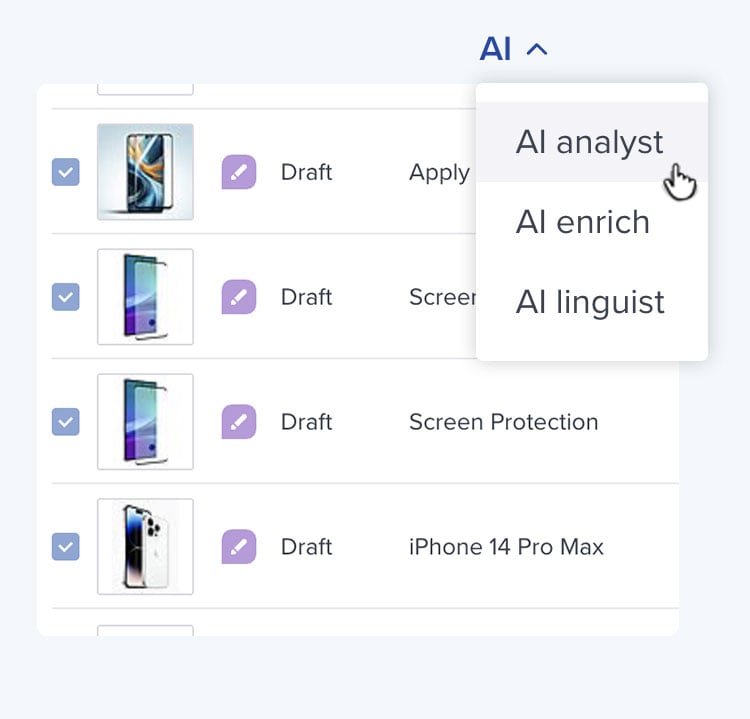
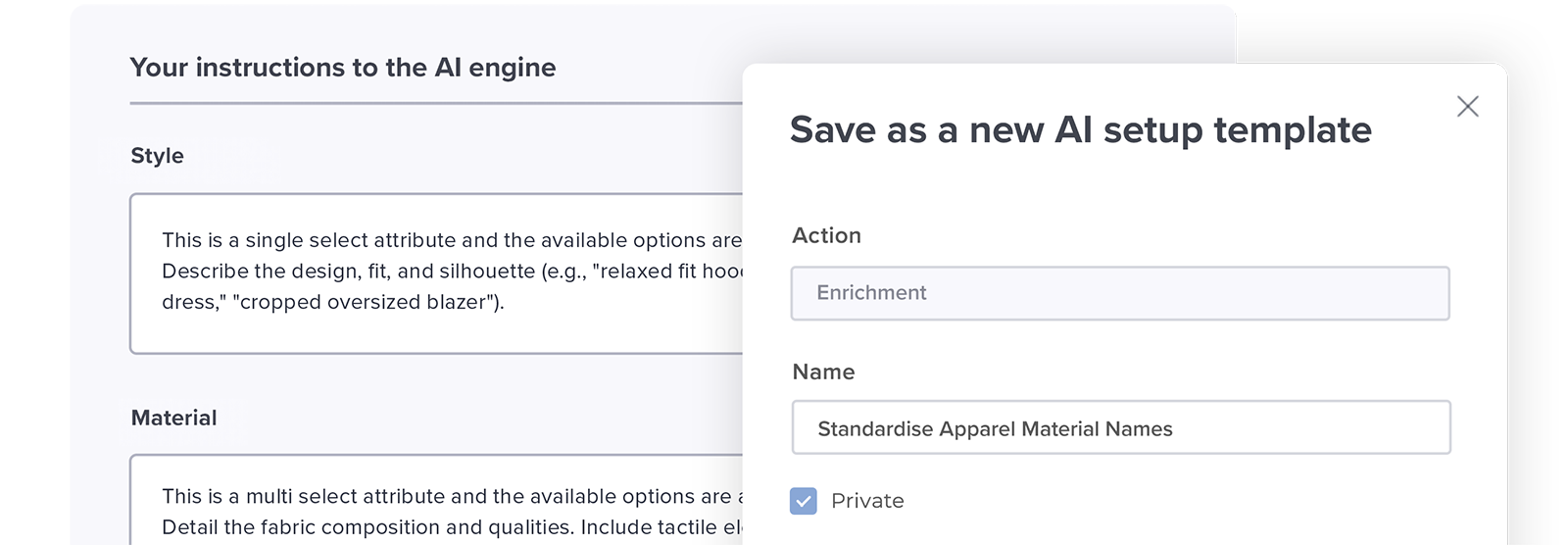
AI Templates standardise how product data is structured and enriched across teams and catalogues.
- Apply consistent enrichment rules across products
- Reuse templates for faster product onboarding
- Keep data aligned across large catalogues
- Reduce repetitive setup and manual work
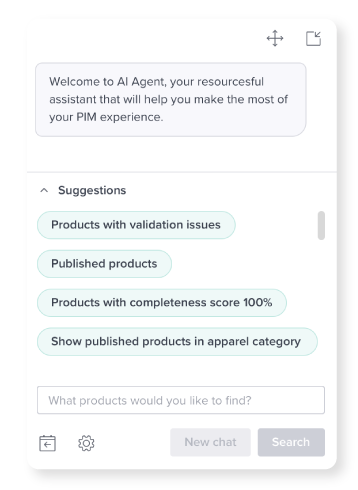
AI Agent enables users to interact with Bluestone PIM through natural language instead of complex navigation.
- Use plain language to access and manage product data
- Convert user requests into precise system queries
- Answer questions about platform functionality in real time
- Connect data and logic using MCP-based orchestration
AI Automation removes manual bottlenecks by automating workflows and connecting systems across the product lifecycle.
- Trigger enrichment, approvals, and updates automatically
- Connect ERPs, marketplaces, and channels via APIs
- Handle repetitive catalogue and data management tasks
- Coordinate data flow across systems from one central hub
AI DAM manages and enhances digital assets as part of the product data workflow, not as a separate system.
- Improve images and generate new visual content
- Extract product data directly from visual assets
- Deliver optimised assets in real time per channel
- Automatically tag and organise media files
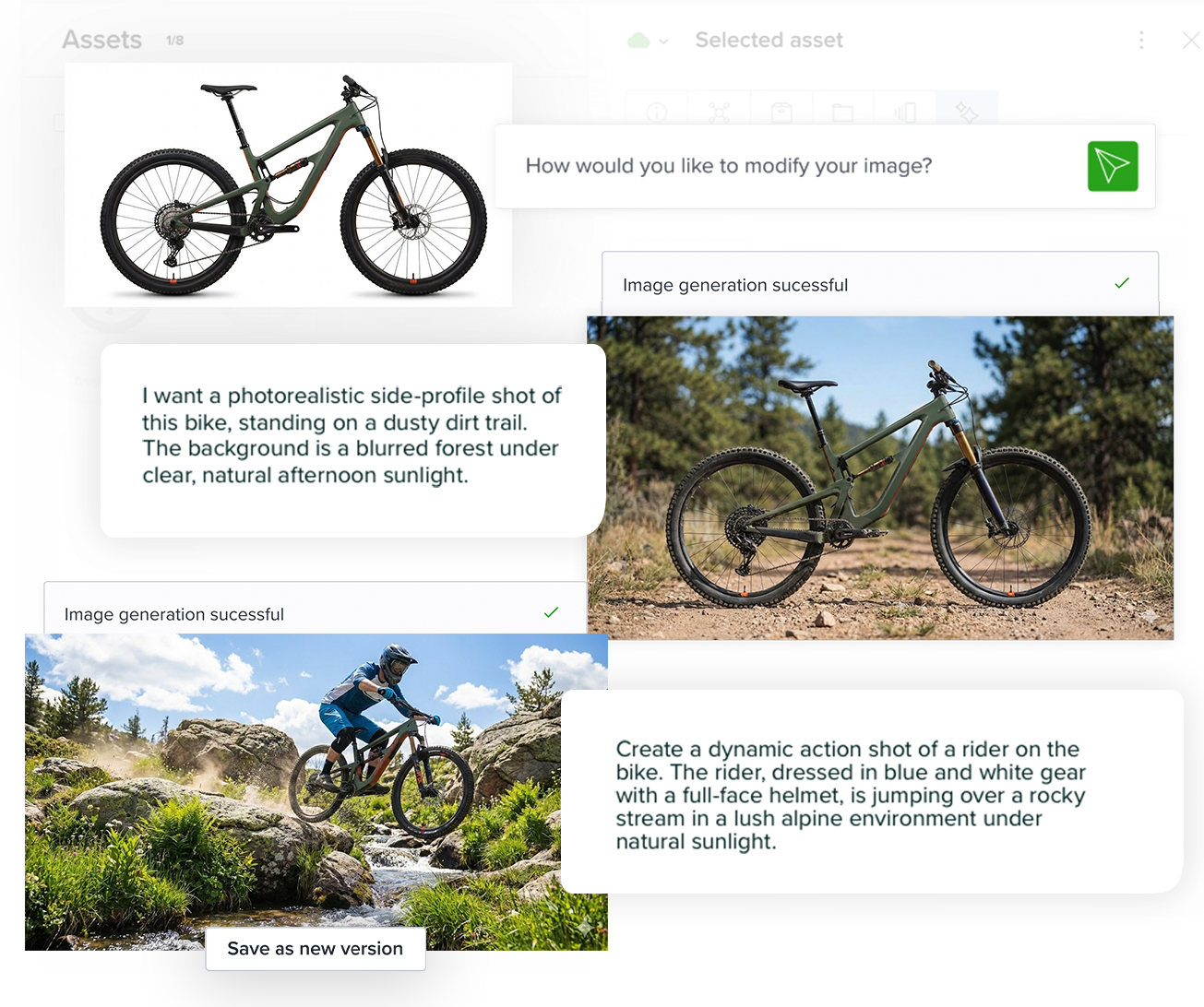
AI-powered capabilities, including automation and smart data enrichment are available whenever you need them at no extra cost or limitations, giving you the full control to enhance product data and streamline operations. Bluestone PIM also lets retailers choose their own AI model providers, giving full control over cost efficiency and task complexity.
Pimberly has introduced AI features, including text generation capabilities. However, AI and certain automation modules come at an additional cost. For retailers planning to use AI at scale across a large catalogue, the pricing structure matters. An AI feature that costs extra per module can change the ROI calculation significantly when applied to 100,000 products across 12 languages.
What Does Bluestone PIM's AI Automation Actually Look Like?
"Automation" is easy to claim and harder to show. Bluestone PIM's e-book, Automation in Product Information Management, documents the specific rules running underneath the AI Automation capability above:
- Automatic category assignment. A team defines a product group by attribute, brand or supplier. When a new product matches that condition, Bluestone PIM assigns the category on creation, with no manual sorting required.
- Team handoff without a spreadsheet. A team sets completeness requirements for each production stage. When a product hits the threshold, it moves automatically to the next team.
- Channel sync on data change. When a live product's attributes or labels change, Bluestone PIM detects it and syncs every connected channel automatically.
Because these rules run through the same AI Automation capability included in every Bluestone PIM plan, retailers don't pay per rule or per workflow to use them, unlike modules Pimberly prices separately.

Download free e-book
Automation in Product Information Management
This e-book explains how automation works in product information management, which catalogue workflows can be automated today, and how an event-based architecture creates the foundation for the agentic PIM.
How Fast Can Each Platform Be Implemented?
Implementation speed is directly tied to how quickly your team sees value from the investment.
Bluestone PIM uses a partner-led implementation model, drawing on a global network of certified solution partners. The implementation team works closely with the retailer's own team to reduce internal workload and avoid delays. A typical Bluestone PIM implementation takes three to six months from kick-off to go-live, depending on catalogue size and the number of systems you connect.
Pimberly's implementation experience varies. Positive reviews describe efficient onboarding with helpful support teams. Less favourable reviews describe setups that dragged on due to customisation complexity or integration challenges. The variance suggests that implementation success depends heavily on the specific technical requirements and the integration partner involved.
Retailers evaluating both platforms should ask for reference customers with similar catalogue sizes, channel requirements, and integration stacks. A successful implementation at a company with 500 products does not guarantee the same result at 500,000.
How Do Bluestone PIM and Pimberly Compare on AI Agent Readiness?
AI agent readiness is becoming a real evaluation criterion for enterprise retailers, not just architecture on paper. It depends on one specific thing: full UI/API parity, meaning every function a person can trigger through the interface is also exposed as a granular API call an agent can use directly.
Bluestone PIM was built API-first from the ground up, which is what makes its MCP integration possible: AI agents such as Claude, ChatGPT or Cursor can read and act on product data directly, under a team's governance, rather than only reading it. That's a structural property of the platform, not a feature bolted on afterwards.
Bluestone PIM vs Pimberly: Features Comparison
These two platforms share the same goal, better product data management, but they approach it differently.
| Area | Pimberly | Bluestone PIM |
|---|---|---|
| Architecture | MACH-certified, API-first, cloud-native | MACH-certified, microservices-based, 700+ API endpoints |
| AI Capabilities | Available at additional cost | Included: AI Enrich, AI Analyst, AI Templates + AI Linguist, AI Agent, AI Automation, AI DAM |
| AI Agent Readiness | Not documented as full UI/API parity | Full UI/API parity; MCP integration for AI agents |
| Scalability | Unlimited SKUs stated; performance concerns reported at scale | Built for millions of SKUs with independent service scaling |
| Data Modelling | Flexible schemas; some users report limitations on complex product relationships | Advanced data modelling with full API flexibility and custom PBCs |
| DAM (Digital Asset Management) | Integrated DAM; some users report limited bulk download capabilities | Integrated DAM with CDN and AI capabilities |
| Implementation | Varies; some report delays with complex setups | Partner-led, structured for speed |
| Enterprise Readiness | Strong for mid-market; enterprise fit depends on complexity | Built for enterprise with modular flexibility and deep integrations |
| Extension Ecosystem | Connectors for major ecommerce platforms | Extension Hub with PBCs, connectors, and accelerators |
Who Is Bluestone PIM Best Suited For?
Bluestone PIM is the stronger fit for enterprise retailers and fast-growing mid-market retailers who need a PIM that scales with their business. Specifically:
-
Retailers managing 50,000+ SKUs across multiple channels and markets
-
Teams that need AI-powered enrichment and translation included in the core platform, not as paid extras
-
CTOs building composable commerce stacks who require deep API coverage and architectural flexibility
-
Organisations that value transparent, predictable pricing with no surprise costs at scale
-
Retailers preparing for EU Digital Product Passport compliance who need structured data collection and distribution capabilities
Book a demo with Bluestone PIM to see how the platform handles your specific catalogue size, channel mix, and integration requirements.
Best Practices
 Best Practices
19 Oct 2026
3 Best Practices For PIM Implementation
 Product Information Management