

 Best Practices
Fashion retailers reduce returns by improving the quality, accuracy, and consistency of their product data. When sizing guidance, materials, fit details, and images are clear and reliable, customers understand what they are buying and return fewer items.
According to the data, the average return rate in online retail can reach around 30%, and in clothing it often exceeds 50%. The main reason is usually simple: the product does not fit as expected or does not match the customer’s expectations of quality, fabric, or appearance. In many cases, the problem begins with incomplete or inconsistent product information on the product page.
For many retailers, reducing returns starts with improving product data management. Product Information Management platforms such as Bluestone PIM help centralise product information and deliver consistent, detailed product content across websites, marketplaces, and mobile channels.
Why Do Fashion Retailers Experience High Return Rates?
Fashion retailers experience high return rates, largely due to unclear or incomplete product information. When shoppers cannot accurately judge size, fit, colour, or fabric from the product page, they order multiple options or return items that do not match expectations.
Online fashion retail lacks the physical fitting room, so detailed product data must replace that experience. When information differs across websites and marketplaces, confusion increases and return rates rise.
Common data-related causes of returns include:
- Inconsistent sizing information across products
- Missing measurements or fit guidance
- Low-quality or limited product imagery
- Generic product descriptions
- Unclear material composition
Bluestone PIM addresses these issues by centralising product information from multiple systems and organising it into a structured catalogue. Teams manage product data in one place and publish consistent product details across all channels.

Download free e-book
5 Signs You Need a PIM System
Stop guessing. See the red flags teams miss until product data starts slowing growth. A quick, practical guide for e-commerce, marketing, and product teams.
How Does Product Data Quality Influence Fashion Return Rates?
Product data quality affects fashion return rates by helping customers make accurate purchase decisions before they buy. The clearer the product information, the less uncertainty customers face when choosing size, fit, or material.
High-quality product data answers the questions customers naturally ask when buying clothing online.
Accurate Sizing and Fit Information
Sizing and fit information is one of the main reasons for fashion returns. Standard labels such as S, M, or L are rarely enough.
Fashion retailers should provide:
- Body measurements for each size
- Garment measurements
- Fit descriptions such as slim, relaxed, or oversized
- Model height and size worn
Structured sizing attributes make product comparisons easier and reduce incorrect purchases.
Clear Material and Fabric Descriptions
Material composition influences comfort, stretch, durability, and care requirements. Customers often return products when the fabric behaves differently than expected.
Effective product pages include:
- Fabric composition percentages
- Stretch characteristics
- Fabric weight or texture
- Washing and care instructions
When this information is structured in a PIM system, it remains consistent across the entire catalogue.
High-Quality Images and Media Assets
Visual content strongly influences fashion buying decisions. Shoppers rely on imagery to evaluate style, colour, and texture.
Retailers should provide:
- Multiple product angles
- Close-ups of materials
- Lifestyle images
- Videos or 360-degree views
Bluestone PIM includes centralised digital asset management so images, videos, and documents can be organised and linked directly to product records. This keeps visual content consistent across sales channels.

Download free e-book
AI Visibility Guide for Retailers
Learn how to structure product data so AI can find, cite, and recommend your products. Covers GEO, agentic commerce, and 30+ data fields.
How Does Product Information Management Reduce Fashion Returns?
Product Information Management reduces fashion returns by creating a structured product data foundation that ensures consistent product information across every sales channel.
A PIM system collects product data from different sources, enriches it with detailed attributes, and distributes that information across e-commerce platforms, marketplaces, and marketing channels.
| Strategy | Implementation in Bluestone PIM | Impact on Returns (Per Internal Data) |
|---|---|---|
| Fit & Sizing Accuracy | Mandatory attributes for measurements and fit types (true-to-size, oversized). | Addresses the ~50% of returns attributed to fit discrepancies at one of Bluestone PIM clients. |
| Complete Product Picture | Completeness checks prevent publishing products missing key materials or images. | Reduces returns by closing the "expectation gap" regarding materials and features. |
| Localisation Integrity | AI-assisted translations for technical attributes (neckline, sleeve shape). | Prevents returns caused by misleading or confusing product descriptions in local markets. |
Bluestone PIM supports several key processes that directly influence return rates by improving how product data is structured, enriched, and published across channels. These include:
Centralising Product Data Across Systems
Centralising product data prevents conflicting information across sales channels. Instead of managing product information separately in ERP systems, spreadsheets, and e-commerce platforms, retailers manage it in one structured catalogue.
For example, a jacket listed on a website and a marketplace might show different fabric details if managed separately. With Bluestone PIM, product attributes are defined once and reused across all channels. Customers receive the same sizing guidance and material details regardless of where they shop.
Creating Detailed and Structured Product Attributes
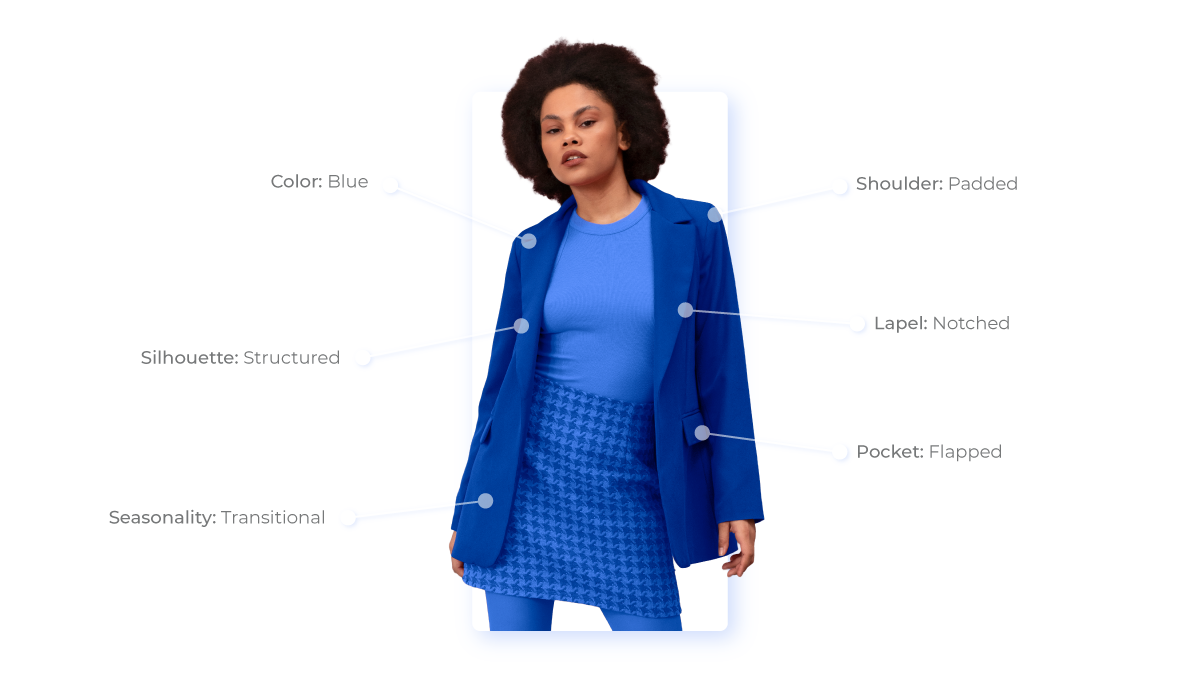
Structured product attributes allow fashion retailers to describe garments in a consistent and searchable way. This helps customers understand what they are buying before placing an order.
For example, instead of a short description like:
“Comfortable cotton shirt for everyday wear”
A well-structured product page might include:
- Fabric composition: 100% organic cotton
- Fit type: regular fit
- Fabric stretch: non-stretch
- Collar type: button-down
- Model height: 185 cm wearing size M
- Care instructions: machine wash at 30°C
Bluestone PIM allows retailers to define these attributes once and apply them consistently across all similar products. This ensures every shirt or jacket includes the same information structure, making it easier for customers to compare products and choose the correct option.
Improving Size Guidance and Fit Information
Sizing is one of the main drivers of fashion returns. Customers often struggle to interpret size labels across brands.
Product Information Management helps retailers provide consistent and detailed size information.
Examples include:
- Garment measurements for each size
- Body measurement guides
- Fit descriptions such as slim, regular, or oversized
- Model size references
When these measurements are structured within Bluestone PIM, they appear automatically on product pages and marketplaces. This removes guesswork and helps customers select the correct size.
Managing Product Variants Clearly
Fashion products often include many variants, such as colour, size, pattern, or material. Poorly structured variants can confuse customers and lead to incorrect purchases.
Bluestone PIM allows retailers to group product variants into clear product families. Shared attributes such as material or fit apply to the entire product group, while variant attributes such as size and colour remain specific to each option.
For example, a sneaker model might include:
- Five colour variants
- Eight size variants
- Two material variations
Bluestone PIM manages these variants within a structured product hierarchy. Customers see the full product range clearly, reducing mistakes when selecting variants.

Maintaining Consistent Visual Content
Images strongly influence fashion purchase decisions. Poor image quality or inconsistent visual content can lead to unrealistic expectations.
A well-managed product catalogue typically includes:
- Studio images
- Lifestyle images
- Close-up material shots
- Videos showing garment movement
Bluestone PIM stores and organises these assets in a centralised digital asset library. Teams link images and videos directly to product records, ensuring the same visual content appears across websites, marketplaces, and marketing channels.

Monitoring Product Data Completeness
Incomplete product pages are a common cause of returns. Missing information creates uncertainty and encourages customers to order multiple options.
Bluestone PIM includes product completeness monitoring, which tracks whether all required attributes are present before a product is published.
For example, a product may require:
- At least three images
- Full-size measurements
- Fabric composition
- Care instructions
If any field is missing, the system flags the product as incomplete. Teams can resolve these gaps before the product becomes visible to customers.
Supporting Consistent Product Information Across Channels
Fashion retailers rarely sell through a single channel. Most brands distribute products across:
- Their own e-commerce platform such as Shopify or commercetools
- Marketplaces
- Social commerce platforms
- Mobile apps
- Printed catalogues
Each channel may require different formats or attribute sets. Without a centralised system, product information quickly becomes inconsistent.
Bluestone PIM allows retailers to adapt product data for each channel while maintaining one central product record. This ensures customers receive consistent product details everywhere they shop.

Download free e-book
SEO Checklist for Product Managers
A practical checklist to help you optimise product pages at scale. Cover SEO, AEO, and GEO essentials, keep product data accurate, and improve visibility without manual work.
How Do Leading Fashion Retailers Use Product Data to Reduce Returns?
Leading fashion retailers reduce returns by standardising product attributes, verifying product content quality, and maintaining consistent product data across markets and channels. Large retailers rely on Product Information Management platforms such as Bluestone PIM to manage product data at global scale.
Two examples illustrate how this works in practice.
A Global Leading E-commerce Fashion Retailer: Precision at Global Scale
A global leading e-commerce fashion retailer manages around 45,000 variant groups per year across more than 110 online markets. At this scale, size and fit discrepancies account for roughly half of product returns.
The retailer uses Bluestone PIM to manage detailed product attributes such as:
- Precise garment measurements
- Fabric compositions
- Care instructions
- Design features such as neckline or sleeve shape
The retailer also experiments with AI-driven quality checks inside the PIM. These checks help ensure that product descriptions match images, for example verifying whether a zipper is gold or silver.
The platform also supports localisation across nearly 100 languages, ensuring product descriptions remain accurate for each market.
Zeeman: Faster Product Data Workflows and Fewer Errors
Zeeman, a European fashion retailer with more than 1,300 stores, modernised its product data infrastructure using Bluestone PIM.
Before adopting PIM, localised product information could take six weeks to appear online.
With Bluestone PIM and AI-powered localisation workflows, this process now takes around one week.
Operational data from PLM and ERP systems flows into Bluestone PIM, where teams enrich it with:
- Detailed product descriptions
- Fit guidance
- Product features
- Marketing content
Zeeman also integrates Bluestone PIM with digital asset management to ensure correct imagery is linked to each SKU.
This reduces one of the most common return reasons: “the item looked different online.”

Download case study
How Zeeman Cut Product Localisation from 6 Weeks to 1
Zeeman aimed to modernise their e-commerce stack and reduce dependency on legacy systems. Using Bluestone PIM’s MACH-based platform they transformed product data operations and optimised their customer buying journey foundations.
Download Case Study hereHow Can Fashion Retailers Scale Product Data Quality Across Large Catalogues?
Fashion catalogues grow quickly. Seasonal collections and product variants can easily create tens of thousands of SKUs.
Bluestone PIM supports large catalogues through structured product templates, collaborative workflows, and automation.
Standardised Product Templates
Standardised product templates ensure every product within a category follows the same structure.
For example, a retailer can define separate templates for categories such as:
- Dresses
- Shoes
- Outerwear
- Accessories
Each template includes the required attributes for that category.
Collaboration Across Teams
Fashion product data is rarely created by one team. It usually comes from several departments and partners.
Typical contributors include:
- Design teams defining materials and product specifications
- Merchandising teams organising categories and variants
- Marketing teams writing product descriptions
- Suppliers providing technical product data
Bluestone PIM enables collaboration through role-based access and workflow approvals.
Automation and AI-Based Enrichment
Large fashion catalogues make manual product enrichment slow and expensive. Automation helps retailers maintain product data quality without increasing operational workload.
AI features in Bluestone PIM can help:
- Generate product descriptions based on structured product attributes
- Detect missing product attributes or incomplete product records
- Translate product information for international markets
For example, when launching a new clothing collection with hundreds of SKUs, AI can automatically generate consistent product descriptions based on materials, fit, and style attributes stored in the system.
Automation also helps maintain catalogue quality over time. If a product is missing key attributes such as size measurements or care instructions, Bluestone PIM flags the issue before the product is published.
How Fashion Retailers Can Turn Product Data Into a Return Reduction Strategy
When sizing, materials, and product imagery are clear and consistent, customers make better purchase decisions. This improves conversion rates, reduces operational costs, and strengthens customer trust.
Bluestone PIM helps fashion retailers centralise product data, enrich product attributes, and deliver consistent product information across all channels. The result is a stronger product catalogue, better shopping experiences, and fewer costly returns.
If you want to see how structured product data can reduce returns and improve your product catalogue, talk with Bluestone PIM experts and book a personalised demo.
Best Practices
 Best Practices
19 Oct 2026
3 Best Practices For PIM Implementation
 Best Practices