

 Best Practices
Due to the wide range of marketplaces and products in the digital world today, it can be challenging to make your product page discoverable on Google’s results pages.
A product page is the main selling point for your e-commerce sites, representing your products in all their glory to visitors who could potentially become customers.
For this reason, you need high-performing, informative, and optimised product pages to boost customer confidence and maximise your conversion rate.
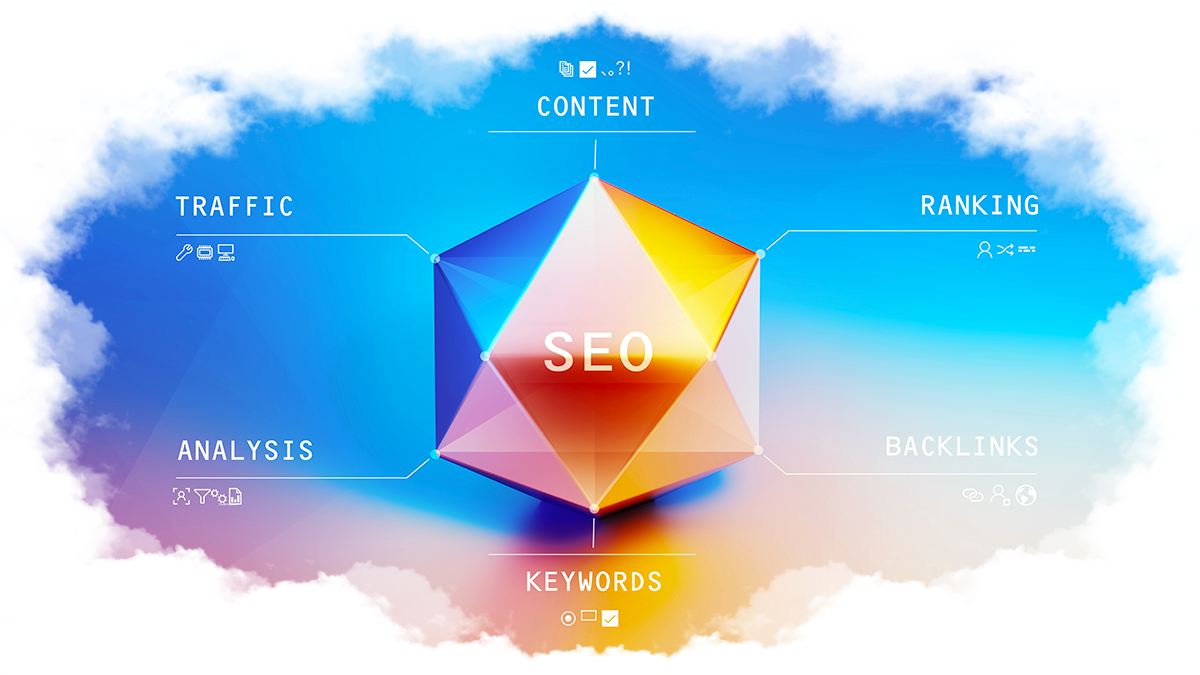
SEO for e-commerce product pages determines their effectiveness at attracting and engaging customers, and allows your products to appear higher on SERPs. On top of that, it’s an easy way for you to increase traffic to your site and improve site performance.
In this product page SEO guide, we will teach you how to create great product pages that generate higher conversion rates, significantly increase your sales, and improve your overall search engine rankings.
What Does SEO Bring to E-commerce Product Pages?
SEO brings numerous benefits to e-commerce product pages, just as it does to websites in general. If you want to get found, you need to have your products near the top of the search results.
One of the most important factors which influences your rankings is how relevant your website appears to search engines when users enter key phrases.
Having a well-optimised product page with the right information at the e-commerce store where you sell the product can help you to appear relevant.
The e-commerce product page SEO involves shaping your on-site and off-site activities to build good relations with search engines, giving you an advantage over your competitors.
For this reason, it is necessary to optimise your e-commerce product pages appropriately so that they rank highly in Google and give you lots of sales.
In 2026, SEO covers even more ground: Google's AI Overviews, ChatGPT Shopping, and Perplexity all surface product recommendations directly in their responses. A product page that ranks in traditional search but lacks the structured signals AI systems need will miss a growing share of buyer intent.
The goal is a product page that works across both: ranked on Google, cited by AI.
SEO gets your products into Google. AI visibility gets them into ChatGPT and Gemini. See the AI Visibility Guide:
Download free e-book
AI Visibility Guide for Retailers
Learn how to structure product data so AI can find, cite, and recommend your products. Covers GEO, agentic commerce, and 30+ data fields.
10 Best Practices for E-commerce Product Pages
1. How Do You Build a Keyword Strategy for Product Pages?
Start with three to five product-focused keywords per page, with one primary keyword to anchor the page.
Transactional intent dominates product pages. The people searching are close to a buying decision: they're comparing options, looking for specific attributes, or searching a product name directly. Keywords should reflect that intent, not the broader informational queries that belong on blog posts or category pages.
Long-tail keywords are worth prioritising. Lower competition means faster ranking, and longer search phrases often signal higher purchase intent. A search for "waterproof hiking boots men size 10 UK" is a much warmer signal than "hiking boots."
People Also Ask and AI-generated answer boxes are now reliable keyword sources. The questions that appear there reflect how real buyers phrase their queries in 2026, including the conversational phrasing that voice and AI search reward.
One practical step: search your target keyword in incognito mode and read the first page of results. If Google is returning product pages, your page should be a product page. If it's returning guides or comparisons, reconsider the keyword or the content format.
Watch the video and see how to stay visible in AI search.
2. What Does a Fully Optimised Product Page Look Like?
A product page ranks when it does two things well: it satisfies the searcher's intent and it gives search engines enough clear signal to understand the page's subject.
In practice, that means:
-
Title and H1: Include the primary keyword. Write for the buyer first, the algorithm second. "Men's Waterproof Hiking Boots | Brand Name" outperforms "Product 4782B" every time.
-
Meta description: This is a click driver, not a ranking factor. Write it as a short sales pitch: what the product is, who it's for, and why the buyer should click.
-
Product description: Write content that addresses the questions a buyer has before committing. What is it made of? Who is it for? What problem does it solve? Attribute-rich descriptions also feed the structured data and AI citation signals covered further down.
- URL structure: Keep it clean, descriptive, and keyword-relevant.
Bluestone PIM's AI enrichment capabilities let e-commerce teams generate multiple description variants per SKU and select the version that best matches their channel's requirements. For catalogues with thousands of SKUs, that saves significant manual time.
Discover how to enrich product data with AI.
3. Keep Your Product Page Content Fresh
Your product pages need to walk the fine line between attracting visitors, earning your visitors’ trust, and also offering them exactly what they’re searching for.
Product pages are your chance to shine, whether you’re selling products for your manufacturer or yourself. You should strive to make your product pages compelling and exciting so that customers feel compelled to read them and interact with forms, offers, or special deals you choose to include.
Download free e-book
SEO Checklist for Product Managers
A practical checklist to help you optimise product pages at scale. Cover SEO, AEO, and GEO essentials, keep product data accurate, and improve visibility without manual work.
Businesses and publishers usually use thin content to attract clicks, but in most cases, an alluring headline doesn't translate into value for visitors. As a retailer, you have to sell your items using an up-to-date product description, following your brand’s voice and offering the information shoppers need to buy your product.
The best way to keep your audience on your site is by writing content that speaks directly to them in a language that they can understand.
Moreover, don’t forget about call-to-action (CTA) buttons, as they are important elements of website design that encourage visitors to take the next step in the buying process.
Duplicate content is a persistent problem for retailers who copy manufacturer descriptions verbatim. If five retailers use the same description, none of them win. Write original copy, even a short paragraph of positioning context, to differentiate.
Thin content also affects AI citation. LLMs prefer pages that answer questions fully over pages that skim the surface. Completeness matters both for ranking and for the AI visibility that matters in 2026.
4. Add FAQ to Your Content (Based on Keyword Research)
High-quality information is what really matters to rank high in SERPs. If a user doesn't see the value in your content, it is doubtful that he will convert.
Most categories and product pages are light on optimised content and do not have FAQs marked up with simple questions and answers. Keep in mind that users who do not find your content useful may bounce from your site and search for another solution.
Search engines are literally the gateway to your potential customers. If a customer can't find you using this gateway, they will never get to your product pages.
To determine the focus of an FAQ section, put yourself in your customer's shoes. Run research with commonly asked questions so that you can identify all the possible questions you should answer, and then organise them into a FAQ section that's easy to find and reference.
This can be done by identifying keyword opportunities, conducting a search query analysis, and reviewing the competition using various SEO tools. These keyword research results will be useful for copywriters who are writing content based on those target keywords.
It’s critical to generate content that is compelling and can answer any questions a user might have. Otherwise, users can move on to a more seasoned company, which will negatively influence your bounce rates.
An effective FAQ section can help you answer any customer questions that may arise from your product pages. In addition, using FAQ-structured data can also potentially help your business with rankings on the SERPs.
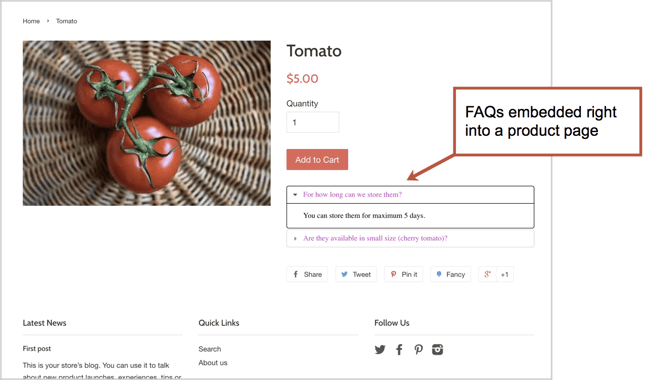
Source: OrbitMedia
This is something customers will readily click on as they no longer have to visit multiple third-party sites to find the answer they are looking for. Moreover, it helps the brand to easily include the answers to questions that people have related to their products.
5. Use Big and Clear Images
Images are a critical part of any e-commerce website because they let customers know exactly what the item looks like.
Potential buyers need to be able to see what they are paying for. This is why it’s recommended to add photos of items from all angles, especially if your items look drastically different depending on their position.
Use zoom-in and zoom-out features to give customers a good idea of how an item looks from different perspectives. Doing this helps potential buyers imagine themselves in possession of the item they are looking at and makes them feel like buying it fits into their lifestyle.
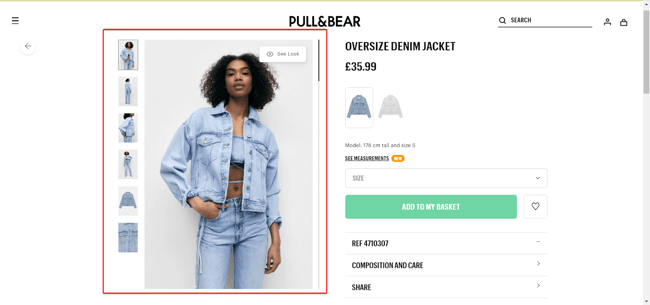
Source: Pull&Bear
When you want to draw people's attention and persuade them to buy a particular item of clothing, accessories, or shoes, pictures are imperative.
A picture is worth 1000 words, you could say.
You may notice how many sales you lose because potential shoppers cannot find enough details about your products. Images can fix this issue and help increase your conversion rate.
Beyond showcasing the product itself, you can also use images to create an aspirational lifestyle around your brand. For instance, you can use photos of people using your products in various settings.
Image SEO optimisation is a process in which an image’s title, caption, and alt text are optimised to increase its ranking.
By optimising your images with metadata, you increase their visibility in image search results. Optimising your images through resizing also helps your website load faster, which results in a better user experience for all visitors.
6. Incorporate Engaging Product Videos
A lot of people are wary of buying something that is difficult to understand from just pictures, especially if it's a pricey purchase, but videos showing how the product is used might just be the thing that convinces them to make the purchase.
Whether you are offering an informative tutorial or engaging in storytelling to tell your customers why they will love your product, videos are far more effective at demonstrating and selling your product than a static image or written description.
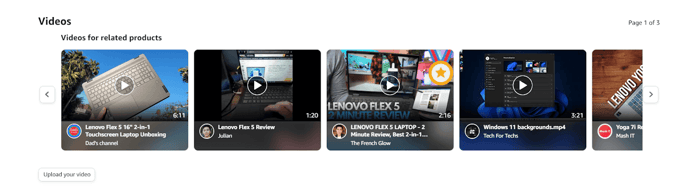
Source: Amazon
Make sure to check that your videos don't impact the user experience by being too heavy or distracting and that they're optimized for search engines.
If a video is too long and the viewer gets lost, bored, or confused, it could hurt your site’s user experience rather than help it.
It’s also important to keep in mind that video files that are too large can badly affect your website’s speed. Your page speed, in turn, can have a major impact on your conversion rate and website performance.
Optimising your videos will not only increase the speed of your website but will also improve your load times.
Furthermore, when it comes to creating videos, it's worth taking the time to add meta tags. Meta tags, also known as metadata, are bits of information that tell Google how to display your videos, including a title, description, tags, and a thumbnail.
These little details can help visitors click on your video when they're searching for something related to what you're talking about in your video. This will also help your videos receive the best possible ranking and improve the overall user experience.
7. Encourage User Engagement
Customer reviews contribute to SEO in two ways: they add fresh, keyword-rich content to the page over time, and they feed the AggregateRating schema that produces star ratings in search results.
Star ratings in SERPs increase click-through rates. A product page with 4.7 stars visible in the search result will consistently outperform an identical result without them.
Beyond reviews, trust signals reduce bounce rates. Buyers who land on a product page and immediately see payment security logos, delivery guarantees, and return policies are less likely to leave without converting. Lower bounce rates send positive engagement signals to search engines.
The practical rule: earn the click with SEO, earn the conversion with trust signals.
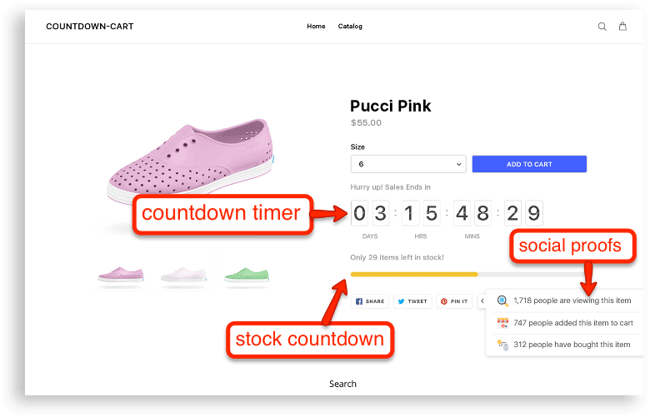
Source: Beeketing
8. Utilise Structured Data
Structured data for product pages is the missing piece of the puzzle that every e-commerce site should have.
It is generated from structured markup languages like RDFa, Microdata, and JSON-LD, turns the content on your product pages into code, and makes it a lot easier for search engines to understand.
Structured data helps describe your content (adding information at a deeper level than the page title or URL) and leverage signals like product identifiers and attributes to communicate your products' features and other important information directly in search results.
This is the kind of data that search engines are looking for because it helps them better understand the content on your web pages.
By implementing structured data, you can obtain special search result features and enhancements like Popular Products or Product Snippets, which give more information about the page content to users directly in search results, or even have your products appear in a special featured section on Google Shopping.
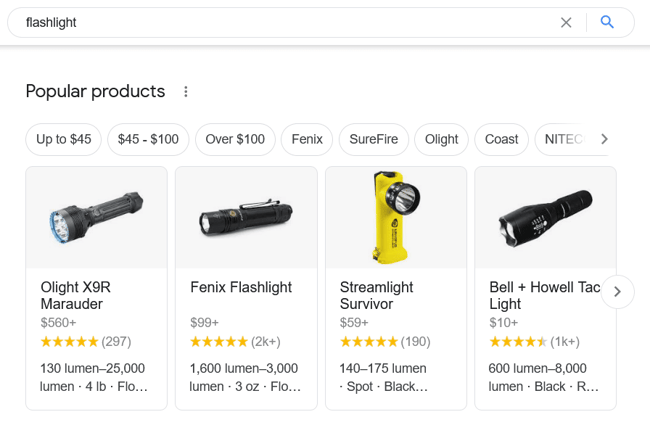
Source: Feedonomics
With the help of structured data, you can boost organic rankings, get more traffic from search engines, and attract more visitors from search engines' enhanced product listings.
9. Add Trust Badges and Customer Reviews
Increasing your conversion rate and sales is tough, but it's even harder if visitors don't trust your brand.
Customers these days are becoming more critical about who they buy from. In an attempt to become more transparent and gain their trust, businesses started to add trust badges to their website and include customer reviews and testimonials.
Once you have established your brand identity and created the right tone, you are ready to think about trust-building visuals.
A trust badge or social proof on your website can help reassure potential customers when they decide to buy your products or services. When you show that other people trust your brand and use your products, it helps potential customers feel more comfortable purchasing from you.
And there is nothing better than word-of-mouth marketing when it comes to growing your business.
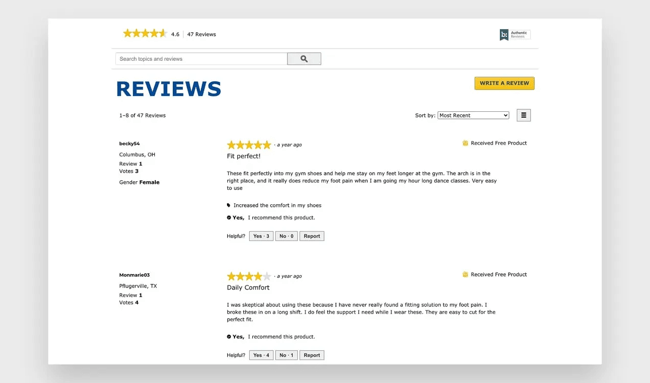
Source: WooCommerce
There are also other ways you can boost your customers' confidence in your business, such as:
-
Be transparent about the terms and conditions of service delivery, especially for expensive goods.
-
Offer secure payment options via secure gateways and SSL certificates.
-
Offer a personal guarantee that your business can fulfil your customer's needs; ask them if their product was delivered on time, and if they were satisfied with the quality of services.
-
Offer a money-back guarantee through trusted platforms like PayPal.
-
Add logos or seals that indicate that your business is certified with standard bodies.
10. Implement Internal Linking and Ensure Easy Navigation Between Pages
While there will always be a variety of opinions about how many links you should have on your pages and where they should be placed, nobody will ever disagree with the statement that you should have internal links.
Internal links are the links that connect different pages within a website. They can be either text or images that are clickable and direct users to other pages within the same website.
Considering that internal links to pages on your own site engage users longer and help improve your product page SEO, you can't go wrong with providing these pointers.
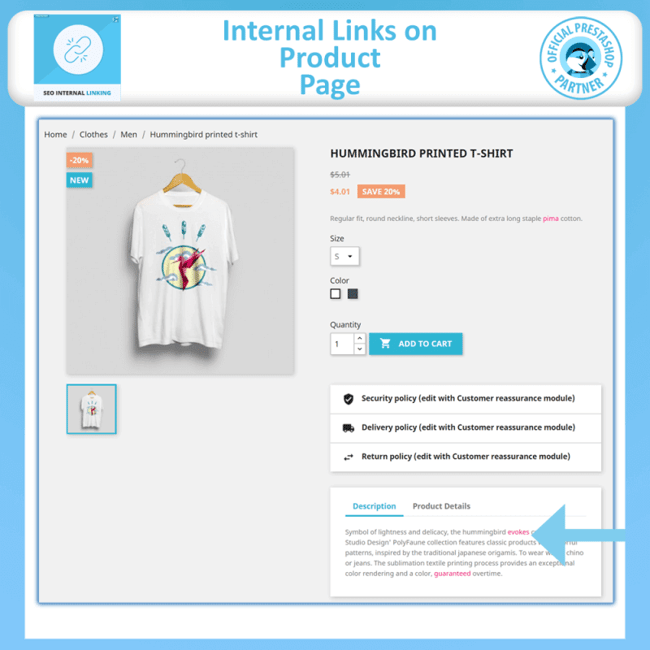
Source: FMEModules
When you include internal links on a product page, you are providing users with additional information that they may find helpful or interesting, giving them more reasons to explore your website further, and allowing them to become more confident in their purchase.
This could include links to related products, product reviews, product comparison pages, or other helpful resources that provide more context about the product they are considering.
Internal linking can help people navigate through your page's architecture while also making it easier for search engines to crawl the website and make sense of the content. This is important because it connects users more easily to the content they are looking for.
The main challenge for the web developer when it comes to internal linking is finding a balance between establishing links and avoiding the creation of unnecessary links. Internal links should be created only to provide value to the reader.
One of the best ways to know that you're creating the right number of internal links is to create a sitemap. That way, there will be no missing links since a web developer will be able to see them all at once.
Note: Internal links can be implemented in a number of ways. One way is through anchor texts or using the <a> HTML anchor tag followed by the internal page address. If you're using a CMS, like WordPress, Drupal, Joomla, or another type of CMS, there are internal page linking plugins that allow you to link internally using categories and tags. This is the recommended way to create internal links because it gives your readers more options than just standard anchor text and URLs.
How Does PIM Help With SEO and GEO Specifically?
roduct page SEO has always been a data problem wearing a content problem's clothes. The pages that rank and get cited share one trait: complete, consistent, well-structured product data published to every channel from a single source. The pages that don't rank share another: fragmented data, missing attributes, and descriptions that differ between your website, your marketplace listings, and your product feeds.
This is where a PIM system becomes a direct SEO and GEO asset, not just an operational one.
SEO: Consistency Across Channels Signals Trustworthiness
Search engines cross-reference product data across the sources they crawl. When your product description on your website, your Google Shopping feed, and your marketplace listing all say slightly different things (because they were updated separately, at different times, by different people), that inconsistency reduces confidence in each individual source.
Bluestone PIM maintains a single product record as the source of truth. When a description is updated, that update propagates to every connected channel. Every page, feed, and listing reflects the same data. That consistency is a ranking signal in its own right.
Built-in completeness rules flag missing fields before publication: no product page goes live with an empty title tag, a missing attribute, or a description below the minimum required length. Completeness is enforced at the data layer, before the content team ever touches a page.
GEO: AI Systems Read Structure, Not Narrative
AI systems including Google's AI Overviews, ChatGPT Shopping, and Perplexity do not read product pages the way a human buyer does. They extract structured signals: schema markup, attribute fields, Q&A blocks, and specification data. A product page with rich structured data is far more likely to be cited than a page with a well-written paragraph and nothing else behind it.
Bluestone PIM's data model is built for this. Attribute fields, specification tables, intent attributes (the fields that answer "is this waterproof?", "what is the weight?", "who is this for?"), and localised content are all managed and validated before distribution. When Bluestone PIM pushes data to a channel, it pushes structured data: the kind AI systems can read, trust, and act on.
The practical outcome: teams using Bluestone PIM to manage product data are building GEO-ready content as part of their normal publishing workflow, not as a separate optimisation effort added afterwards.
The Scale Problem No Spreadsheet Solves
Manual SEO optimisation at small catalogue sizes is achievable. At ten thousand SKUs across five markets and three languages, it is not. Bluestone PIM's AI enrichment capabilities (AI Enrich, AI Linguist) generate descriptions, translate content, and populate attribute fields at scale, so the data completeness that SEO and GEO require is not dependent on the size of the content team.
Book a demo and talk to our team to see how Bluestone PIM manages product data at scale.
Common Questions About Product Page SEO in 2026
How many keywords should a product page target?
Focus on one primary keyword and three to five supporting terms per page. The primary keyword should match the transactional intent of the buyer: what they would type when they are ready to buy, not when they are still researching. Supporting terms include long-tail variants, attribute combinations, and question-based phrases that appear in People Also Ask.
Targeting too many keywords on a single page dilutes focus and makes it harder for search engines to assign a clear topic to the page. Use category pages and supporting content to cover related but distinct keyword clusters.
Does duplicate product content affect rankings?
Yes. When multiple pages on your site use identical product descriptions (or when you copy manufacturer content that competitors also use), Google struggles to determine which page is the original. Rankings can drop across all affected pages. The solution is to write original descriptions for every product, even if it is a short unique paragraph added to a manufacturer base description. Managing this at scale requires a centralised product content system.
What structured data types matter most for product pages?
The four most important schema types for product pages are: Product, Offer, AggregateRating, and FAQPage. The first three unlock rich results in Google Search (price, availability, and star ratings). FAQPage schema increases the chance of your page appearing in AI-generated answers, as it gives AI systems a clearly formatted question-and-answer structure to reference. All four should be validated using Google's Rich Results Test before publishing.
How does AI search affect product page SEO in 2026?
AI assistants including Google's AI Overviews, ChatGPT Shopping, and Perplexity now surface product recommendations directly in their responses. These systems read structured data, FAQ content, and attribute completeness to decide which products to recommend. A product page optimised only for traditional search may rank on Google but still be invisible in AI-driven results. The fix is the same as the fix for traditional SEO: complete, well-structured, attribute-rich product data with proper schema markup.
How often should product pages be updated for SEO?
Review high-traffic product pages at least once per quarter. The signals that matter for freshness are: updated content (new information added), resolved thin content (descriptions expanded), new reviews indexed, and current pricing or availability data in schema. Pages that have not been updated in over 12 months and have thin content are the highest priority for a completeness audit.
Can a PIM system help with product page SEO?
A PIM system centralises product data and ensures consistency across all sales channels. For SEO, this matters because inconsistent product attributes, missing fields, and outdated descriptions across channels create both ranking problems and buyer confusion. Bluestone PIM lets teams set completeness rules, enrich descriptions with AI, and distribute updated content to every channel from a single source, removing the manual work that makes large-catalogue SEO difficult to maintain.
Best Practices
 Best Practices
19 Oct 2026
3 Best Practices For PIM Implementation
 Best Practices