

 Best Practices
Direct marketplace feeds vs Shopify as a hub is a decision about where product data should live and how it should be distributed to marketplaces. Many commerce teams start by using Shopify as the hub, since it is quick to launch and familiar to marketing and product teams. As marketplace operations expand, the limits of that model become visible.
The core issue is product data management. Shopify is strong at commerce execution: checkout, promotions, and orders. Marketplace operations demand something different: flexible product modelling, channel-specific attributes, localisation, and governance.
That gap explains why scaling teams often introduce a Product Information Management system such as Bluestone PIM, which becomes the structured product data layer feeding both Shopify and marketplaces.
What Does Shopify as a Marketplace Hub Mean?
Shopify as a marketplace hub means Shopify stores and distributes product data to marketplaces using connectors or marketplace apps.
In this setup, product data is created and maintained inside Shopify. Marketplace connectors then pull that data and publish listings on external channels such as Amazon, eBay, Zalando, and others.
Shopify becomes the operational centre of the catalogue. Merchandising, pricing, and publishing are managed from one platform.
For brands launching their first marketplaces, this model works well. Teams already manage their online store in Shopify, so adding marketplace integrations feels like a natural extension of existing workflows.
Why Do Many Commerce Teams Start With Shopify as a Marketplace Hub?
Shopify as a marketplace hub is popular since it reduces early technical complexity and allows quick marketplace launches.
Three factors explain why many brands choose this model first.
1. Fast Marketplace Launch
Shopify apps and integrations allow brands to connect marketplaces in days rather than months. Product data already exists in the store, so listing products externally feels straightforward.
2. Familiar Workflows
Product managers and marketing teams already work inside Shopify. Keeping marketplace publishing there avoids introducing another platform.
3. Fewer Systems to Manage
At the beginning, fewer platforms mean simpler operations. There is no need to define data flows between multiple systems or create governance rules for a product data platform.
For businesses selling a limited number of SKUs across one or two marketplaces, this approach remains practical.
Why Does Shopify as a Marketplace Hub Start Breaking at Scale?
Shopify as a marketplace hub becomes difficult when catalogue complexity and marketplace requirements increase.
Several structural limitations begin to appear.
Marketplace Attributes Don't Match Shopify’s Product Model
Marketplaces require specialised attributes such as technical specifications, compliance data, sustainability information, and category-specific fields. Shopify’s product model was designed for storefronts rather than marketplace catalogues.
Teams often rely on workarounds such as metafields or marketplace-specific scripts.
Channel-Specific Content Becomes Harder to Manage
Marketplaces frequently require different product information:
- Channel-specific descriptions
- Local language content
- Category-specific attributes
Managing these variations inside Shopify quickly leads to duplication or inconsistent listings.
Product Governance Becomes Difficult
When many teams edit product data inside Shopify, questions arise:
- Which data version is correct?
- Who owns attribute definitions?
- Why do marketplaces display different information?
These problems are signs that the architecture needs a dedicated product data layer.
What Are Direct Marketplace Feeds?
Direct marketplace feeds are integrations where each marketplace receives product data through its own dedicated feed rather than through Shopify.
Instead of routing product information through Shopify, teams build direct connections to marketplaces using:
- Feed management tools
- Middleware platforms
- Marketplace API endpoints
- Custom integrations
Each marketplace receives a tailored feed with attributes, formatting rules, and validation requirements adapted to that channel.
This architecture gives marketplace specialists more flexibility when optimising listings.
Why Do Some Teams Move to Direct Marketplace Feeds?
Direct marketplace feeds give teams greater control over marketplace listings and channel-specific product data.
This approach offers several advantages.
Marketplace-Specific Optimisation
Each marketplace has different ranking factors and attribute requirements. Direct feeds allow teams to adjust titles, descriptions, and attributes without affecting the core product data structure.
Better Localisation
Marketplace feeds allow regional content variations:
-
Translated descriptions
- Region-specific attributes
-
Local measurement units
Direct feeds allow these variations to be configured per channel.
Channel-Specific Business Logic
Pricing rules, promotions, and stock allocation often vary by marketplace. Direct feed logic allows those rules to be implemented independently. This flexibility improves listing performance and marketplace visibility.
What Problems Do Direct Marketplace Feeds Create?
Direct marketplace feeds improve flexibility but often create fragmented product data governance.
When every marketplace has its own feed logic, product data becomes scattered across systems.
Common issues include:
Fragmented Product Data
Product attributes are duplicated across multiple feed configurations. When core product information changes, teams must update it in several places.
Operational Overhead
Every new marketplace introduces additional:
- Feed mappings
- Validation checks
- Monitoring processes
Managing ten marketplaces means managing ten sets of integration logic.
Harder Long-Term Scalability
Launching the second marketplace is easy. Launching the tenth marketplace often requires rebuilding the feed architecture.
Direct feeds solve flexibility but not data structure.
Where Should Product Data Live in a Marketplace Architecture?
Product data should live in a dedicated product data layer like a PIM software, rather than inside a commerce platform or a collection of marketplace feeds.
This is the architectural shift many scaling commerce teams eventually make.
Each system in the stack gets a clear role:
| System | Responsibility |
|---|---|
| PIM | Product structure, enrichment, governance |
| Shopify | Commerce execution |
| Marketplaces | Sales channels |
A Product Information Management system such as Bluestone PIM becomes the central data foundation.
Bluestone PIM collects product information from multiple sources, structures it, enriches it, and distributes it to channels such as Shopify and marketplaces.
This separation prevents Shopify from becoming overloaded with product data logic.
How Does Bluestone PIM Solve Marketplace Data Complexity?
Bluestone PIM solves marketplace data complexity by providing a structured product data platform that feeds Shopify and marketplaces from a single source of truth.
Instead of managing product attributes across multiple systems, teams manage them once inside the PIM and distribute them automatically to each sales channel.

Download free e-book
Complete Guide to PIM
This free guide walks you through everything you need to know about modern Product Information Management (PIM) and how to use it as a foundation for growth.
1. Centralised Product Data Foundation
Bluestone PIM aggregates product data from multiple systems such as ERP, supplier files, spreadsheets, and asset libraries. The platform organises this information into structured product models, categories, attributes, and relationships.
This structure creates a consistent product definition across every channel. Teams work with one reliable dataset instead of maintaining separate versions of product information.
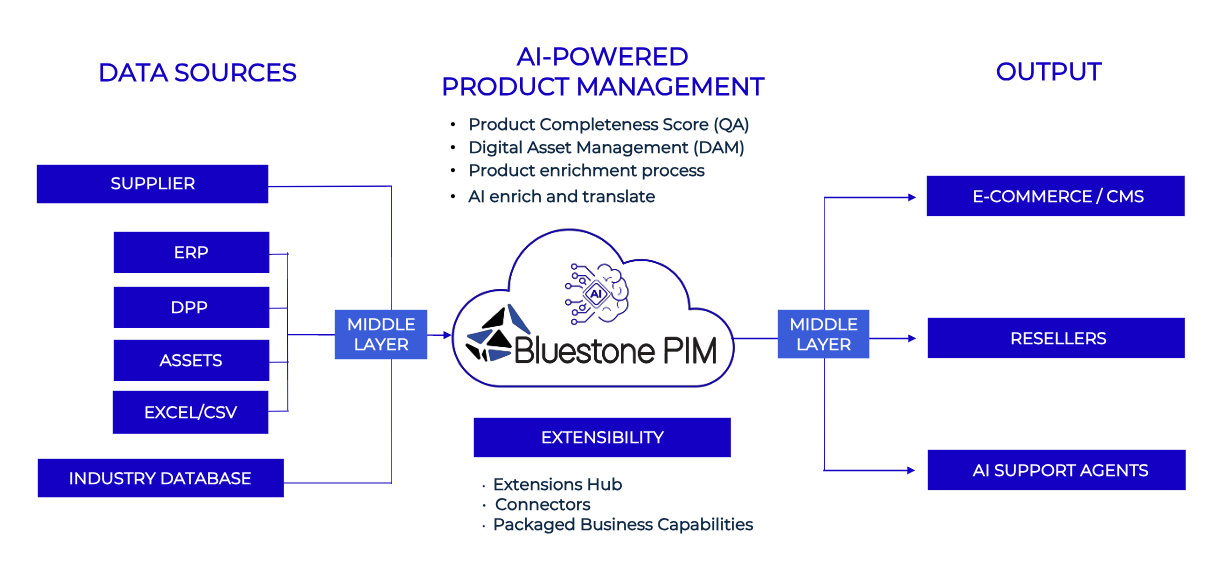
Bluestone PIM allows businesses to import product data from various sources and organise it into structured hierarchies and attributes that support large catalogues and complex product relationship.
2. Native Shopify Integration and Automated Data Sync
Bluestone PIM connects directly with Shopify through API-based integration. Product information enriched in the PIM is synchronised with Shopify automatically, including:
- Product titles and descriptions
- Attributes and specifications
- Images and media assets
- Variant data and product relationships
- Category structures
This means merchandising teams can manage structured product data in Bluestone PIM while Shopify focuses on commerce tasks such as storefront presentation, checkout, and order management.
Changes made in the PIM flow directly into Shopify without manual exports or spreadsheet uploads. Shopify remains the storefront and commerce engine, while Bluestone PIM becomes the system responsible for product data governance.
3. Channel-Specific Publishing
Marketplaces rarely share identical product requirements, each require different attribute sets, categorisation rules, and validation logic.
Bluestone PIM allows teams to configure separate publishing contexts for each channel. Product data remains consistent at the core level, but channel-specific fields can be added and mapped to the appropriate marketplace.
This approach allows one product model to support multiple marketplaces without duplication.
4. Data Quality Control
Marketplace listings fail when required attributes are missing or inconsistent. Bluestone PIM addresses this through governance features such as:
- Attribute validation rules
- Completeness scoring
- Role-based editing permissions
- Change tracking
Teams can identify incomplete product records before publishing them to marketplaces.
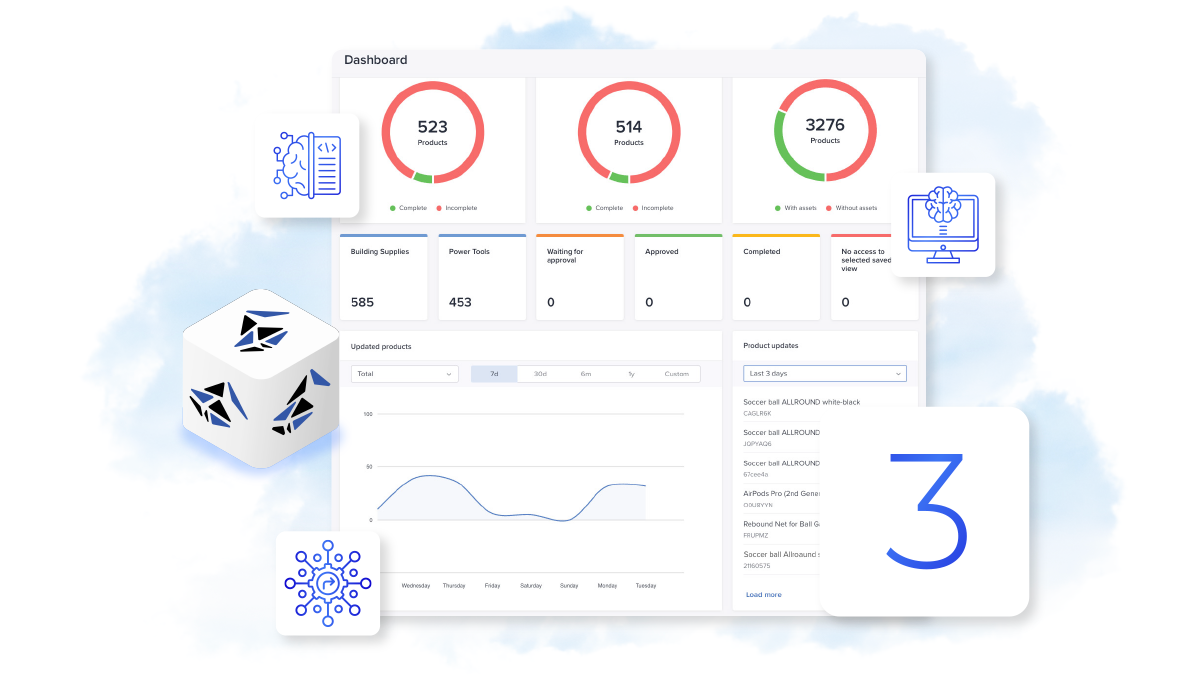
Bluestone PIM includes dashboards and analytics tools that help teams monitor product data quality and enrichment progress across large catalogues.
5. Automated Enrichment
Marketplace operations often require large amounts of content creation: product descriptions, attribute values, translations, and marketing text.
Bluestone PIM includes AI-assisted enrichment tools that generate and refine product descriptions, translate content, and improve text quality directly within the platform.
AI-powered enrichment helps teams create multilingual product content and manage large catalogues without manual copy-paste processes
6. Predictable Marketplace Onboarding
When product data is structured inside a PIM, launching a new marketplace becomes a mapping exercise rather than a restructuring project.
Teams define the marketplace requirements once, map the attributes, and publish products to the channel.
This architecture allows organisations to add new marketplaces without rebuilding their product catalogue or creating additional data silos.
How Do I Decide Between Shopify as a Hub and Direct Marketplace Feeds?
Choosing between Shopify as a hub and direct marketplace feeds depends on catalogue complexity and marketplace scale.
Shopify as a hub works best when:
- You sell on one or two marketplaces
- Your catalogue contains fewer SKUs
- Product attributes are relatively simple
- Localisation requirements are limited
Direct marketplace feeds work best when:
- Marketplaces require detailed attributes
- Listings must be optimised per channel
- Pricing and stock logic vary across marketplaces
A PIM architecture becomes necessary when:
- Teams duplicate product data across channels
- Marketplace onboarding becomes slow
- Data governance becomes unclear
In this architecture, Bluestone PIM manages product data centrally while Shopify and marketplaces act as distribution channels.
What Are the Signs You Need a PIM Instead of Shopify as a Hub?
You need a PIM instead of Shopify as a hub when marketplace operations create duplicated work, data inconsistency, and slow onboarding.
Typical warning signals include:
-
Marketplace onboarding takes months
-
Product attributes differ across channels
-
Teams manage marketplace data in spreadsheets
-
Localisation workflows become manual
-
Shopify performance slows under heavy catalogue logic
At that stage, product data complexity has outgrown the original architecture.
A MACH-based PIM such as Bluestone PIM allows organisations to add a product data layer without replacing their existing commerce platform.

Download free e-book
5 Signs You Need a PIM System
Stop guessing. See the red flags teams miss until product data starts slowing growth. A quick, practical guide for e-commerce, marketing, and product teams.
Talk to Bluestone PIM Experts About Marketplace Architecture
Marketplace growth often exposes limitations in product data architecture. What begins as a simple Shopify setup can become difficult to manage once catalogue size, localisation needs, and marketplace-specific attributes increase.
Bluestone PIM helps e-commerce teams establish a single source of truth for product data that feeds Shopify, marketplaces, and other channels. The platform structures product information, manages enrichment workflows, and distributes data through API-driven integrations across the commerce stack.
With its MACH-based architecture, Bluestone PIM allows organisations to scale product catalogues, introduce new marketplaces, and adapt product models without rebuilding their infrastructure.
Talk with a Bluestone PIM expert to see how a composable product data layer can support your marketplace growth.
Best Practices
 Best Practices
19 Oct 2026
3 Best Practices For PIM Implementation
 Product Information Management