

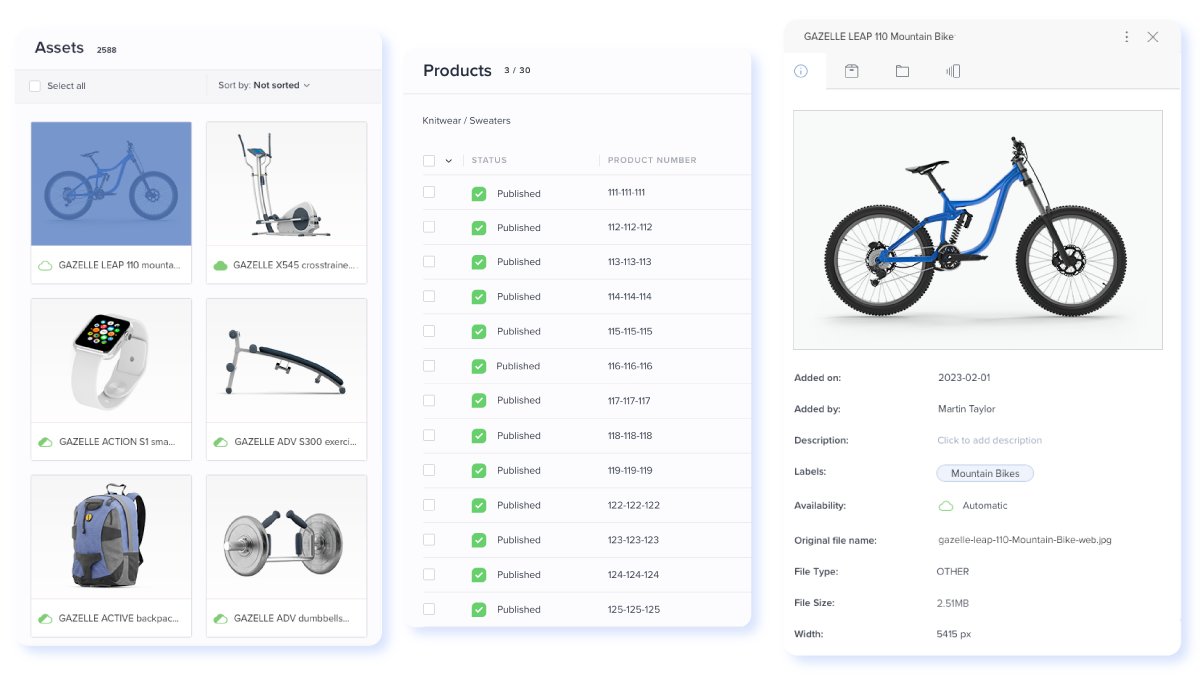
 Product Information Management
Managing 50,000 product SKUs across multiple markets, languages, and sales channels is not a spreadsheet problem. At that scale, product information becomes a business-critical asset, and the system that manages it either accelerates your operations or becomes the bottleneck that slows them down.
The challenge for enterprise retail teams is that not every PIM on the market is built for enterprise demands. Some are excellent tools for growing mid-market businesses. Others add complexity without delivering the composability, API depth, or AI capability that large retailers genuinely need.
This article compares the leading PIM systems for enterprise retailers and breaks down where each one fits, where each one starts to show its limits, and what to look for before you commit.
What Does "Enterprise-Grade PIM" Actually Mean?
Enterprise-grade PIM is not simply a PIM with more storage. The term refers to a set of architectural and operational requirements that become non-negotiable at high data volumes and multi-channel distribution.
At 50,000+ SKUs, an enterprise PIM must deliver on all of the following:
-
Handle bulk imports and parallel processing without performance degradation
-
Support complex product relationships, multi-locale content, and channel-specific publishing logic
-
Integrate cleanly with ERP, CMS, DAM, and marketplace systems via stable, well-documented API endpoints
-
Connect through purpose-built integrations, not brittle connectors that require ongoing maintenance
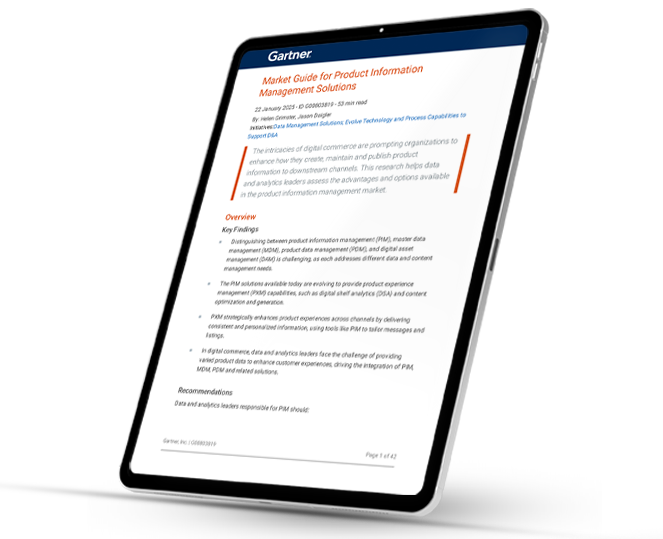
Download free e-book
Gartner® Market Guide for Product Information Management Solutions
The 2025 Gartner® Market Guide for Product Information Management is a trusted resource for business and tech leaders who want to make a confident decision about their PIM solution.
Which PIM Features Are Essential for Global Companies?
Global enterprise retailers need product information management that goes well beyond a central data repository. The features that separate capable enterprise PIM tools from mid-market tools include the following:
| Feature | Why It Matters | What to Look For |
|---|---|---|
| High-Volume Performance | Large catalogues, bulk updates, and peak-demand publishing must not slow down customer-facing channels. | Cloud-native architecture with independently scaling microservices. |
| Composable Integration | Custom-built connectors for every integration create ongoing IT overhead that compounds at scale. | API-first architecture with granular, task-level endpoints that allow integration without rip-and-replace risk. |
| Multi-Locale Content Management | Global retailers must manage translations, regional pricing, and market-specific variants from a single source of truth. | Native multi-language and multi-market support, not a layer built on top of a single-market system. |
| AI-Powered Enrichment at Scale | Manually enriching 50,000+ product records is not viable. | Built-in AI for description generation, completeness validation, translation, and error flagging as a core workflow capability, not a bolt-on. |
| Governance and Approval Workflows | Product data managed across multiple teams, suppliers, and agencies degrades in quality without structured rules. | Configurable validation rules and approval workflows that business teams control without IT involvement. |
| Readiness for Agentic Commerce | Generative AI referral traffic to retail grew 393% YoY in Q1 2026 (Adobe), with Gartner® forecasting up to 20% of retail revenue flowing through machine customers by 2030. A PIM that cannot be operated by external AI agents will be invisible in those channels. | Task-level APIs, full UI/API/agent parity, and MCP (Model Context Protocol) support. Bluestone PIM operates at the highest level of the agentic maturity ladder: AI acts as the operator, not the assistant, with MCP live in production. |
How Do the Leading PIM Systems for Enterprise Compare?
Not every PIM on the market is built for the same scale or use case. The table below covers the five platforms most commonly shortlisted by enterprise retail teams: Scrut, Sales Layer, Pimberly, Inriver, and Bluestone PIM, while Scrut and Sales Layer are solid options for mid-market teams.
| Scrut | Sales Layer | Pimberly | Inriver | Bluestone PIM | |
|---|---|---|---|---|---|
| Best for | Mid-market businesses with straightforward product structures | Mid-market teams needing fast onboarding and catalogue feed management | Mid-market retailers with manageable catalogue sizes and moderate channel demands | Enterprises with complex product relationships and marketplace syndication focus | Enterprise retailers at 50,000+ SKUs with complex integration and AI requirements |
| Architecture | SaaS, mid-market focused | SaaS, catalogue-distribution focused | MACH-certified, not designed for high enterprise volumes | MACH-certified (2023), enforces specific data structures | MACH-native, composable, API-first |
| API coverage | Limited for enterprise use cases | Limited for complex enterprise integration requirements | Rigid at high volume; limits reported at enterprise scale | Restricted; additional fees apply for API-heavy use cases | 700+ granular, task-level endpoints |
| AI capabilities | Basic enrichment features | Basic enrichment features | Separate paid modules: copy generation, image attribution, and data enrichment each purchased individually | Token-based bundles; limits enrichment at high volume without additional cost | Native, model-agnostic AI suite with bulk description generation, translation at scale, structured content creation, data quality monitoring, and natural-language catalogue queries. MCP live in production. |
| Enterprise scalability | Below enterprise capability threshold | Below enterprise capability threshold | Architectural ceiling reported above enterprise catalogue volumes | Capable but users report slower time-to-value and process redesign requirements | Built for high-volume SKUs; independently scaling microservices |
| Pricing model | Subscription-based | Subscription-based | Modular add-ons increase total cost as AI and channel needs grow | Custom enterprise contracts; surprise costs reported at scale | Pay-for-what-you-use with no hidden fees. DAM, CDN, AI tools, and supplier portal included in every plan |
Why Do Large Retail Organisations Choose Bluestone PIM?
Bluestone PIM is the first MACH-certified PIM on the market, with an architecture built specifically for the data volumes, integration demands, and operational pace that enterprise retail requires.
The 700+ granular API endpoints give technical teams surgical control over every function in the system. Individual operations such as enriching a single product attribute, triggering a validation rule, or publishing to a specific channel can each be called independently via API. This is the foundation of agentic automation at scale, and it is fundamentally different from the bulk CRUD APIs that most competitors offer.
AI is built into the core workflow, not assembled from separate modules. The system is AI-provider agnostic, meaning enterprises can connect their preferred models without being locked into a vendor-managed AI layer. Here is how enterprise teams use Bluestone PIM AI in practice:
-
Bulk description generation: AI Enrich writes and rewrites product descriptions at scale, across any catalogue size
-
Translation at scale: AI Linguist handles multi-locale content without manual handoffs to translation agencies
-
Structured content creation: AI Templates applies consistent formats and brand guidelines across product families
-
Data quality monitoring: AI Analyst flags incomplete, inconsistent, or non-compliant product records before they reach any channel
-
Natural-language catalogue queries: AI Agent lets teams interrogate and act on the catalogue using plain-language instructions, without raising IT tickets
-
MCP-based external agent access: External AI agents can query, operate, and publish to the catalogue directly via Model Context Protocol, with no human in the loop
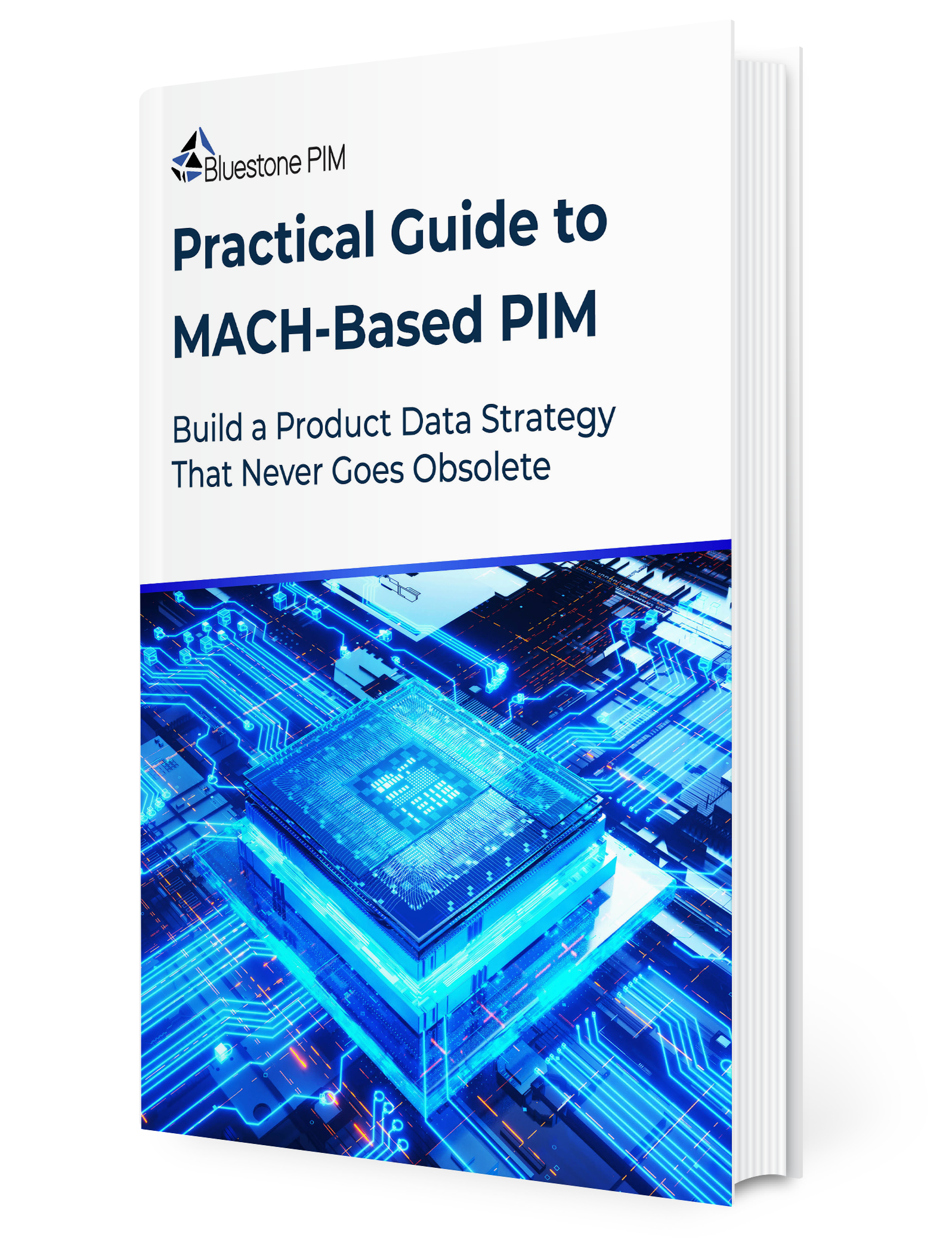
Download free e-book
MACH-Based PIM: The Ultimate Guide
Going deeper into MACH and product data? This e-book explains how MACH-based PIM supports composable commerce in practice.
How Do Enterprise Retailers Use Bluestone PIM in Practice?
A European fashion retailer with 4,000+ physical stores and digital marketplaces across multiple regions used Bluestone PIM to unify and enrich a catalogue of over one million SKUs across 90+ languages, migrating from a legacy PIM in nine months. Product data from PLM, ERP, and DAM systems now flows into Bluestone PIM as the central control layer, with custom enrichment workflows built on Bluestone PIM's extension framework and AI-assisted tagging running continuously. The result: faster product launches, reduced manual work, and a data architecture the retailer's own team describes as ready for AI-driven commerce.
Stadium, Scandinavia's largest sporting goods retailer, uses Bluestone PIM to manage product data across its entire catalogue and distribution network. Saint-Gobain Norway and Bergene Holm are among the enterprise customers who chose Bluestone PIM specifically to avoid the process redesign that competing platforms require.

DOWNLOAD CASE STUDY
Case Study: How a Global Fashion Retailer Unified 1M+ SKUs
Faster product launches, AI-powered enrichment across 90+ languages, and a single source of truth for 4,000+ stores worldwide. A composable, MACH-based architecture with Bluestone PIM at the centre made it possible.
Get your copy hereWhat Should You Ask Before Choosing an Enterprise PIM?
Before committing to any platform, enterprise buyers should get clear answers to the following.
 How does the API work at task level?
Ask whether the system can invoke individual operations independently, such as enriching one attribute or triggering one validation rule, or whether it operates only at bulk data level. The answer determines whether the PIM can support agentic automation.
Where does AI sit in the architecture?
Ask whether AI features are part of the core platform or assembled as separate paid modules. Understand what each AI feature costs and whether the system is model-agnostic or locked to a proprietary AI provider.
What is the full cost at your volume?
Request a written quote that includes implementation, API usage, channel fees, and AI modules at your current and projected catalogue size. Ask specifically about renewal pricing.
How do business teams operate the system day to day?
Ask whether product teams can set validation rules, manage workflows, and publish to channels without raising IT tickets. The answer determines whether the PIM accelerates your team or adds a new dependency.

Download free e-book
Bluestone PIM Template: RFP Template for PIM Evaluation
Choosing the right PIM system starts with asking the right questions. This RFP template helps you structure your vendor evaluation, define your business and technical requirements, and compare PIM platforms more clearly.
The Right PIM for Enterprise Retail Pays for Itself Quickly
Choosing the wrong PIM at enterprise scale is expensive in ways that only become visible after go-live: slow implementations, brittle integrations, AI capabilities locked behind additional modules, and pricing that grows unpredictably as your catalogue does.
The best PIM for enterprise retailers is one built for the demands you have today and the scale you are moving towards. That means MACH-native architecture, task-level API access, a native AI layer that your team can actually use across the full product data workflow, and usage-based pricing.
Bluestone PIM is built for exactly this. Over one million SKUs unified across 90+ languages for a global fashion retailer. Catalogue operations running across Scandinavia's largest sporting goods network. Product data teams self-serving without IT tickets, at the scale enterprise retail demands.
![How To Scale SKU-Heavy Catalogues Without Duplication [Guide For Retailers]](https://www.bluestonepim.com/hubfs/How-To-Scale-SKU-Heavy-Catalogues-Without-Duplication-1.png)