
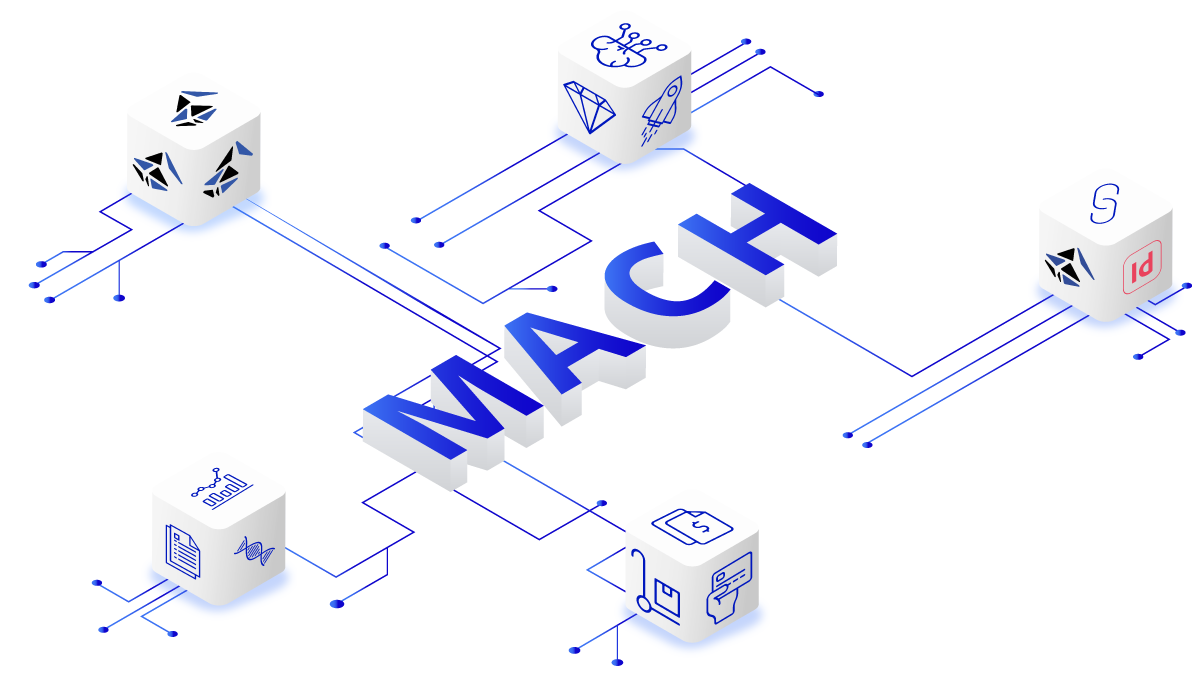
 Product Information Management
In enterprise commerce environments, MACH architecture is often adopted to improve flexibility, scalability, and integration speed. Yet the architecture only works when shared data is structured, owned, and accessible across services.
Product information plays a central role in this setup. Commerce platforms, content systems, search services, marketplaces, and analytics tools all depend on the same product data, accessed through APIs rather than shared databases.
This article explains what MACH architecture is, how it works in practice, and why Product Information Management becomes the backbone of MACH-based and composable commerce systems.
What is MACH Architecture?
MACH architecture is an architectural approach for building digital platforms that can change without constant replatforming.
If you are looking for a MACH architecture definition, it is best described as a set of technical principles rather than a product or platform. MACH stands for:
- Microservices – small, independent services that handle one business capability
- API-first – all functionality exposed and consumed programmatically
- Cloud-native – designed to scale and run entirely in the cloud
- Headless – frontend and backend fully decoupled
Together, these principles allow organisations to replace, extend, or scale individual parts of their stack without disrupting everything else.
That is the key point to understand early: MACH is not software you buy. It is an architectural approach you design around.
Download free e-book
MACH-Based PIM: The Ultimate Guide
Going deeper into MACH and product data? This e-book explains how MACH-based PIM supports composable commerce in practice.
Mach Architecture vs Composable Commerce
The terms often appear together, which leads to confusion. They solve different problems.
- MACH architecture is the technical foundation
- Composable commerce is the business outcome
Composable commerce describes a way of building your commerce stack from best-of-breed components rather than a single suite.
MACH makes this possible by providing the architectural rules that allow those components to coexist, integrate, and evolve.
So when comparing composable commerce vs MACH architecture, it is not a choice between two approaches. MACH enables composable commerce.
3 MACH Architecture Principles in Practice
The value of MACH architecture becomes visible when you look at how systems interact day to day, especially around product data.
Why APIs Matter More Than Platforms
In MACH architecture, API endpoints define how systems work together. Product data is requested, updated, and distributed through stable interfaces rather than direct database access.
This matters for product information since many systems depend on it at the same time: commerce engines, CMS platforms, search services, marketplaces, and analytics tools.
When API endpoints are the foundation, each system can evolve without breaking others.
Why Independence Between Services Reduces Risk
Microservices isolate change. A new product attribute model, a new market catalogue, or a new enrichment workflow can be introduced without redeploying the entire platform.
For product teams, this lowers the risk of updates and removes the fear that small changes will trigger system-wide issues.
Why Release Speed Depends On Decoupling
Release speed improves when changes are smaller and more focused.
Decoupled services allow product data updates, integrations, and schema changes to move independently. This is why MACH architecture supports faster iteration without increasing instability.
Why Product Information Becomes The Backbone In MACH
In MACH architecture, systems do not share databases. They communicate through API endpoints and that makes product information a shared dependency across services.
Without a clear owner of product data:
-
commerce systems duplicate logic
-
content teams manage parallel datasets
-
integrations multiply
-
consistency erodes
A PIM system becomes:
-
the system of record for product content
-
the stabilising layer in a fast-changing stack
-
the source that feeds commerce, content, search, and syndication
Without a proper PIM, MACH architectures tend to drift into complexity rather than clarity.
What A MACH-Based PIM Needs To Deliver
A MACH-based architecture places clear demands on Product Information Management.
A composable PIM designed for this environment must support:
-
API-first access to all product data
-
independent scalability from other systems
-
channel-specific product views
-
multiple languages, markets, and regulatory contexts
-
clean integration with microservices and headless frontends
The focus is architectural fit, not feature volume. The goal is to support change without introducing friction.
How Bluestone PIM fits into MACH Architecture
Bluestone PIM is designed to operate as a standalone service inside MACH-based environments.
From an architectural perspective, Bluestone PIM:
-
exposes product data through API endpoints by default
-
operates independently from commerce and CMS platforms
-
connects cleanly into composable stacks
-
acts as a long-term product data backbone rather than a channel add-on
This makes it suitable for organisations building MACH architecture step by step rather than through full replacement.
Transitioning to a MACH-based PIM Setup
A common mistake is trying to modernise everything at once. That approach increases risk and slows progress.
Most teams succeed by:
-
decoupling product data first
-
introducing PIM as the initial MACH service
-
keeping ERP and commerce systems in place
-
migrating integrations gradually
This is why PIM often becomes the starting point when teams ask how to transition to a MACH-based system. Product data touches many systems but sits outside critical transaction paths like checkout or payments. That lowers migration risk while delivering immediate value.
Is Mach Architecture Suitable For Enterprise Needs?
For large organisations, MACH architecture brings both opportunity and responsibility.
It works well when:
-
change is frequent
-
multiple markets and channels are involved
-
long upgrade cycles are no longer acceptable
It introduces complexity when:
-
governance is unclear
-
data ownership is fragmented
-
teams lack architectural discipline
Enterprises benefit most when PIM is treated as infrastructure rather than tooling. Clear ownership of product data reduces duplication, integration sprawl, and operational friction.
Exploring What Mach-Based Pim Enables In Practice
For organisations adopting MACH architecture, the question is no longer whether product data needs a dedicated system, but how well that system fits a modular, API-driven environment.
Bluestone PIM is designed to operate as an independent service within MACH-based and composable commerce stacks. It provides a structured way to manage, enrich, and distribute product information while remaining decoupled from commerce and content platforms.
This makes it possible to introduce product data governance, regulatory readiness like Digital Product Passport, and multi-channel consistency without locking your architecture into a single vendor stack.
If MACH architecture, composable commerce, or regulatory change are part of your current roadmap, exploring how a MACH-based PIM fits into your setup is a practical next step.
![How To Scale SKU-Heavy Catalogues Without Duplication [Guide For Retailers]](https://www.bluestonepim.com/hubfs/How-To-Scale-SKU-Heavy-Catalogues-Without-Duplication-1.png)