

 Product Information Management
Cloud PIM software centralises product data in one platform and distributes it to every sales channel through APIs. It's replaced on-premises PIM as the default for enterprise commerce because deployment is faster, scale is elastic, and updates ship without IT downtime.
This guide covers what cloud PIM actually is in 2026, how cloud-native differs from cloud-hosted (the two are not the same), and how to evaluate a platform before you sign. It's written for teams running 500 to 10 million+ SKUs across multiple channels, with a focus on UK and European buyers.
What Is Cloud PIM Software?
Cloud PIM software, or cloud-based Product Information Management, is a system that centralises, organises, and distributes product data efficiently across all sales and marketing channels.
Unlike traditional on-premises PIM systems that require heavy IT infrastructure, cloud PIM is hosted online and delivered as Software as a Service (SaaS).
Traditional PIM systems present challenges such as difficulties in scaling, integrating with other platforms, and adapting to global expansion. Cloud PIM leverages cloud computing to provide scalable, cost-effective, and collaborative solutions for modern businesses.
This approach allows businesses to scale quickly, reduce operational costs, and maintain accurate product information across global markets.
As commerce goes digital-first, cloud PIM is now the backbone of composable commerce, keeping product data flowing smoothly between ERP, CMS, DAM, and e-commerce systems.
Download free e-book
Complete Guide to PIM
This free guide walks you through everything you need to know about modern Product Information Management (PIM) and how to use it as a foundation for growth.
Cloud PIM vs On-Premises PIM
Cloud and on-premises PIM take very different approaches. One is agile and scalable; the other is more costly and rigid.
| Cloud PIM Software | On-Premises PIM Software | |
|---|---|---|
| Deployment | SaaS, quick setup, no hardware | Heavy IT infrastructure required |
| Scalability | Composable, API-driven | Limited by servers and storage |
| Cost | Subscription-based, predictable | High upfront and maintenance costs |
| Security | Cloud security with regular updates | Requires in-house management |
| Performance | Elastic, real-time integrations | Slower, dependent on local servers |
Key Benefits of Cloud PIM Software
Cloud PIM brings tangible business benefits. It transforms how companies handle product information by improving accuracy, agility, and efficiency. Cloud based systems enable secure and centralised storing of product data, making it easily accessible and manageable across global teams. By leveraging advanced technology, cloud PIM streamlines product information management and supports business growth.
Centralised Product Data Management
Cloud PIM ensures a single source of truth for product information. By storing and synchronising data in one platform, businesses reduce errors, avoid duplicate work, and deliver consistent product details across every channel.
Scalability and Flexibility
A Cloud PIM platform adapts to business growth. Bluestone PIM, built on an API-first foundation with over 700 APIs, enables seamless integrations with ERP, CMS, CRM, and digital commerce platforms. This composable design makes it future-proof and enterprise ready.
Cloud PIM platforms also support international expansion by enabling localisation, compliance, and efficient management of product data across global markets. As your business grows internationally, cloud PIM empowers your team to manage product information efficiently and adapt to new market requirements.
Faster Time-to-Market
By automating product syndication to marketplaces, e-commerce sites, and print, Cloud PIM shortens product launch cycles. Features like Bluestone PIM AI Enrich streamline data enrichment, while AI Linguist accelerates translation for global launches. Cloud PIM platforms also make it easy to create and manage product content and digital assets, enabling rapid product launches.
Cost-Efficiency
With Cloud PIM, companies eliminate the need for expensive hardware and upgrades. Subscription pricing models make scaling more predictable and budget friendly.
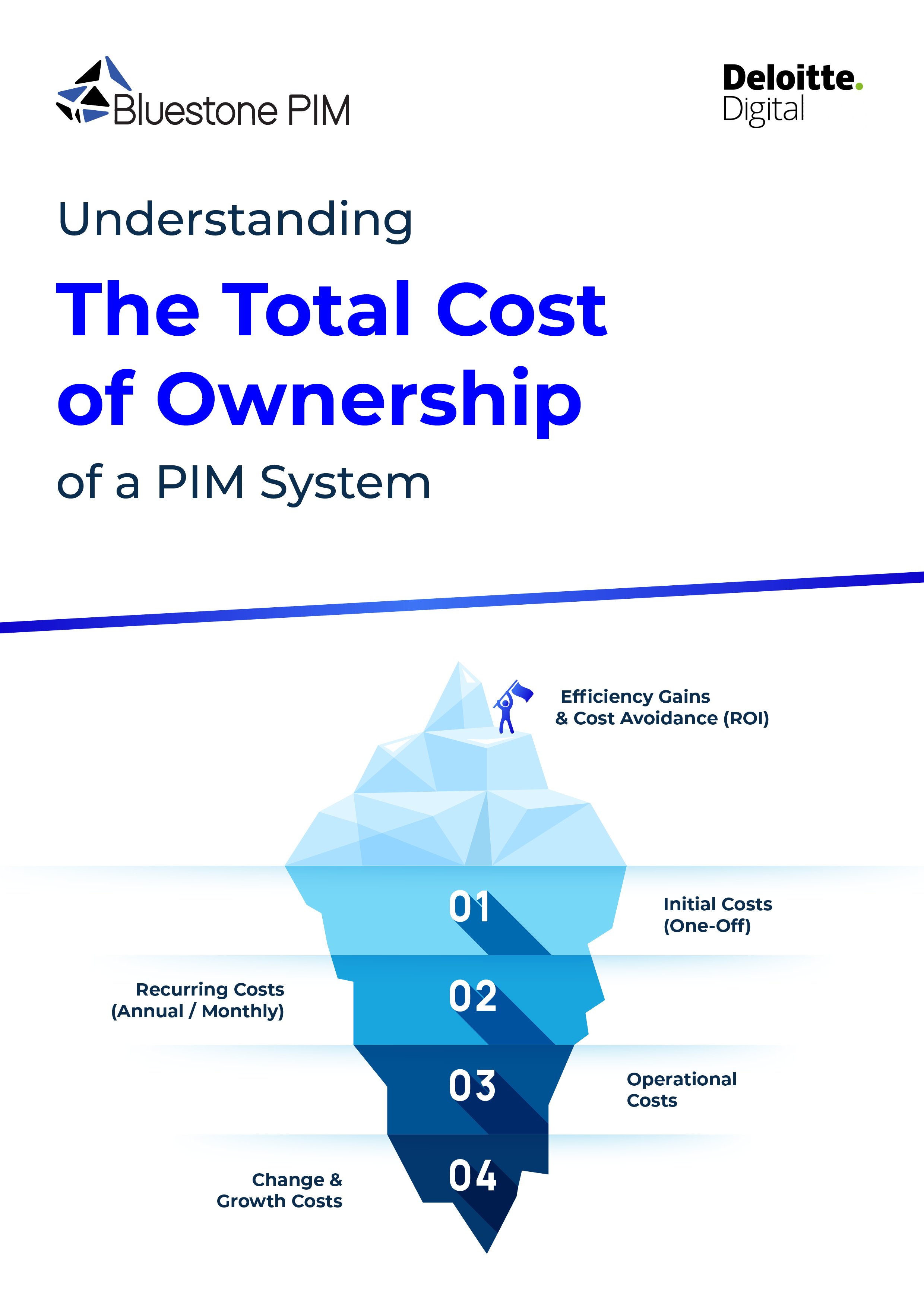
Download free e-book
Total Cost of Ownership: Thinking about investing in a PIM system? The Total Cost of Ownership
This e-book breaks down the true cost of a PIM system: upfront, hidden, and long-term so you can make a confident, informed decision. Get the clarity you need before making a decision.
Who Benefits Most from Cloud PIM?
Cloud PIM is the right fit for three profiles:
- Retailers and brands running multi-storefront or marketplace strategies. If product data lives in three places and reconciling them is a weekly job, cloud PIM replaces that work with one platform and automatic syndication.
- Manufacturers and distributors with complex attributes, variants, and localisation needs. Engineering specs, translations, compliance data, and distributor-specific requirements all live in one governed source.
- Global teams needing role-based access, approval workflows, and 24/7 availability. Cloud PIM handles concurrent users across time zones without performance issues or access conflicts.
The profiles that don't need cloud PIM: single-channel retailers with fewer than 100 SKUs (a spreadsheet still works), or companies with strict data-residency rules that prohibit any cloud hosting.
Digital Asset Management in Cloud PIM Solution
Digital asset management is a cornerstone of modern cloud PIM solutions, providing businesses with a powerful way to organise, store, and distribute their digital assets. With cloud based PIM software, all digital assets, such as product images, videos, and documents are managed from a centralised platform, ensuring consistency and accuracy across every sales channel.
This centralised approach means that teams can easily access the latest digital assets, reducing the risk of outdated or incorrect content reaching customers. Automated tagging and categorisation features make it simple to organise large libraries of digital assets, while advanced search functionality helps teams quickly find exactly what they need.
How To Evaluate Cloud PIM (5-Step Process)
Evaluating cloud PIM properly takes structured comparison across five areas. Don't skip any of them.
- Clarify your data model and governance. Attributes, locales, roles, approval workflows. If you can't describe these on paper before the demo, the vendor will describe them for you, and not necessarily in your favour.
- Map your integrations. Commerce platform, ERP, DAM, channel feeds, GDSN if needed. Require open APIs and eventing. Ask for live API documentation, not a brochure.
- Score AI capabilities. Enrichment, translation, analytics, human-in-the-loop controls. Ask whether AI is built-in or sold as an add-on module.
- Validate syndication. Test the channels, retailers, and marketplaces you actually sell through. Ask for customer references with similar channel mixes.
- Run a pilot with 100 to 500 SKUs. Validate performance, authoring UX, and change control before committing to a full rollout.
Cloud-Native PIM vs Cloud-Hosted PIM
Beware the “cloud” label: cloud-native PIM is multi-tenant SaaS; cloud-hosted is a lifted on-prem app.
Strong network connectivity is essential for both cloud-native and cloud-hosted PIM platforms, as it enables seamless integration, data synchronization, and scalable access to third-party systems.
| Cloud-Native PIM (Bluestone PIM) | Cloud-Hosted “Cloud PIM” | |
|---|---|---|
| Architecture | Microservices, API-only, multi-tenant SaaS | Single app lifted to a cloud server |
| Releases | Automatic, frequent, vendor-managed | Manual patches/major upgrades |
| Scalability | Elastic by design | Limited by VM sizing, ops overhead |
| Extensibility | Composable components; swap/extend without replatforming | Tighter coupling; costly change |
| TCO/Speed | Faster time-to-value, predictable costs | More ops time, hidden infra costs |
Why Bluestone PIM for Cloud-Native PIM?
Bluestone PIM helps enterprise retailers and manufacturers centralise product data, enrich it with AI, and distribute it across every sales channel from one MACH-certified cloud-native platform. It's built for teams moving from spreadsheets, legacy PIM, or on-premises systems to composable commerce.
What's different:
- MACH-certified architecture with microservices, API-first design, cloud-native hosting, and headless delivery. Third-party validated, not self-declared.
- 700+ API endpoints for integration with Shopify, Magento Adobe Commerce, commercetools, Salesforce Commerce Cloud, SAP, Microsoft Dynamics, and any ERP or marketplace you need.
- Built-in AI suite: AI Enrich for bulk content generation, AI Linguist for translation across 50+ languages, AI Analyst for data quality scoring.
- Native DAM and CDN (AWS CloudFront) included as standard, not paid extras.
- Digital Product Passport support built in ahead of the 2027 EU mandates.
- 99.9% uptime on AWS with 24/7 support.
- Pay-for-what-you-use pricing committed in writing, with no per-user penalty as teams grow.
Bluestone PIM fits as the central product data layer in a modular stack, not as a replacement for your commerce platform or ERP. It models, governs, and enriches product data once, then syndicates everywhere through APIs.
Watch the video to check why leading enterprises choose Bluestone PIM.
The Future of Product Information Is in the Cloud
Cloud PIM software is no longer optional for enterprises aiming to scale in omnichannel commerce. It ensures accuracy, agility, and global readiness. Cloud-based platforms are driving the future of product information management by enabling global scalability, regulatory compliance, and technological innovation.
Bluestone PIM stands out as the enterprise-ready, composable, API-first cloud PIM, designed to handle complex product data and accelerate growth.