

 Product Information Management
Product returns are one of the most expensive problems in e-commerce. When customers receive products that do not match their expectations, the result is costly reverse logistics, lost revenue, and damaged trust.
Learning how to reduce product returns often starts with improving the quality of product information. When customers clearly understand what they are buying, they make better purchase decisions and return fewer items.
Retailers and manufacturers increasingly solve this challenge with structured product data platforms such as Bluestone PIM, which centralise product information, improve data quality, and distribute accurate product content across every sales channel.
In this guide, you will learn practical strategies and tools that help e-commerce teams reduce return rates through better product data management.
Why Are Product Returns So High And How Can Businesses Fix The Problem?
Product returns are often high because product information is incomplete, inconsistent, or misleading across sales channels.
Customers rely on product descriptions, images, specifications, and sizing information when making purchase decisions. If any of this information is unclear or inaccurate, expectations quickly diverge from reality.
Common causes of high return rates include:
- Incomplete product specifications
- Inaccurate product images
- Inconsistent sizing information
- Missing compatibility details
- Different product descriptions across marketplaces
These issues usually originate from fragmented product data management.
A Product Information Management platform such as Bluestone PIM helps businesses fix this problem by centralising product data and ensuring every channel uses the same accurate information.
When product content is structured and governed in one system, customers receive clear product information and returns decrease.

Download free e-book
How Top Retailers Use AI: 7 Smart AI Use Cases for 2026
Packed with real examples, practical tips, and the tools behind the strategies, this e-book is a must-read for retail and e-commerce leaders who want AI to really work for their business.
What Are The Top Ways To Reduce Product Returns In E-Commerce?
The top ways to reduce product returns involve improving product information quality, enriching product content, and ensuring consistent product data across all sales channels.
Successful retailers typically focus on several areas.
Improve Product Data Accuracy
Customers return products when the delivered item differs from what they expected. Ensuring accurate attributes, dimensions, and specifications is the first step.
Provide Richer Product Content
High-quality images, videos, and detailed product descriptions help customers understand products before buying.
Standardise Product Data Across Channels
Product data must remain consistent across websites, marketplaces, and mobile apps.
Manage Product Data Centrally
A PIM system such as Bluestone PIM allows teams to maintain product data in one location and distribute it automatically across channels.
This centralisation significantly reduces the risk of inconsistent product information that often leads to returns.
How To Use Product Information To Reduce Returns Effectively?
Product information reduces returns when it provides customers with clear, detailed, and consistent product content before purchase.
Customers typically return products for three reasons:
- The product does not match the description
- The product does not fit or work as expected
- The product appears different from the images
Effective product information addresses these issues by providing:
- Accurate dimensions and specifications
- Clear material descriptions
- Detailed compatibility information
- Multiple high-quality product images
- Videos showing product usage
A PIM platform like Bluestone PIM helps manage this information at scale. By centralising product data and enforcing quality standards, businesses ensure customers receive accurate product information across all channels.
Download free e-book
AI Visibility Guide for Retailers
Learn how to structure product data so AI can find, cite, and recommend your products. Covers GEO, agentic commerce, and 30+ data fields.
What Are The Top Strategies For Minimising Product Returns?
Reducing product returns starts with addressing these common pitfalls. By eliminating ambiguity, you can set realistic customer expectations and reduce returns.
Here are some actionable steps to consider.
1
Provide accurate, detailed product information
Accurate and detailed product information helps customers feel confident enough to buy from you, thus reducing the likelihood of returns. Make sure to include:
-
Exact measurements and dimensions. Specify size details to avoid misunderstandings about product fit or compatibility.
-
Materials and components. Clearly state what the product is made of to set the right expectations.
-
Specific uses and care instructions. Explain how to use, maintain, or assemble the product to ensure long-term customer satisfaction.
2
Use high-quality product images
High-quality product images create a strong first impression and help customers understand what they’re buying. So ensure that your images:
-
Show multiple angles and close-up details. Give customers a full view of the product to reduce uncertainty.
-
Feature true-to-life colour representation. Avoid surprises by ensuring colours match real-life appearances.
-
Provide context for size and scale. Include objects like rulers or models to clearly show product dimensions.
3
Highlight customer reviews
Customer reviews offer authentic insights that build trust and reduce hesitation. Display them prominently to:
-
Showcase real-life experiences. Help potential buyers understand how the product performs in everyday use.
-
Address common concerns. Reviews often answer questions that product descriptions can’t fully cover.
-
Build credibility and trust. Genuine feedback reassures customers that your product delivers as promised.
4
Localise product descriptions
Localised product descriptions ensure that customers understand key product details, no matter where they are. Tailor your content by:
-
Using region-specific measurements. For example, metric for Europe and imperial for the U.S. to avoid confusion.
-
Adapting language and terminology. Speak the same language as your customers by using familiar terms that resonate with them.
-
Reflecting cultural preferences. Adjust product descriptions to align with local customs and expectations.
If you're looking to not only reduce your return rates with AI-powered PIM but also boost your ROI, download our free e-book today:

Download free e-book
Increase Conversion Rates with PIM
Knowledge about the possibilities of a MACH-based PIM system
What Tools Are Recommended For Reducing Product Returns?
Tools that reduce product returns focus on improving product data quality, product content enrichment, and omnichannel data consistency.
Several technologies play a role in this process.
Product Information Management (PIM)
PIM platforms centralise product data and maintain consistent product information across channels.
Bluestone PIM is designed for this purpose, helping businesses manage complex product catalogues and ensure accurate product information everywhere.
Digital Asset Management (DAM)
DAM systems manage images, videos, and product documentation that improve product presentation.
Product Content Enrichment Tools
AI-powered tools generate descriptions, translations, and attributes that improve product content quality.
Bluestone PIM includes enrichment features that automate parts of this process, making it easier to maintain high-quality product information across large catalogues.
How AI-Powered PIM Supports These Strategies
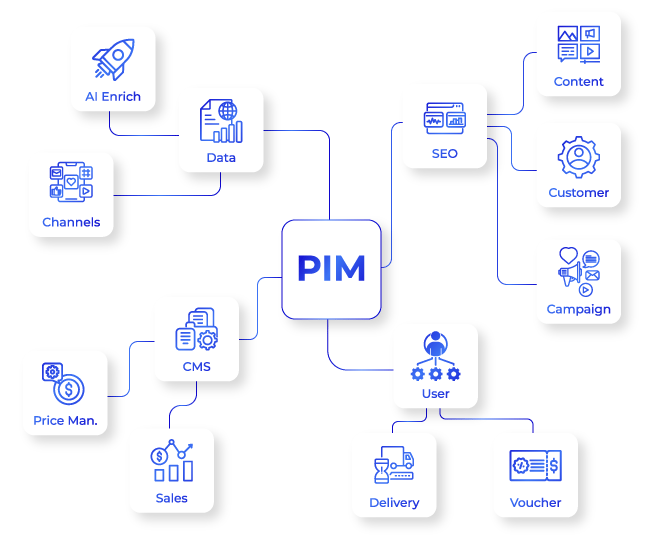
AI-powered PIM systems combine structure with automation to address the root causes of product returns.
Solutions such as Bluestone PIM bring together centralised data management, DAM capabilities, and AI features that improve product data quality at scale.
Product Data Enrichment at Scale
AI-powered product data enrichment fills in missing details and improves existing attributes automatically. By extracting information such as colour, size, style, and key characteristics from product images and source data, it creates descriptions that reflect the actual product.
This reduces ambiguity on product pages and helps customers understand what they are buying before checkout. Enrichment runs consistently across the catalogue, making it easier to launch new products faster with fewer errors.
Product Data Translation and Localisation
Accurate translations play a direct role in reducing returns, especially for cross-border commerce.
AI-powered translation and localisation generate clear, market-appropriate product information in multiple languages. Content is adapted to local terminology, measurements, and language nuances while keeping tone and brand voice consistent across regions.
This ensures customers receive the same level of clarity and accuracy, regardless of market or channel.
Product Data Analysis and Quality Control
AI-driven product data analysis continuously reviews the catalogue to identify gaps, errors, and inconsistencies.
It flags missing attributes, incorrect descriptions, and misclassified products, helping teams prioritise fixes that have the biggest impact on customer decisions. Each suggestion is backed by confidence scoring, so teams know where to focus first.
Corrections can be automated, but final control remains with the business. Changes are reviewed and approved before publication, ensuring accuracy without sacrificing governance.
Business Benefits of Accurate Product Data Using AI-Powered PIM
Inaccurate product data does more than drive returns. It damages trust and long-term revenue.
With AI-powered PIM, retailers see:
-
fewer returns through clearer expectations
-
higher customer satisfaction and confidence
-
lower operational costs through automation
-
stronger brand trust across channels
Future-Proof Your Business with AI-Powered PIM
Product returns are not just a cost line. They signal where product information falls short and where customer expectations break down.
Ready to see the difference? Contact our advisors for a free consultation or book a demo meeting to discover how AI-powered PIM solutions can transform your e-commerce business.
Take control of your product data today and watch your return rates drop.