
 Product Information Management
Choosing between Akeneo and Bluestone PIM comes down to one structural question: are you adding modern capability on top of a legacy core, or building on an architecture that was composable from the start? This comparison covers architecture, AI, data modelling, integrations and total cost of ownership, so you can see exactly where the two platforms diverge.
E-commerce enterprises rely on clean, scalable product data to support automation, personalisation, AI content and global sales. Many traditional PIM solutions were designed for static, manual processes, and as catalogues, channels and expectations grow, these systems introduce bottlenecks and technical debt.
The bigger risk now is staying on a platform that can't support what comes next. An outdated PIM often leads to rising costs, slower delivery, and another migration sooner than expected.
Akeneo and Bluestone PIM both hold MACH certifications, yet their foundations are far from alike. One reworks a legacy engine; the other is composable, headless and API-first from day one.
Looking for a different comparison? If you're weighing Pimberly against Akeneo specifically, see how Bluestone PIM compares to Pimberly instead.
Quick Summary: What Are the Key Differences Between Akeneo and Bluestone PIM?
- Bluestone PIM is composable, headless and API-first from its foundation; Akeneo is a modernised legacy core, with composability still developing.
- Bluestone PIM offers a unified, model-agnostic AI suite (Agent, Analyst, Enrich, Linguist, Templates); Akeneo's AI is more fragmented, split across native features and third-party connectors.
- Bluestone PIM natively supports bundles, kits and complex product relationships; Akeneo's flat data model needs generic associations for the same scenarios.
- Bluestone PIM was the first PIM certified by the MACH Alliance and holds a 4.8 G2 rating, against Akeneo's 4.4.
Akeneo vs Bluestone PIM Feature Comparison
The table below covers the architectural, AI and cost distinctions that affect your long-term results with either platform.
| Area | Bluestone PIM | Akeneo |
|---|---|---|
| Architecture | Composable, headless and API-first from the start. Connects easily with other systems and handles change well. | Modern features layered on top of a legacy system. |
| AI Integrations | A unified, first-party AI suite with flexible model selection, cohesive and customisable. | Akeneo’s integrated AI relies on Akeneo-selected models, while some AI capabilities sit in third-party apps and connectors, leading to a more fragmented AI experience. |
| Conversational Interface | AI Agent turns natural-language requests into product queries and results, with broader agent capabilities expanding over time. | AI is a set of task-specific generators with prompting rather than a conversational agent that operates the PIM. |
| Data Modelling | Handles complex product types (bundles, kits, technical products) with rich relationships. | Limited data modelling, weaker in managing product relations. |
| Scalability | Cloud-native, built for large catalogues; separate Management and Public APIs keep high-volume operations from affecting performance. | More limited for complex structures, so high volumes of data can considerably impact performance within PIM |
| Extensibility | 700+ API endpoints, a UI component library for custom extensions, and prebuilt modules. | Mostly relies on external connectors. Limited options to add custom features. |
| Pricing | Transparent SaaS pricing, low TCO, future-ready. | Growth edition can be very limiting, higher packages can quickly escalate costs, leading to high TCO in the long run. |
| Future-proofing | MACH-native, multi-tenant SaaS with 700+ fine-grained APIs, giving enterprises strong confidence in quality and performance for complex, evolving use cases. | Akeneo’s SaaS offering is less natively composable, so enterprises with complex needs should seek strong, SaaS-specific references to confirm performance and fit. |
| Packaged Business Capabilities (PBCs aka PIM extensions) | Out-of-the-box PBCs (Advanced Bundle Configurator, Voucher Manager, Campaign Manager) for fast deployment. | Limited prebuilt business modules; relies more on external development. |
| MACH Alliance Membership | The first PIM certified by the MACH Alliance; guarantees true, mature composability and modern standards. | Member, but core architecture is not fully MACH-native. |
| G2 Rating | 4.8 | 4.4 |
How Does PIM Architecture Affect Your Team's Daily Work?
The architecture behind a PIM decides how easy (or painful) daily tasks become. It influences integration speed, data accuracy, and how long updates take to publish.
How Is Bluestone PIM Built for Headless, Agentic Architecture?
Bluestone PIM is built headless and API-first from the ground up, so every action available in the interface is also a discrete, callable operation, available to a person, a connected system, or an AI agent with equal access. E-commerce teams get:
- 700+ task-level API endpoints, so attribute updates, image syncs, taxonomy changes and channel exports can all be automated, with the same granular access whether the caller is a person or an agent.
- Event-driven architecture: the moment a product changes, connected systems react instantly, updating the online shop, generating a PDF sheet, or pushing to marketplaces, without a person triggering each step.
- Packaged Business Capabilities (PBCs), ready-made modules that add features like bundling, price management and campaign management without custom development.
- Cloud-native performance, so even catalogues with hundreds of thousands or millions of SKUs load quickly and publish without delay.
In practice, this means less time waiting for imports, less time maintaining custom scripts, and far less time fixing sync issues caused by older system designs. It's also what makes the platform genuinely agent-ready rather than just API-connected: an AI agent operating through MCP has the same access to these operations that a person does, under the same governance.
Want to see what runs underneath this architecture? The e-book Automation in Product Information Management documents the specific rules, category assignment, workflow handoff, channel sync, that Bluestone PIM executes without a person triggering each step.

Download free e-book
Automation in Product Information Management
This e-book explains how automation works in product information management, which catalogue workflows can be automated today, and how an event-based architecture creates the foundation for the agentic PIM.
How Does Akeneo's Architecture Compare?
Akeneo has a clean UI, but the underlying design still stems from its original on-premise, open-source engine.
What users often report:
- Akeneo’s SaaS builds on an earlier core, and its composability is newer and still evolving, so for enterprises seeking a proven, mature composable PIM, it is a higher-risk choice that warrants careful validation on real, complex use cases.
- Connectors do a lot of the heavy lifting, which sounds good until you depend on third parties for almost every integration or extension.
- Because composability is limited, teams may reach practical limits sooner when building adaptable workflows or supporting multi-channel operations.
Practical impact:
Teams often need system integrators to build or maintain even basic automations. Over time, this becomes expensive and slows your ability to adapt.
What Can AI in a PIM Actually Help You Do Today?
AI has moved into the centre of daily work, shaping how teams enrich products, prepare content, manage catalogues, and keep data ready for every channel. The shift is already well underway across the industry.
A recent survey of professionals across retail, distribution, and manufacturing shows how quickly AI is becoming standard practice:
- Difficult to scale for AI-driven operations.
- Unable to supply the structured, instantly actionable data AI tools need.
- Likely to increase long-term technology debt.
89%
are already using AI or running trials
87%
have seen a direct revenue increase
94%
report lower operational costs
97%
plan to increase AI spending next year
These figures make one point clear: companies that adopt AI early gain speed and efficiency, while those that wait risk falling behind. Product data is central to this shift, and the PIM you choose determines whether your team can use AI effectively or is held back by outdated systems.
What AI Capabilities Does Bluestone PIM Include?
Bluestone PIM offers practical, built-in AI features that support real workflows, including a library of AI Templates that standardise repeated tasks, generating channel-ready descriptions, technical summaries, marketing copy and safety notes in one click. Its MCP-enabled architecture and conversational AI Agent let teams work with product data through natural language instead of navigating forms or filters.
AI Enrich
Creates accurate attributes and full product descriptions in different tones or lengths. Useful when:
- launching new ranges
- refreshing outdated content
- producing copy for different channels
AI Linguist
Translates and improves text at scale. Useful when:
- entering new markets
- cleaning messy supplier data
- fixing inconsistent or unclear content
AI Analyst
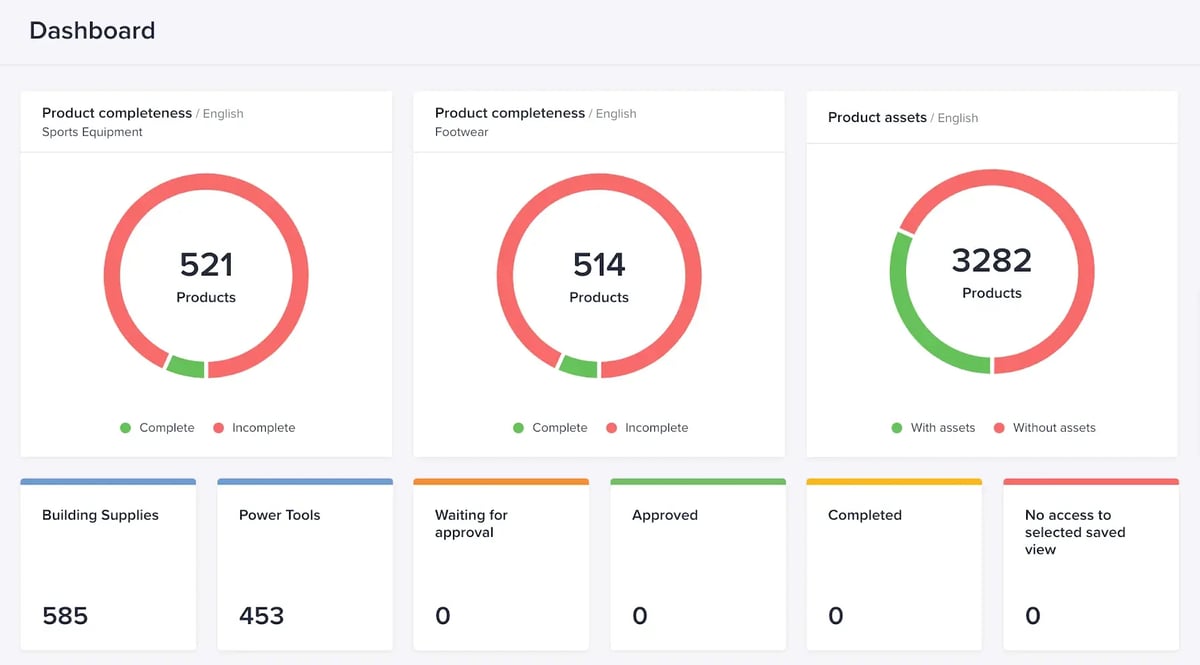
AI Analyst gives teams a faster way to spot issues, fix data, and keep catalogues consistent across all channels. Useful when:
- checking catalogue completeness
- spotting missing attributes, miscategorisation, and anomalies
- finding products that don’t meet channel rules
Conversational AI Agent (MCP-enabled)
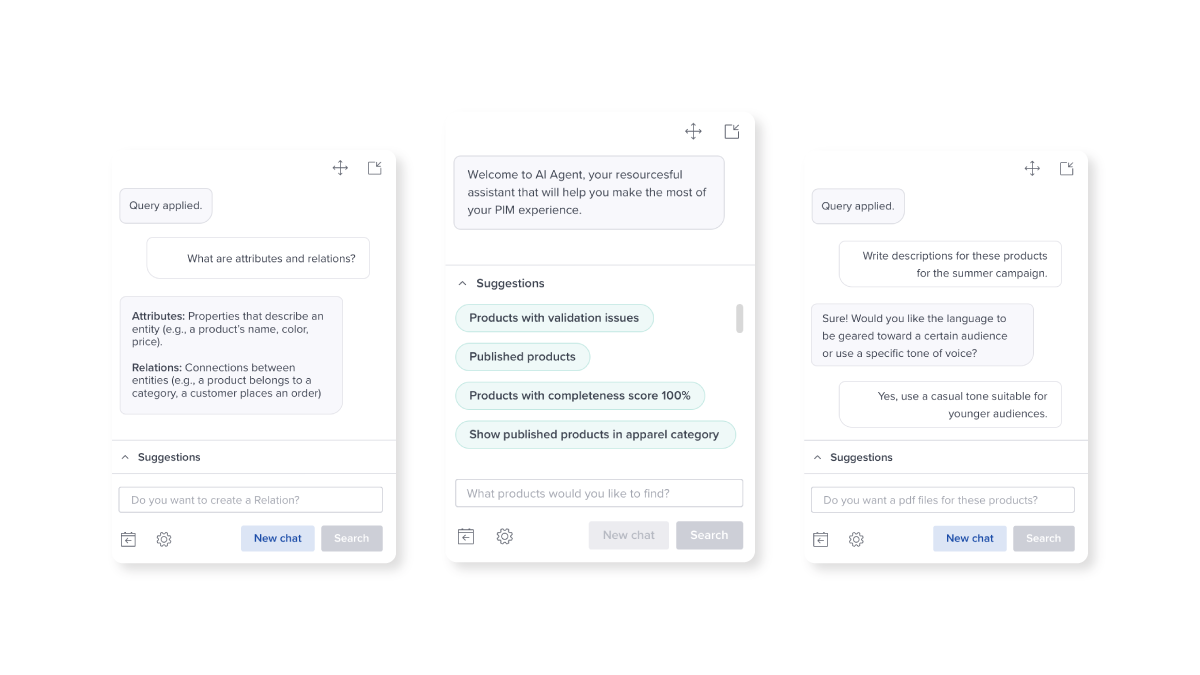
Bluestone PIM’s AI Agent is designed to remove clicks and routine work from everyday PIM tasks and turn them into simple requests.
Today, it already helps with finding and preparing the right products to work on. Instead of building filters and views, you can ask for what you need (“show products missing energy labels”, “find SKUs without images”) and let the Agent handle the query and selection for you.
The next steps on the roadmap move the Agent from “helping you find things” to helping you work faster across the whole platform:
- Platform guidance – supporting users with “how do I…?” questions inside the PIM, such as how to run bulk edits or how attributes and relations work.
-
Task execution – carrying out actions such as generating PDFs, checking for missing data or miscategorised products, creating campaign descriptions, and triggering AI Linguist for translations.
-
MCP-powered orchestration – allowing external agents and AI tools to work with Bluestone PIM through MCP Servers, so product data can be used and updated across commerce, DAM, ERP, and other systems in a controlled way.
All of this builds on a model-agnostic AI layer, so companies can use their preferred AI models and swap them in future without redesigning their setup.
Akeneo: Early-Stage AI Features
Akeneo’s native AI remains relatively early-stage (compared to Bluestone PIM’s AI suite). Akeneo offers:
-
AI Configurations (e.g. “Generate with AI”, translation, SEO prompts) mainly handle per-product text generation, translation and enrichment, not full catalogue-wide intelligence.
-
The data quality auditing or analysis is more of an AI template configuration to save prompts and then get text outputs of issues; rather than a dedicated data-quality module with deep analysis, structured reports and bulk apply-fixes. Bluestone PIM, on the other hand offers the seamlessly integrated AI Analyst that understands your whole data structure and is able to perform deep analysis of your data and implement changes.
-
Data Architect Agent focuses on initial data-model setup, not ongoing, conversational or agentic catalog management.
-
Akeneo’s native AI features run on Akeneo-preselected OpenAI and Gemini models, with no built-in and streamlined way to choose another provider. Using other LLMs requires separate custom apps/connectors via API, adding integration and maintenance overhead compared to Bluestone PIM’s built-in, multi-provider AI support.
-
Many “advanced” AI use cases in Akeneo (e.g. DeepL-based translation, ChatGPT-powered content generation via apps like ChatGPT Bee or RoughDraftPro) are delivered by separate third-party SaaS connectors rather than Akeneo’s own, integrated features, which can make the overall AI experience disjointed, more expensive, inconsistent in quality, and operationally fragmented across different tools and vendors.
How Do Akeneo and Bluestone PIM Compare on Data Modelling?
Bluestone PIM
- Natively supports products, variants, bundles and rich relations (accessories, spare parts, kits, components).
- Offers extension for advanced bundle and configurator needs, to cover for most complex relations and use cases.
- Designed for manufacturers and large, relationship-heavy catalogues, where product links are essential for both operations and customer experience.
- Scales naturally supporting millions of SKUs while maintaining performance and clarity in data management.
Akeneo
- Core model includes Products, Product Models (variants), categories, reference entities and multiple association types.
- No dedicated “Bundle” type, use families, attributes, and quantity-based associations, or Composable Products, to handle kits or spare parts.
- Recent Composable Products help, but complex, multi-level, or highly configurable setups still depend on generic associations and add extra workload.
- May be restrictive for manufacturers and businesses with layered data models.
Practical takeaway:
If you sell configurable products, complex bundles or multi-level assemblies (components, kits, spare parts), Bluestone PIM fits naturally out of the box. Akeneo may handle more complex scenarios, but via more generic modelling patterns and extra implementation work.
How Do Akeneo and Bluestone PIM Compare on Integrations and Extensibility?
Bluestone PIM
- Built for open, composable ecosystems.
- Offers direct connectors to commercetools, Algolia, Adobe, and other key platforms.
- Extension Hub provides PBCs, ready integrations, and a component library to build and embed custom extensions.
- 700+ API endpoints allow teams to build or adjust integrations with more precision and control, while comprehensive documentation streamlines the process.
- Reduces long-term dependence on external partners.
Akeneo
- Relies strongly on system integrators for custom work.
- Marketplace offers a lot of connectors of varying depth and quality, but considerably less integrated type apps (PBCs).
- Older core limits flexibility for advanced integrations.
- Middleware often required for larger, multi-system setups.
- Higher long-term cost due to recurring SI involvement.
Practical takeaway:
If you want a PIM that adapts easily to a changing tech stack, Bluestone PIM offers more flexibility with less ongoing external effort.
How Do Akeneo and Bluestone PIM Compare on Total Cost of Ownership?
Bluestone PIM
- Transparent SaaS pricing with no channel fees.
- Lower maintenance needs due to modular architecture.
- Teams can easily customise and extend their PIM capabilities using PBCs.
- Composable design reduces the cost of future changes.
- Minimises risk of further migrations.
Akeneo
- Advance and Premium pricing can be high.
- Connector maintenance often handled by SIs.
- Custom integrations add to long-term cost.
- Migration from Growth to Advance Package can resemble a replatforming project.
- Legacy core increases the risk of technical debt.
Practical takeaway:
If budget stability and long-term predictability matter, Bluestone PIM provides a clearer and more manageable cost structure.
When Should You Choose Bluestone PIM vs Akeneo?
Both platforms can manage everyday catalogue tasks, but they serve different types of organisations.
If your business depends on:
- quick product launches
- several sales channels
- detailed product structures
- automation
- AI-led support
you’ll reach the limits of older architectures fairly quickly.
Enterprises that value stability, long-term scalability, and fewer dependencies on system integrators tend to gain far more from Bluestone PIM’s composable and future-ready foundation.
Akeneo remains a comfortable choice for smaller companies with straightforward product data. Its approach suits teams with basic workflows, lighter catalogues, and limited technical requirements. For more complex environments, its older core and connector-heavy setup can increase costs and create the risk of another migration later.
Bluestone PIM avoids those issues by offering a modern, scalable architecture designed to grow with your business rather than restrict it.
Make Your Next PIM Decision Your Last
Choosing a PIM shapes much more than your catalogue. It influences how fast you can adapt, how easily you can automate work, and how smoothly you can expand into new markets.
The decision between Bluestone PIM and Akeneo comes down to selecting a modern architecture built for constant change or working within the constraints of a reworked legacy engine.
If you’d like to see how this works in practice, you can book a short meeting with the Bluestone PIM team and explore how an AI-native, composable approach can turn your product data into a genuine driver of growth.