![AI in E-commerce: How to Compare AI Agents in PIM Systems [Framework]](https://www.bluestonepim.com/hubfs/AI-in-E-commerce-1.png)
 AI
AI
Not all AI agents in PIM are the same, some only suggest changes for a person to approve, others can act on product data directly. If you're an e-commerce leader comparing PIM vendors, this framework covers what an AI agent actually needs to do to count as agentic rather than assisted, how to score vendors against that bar, and the questions to ask before you buy.
As brands race to automate and personalise the customer journey, Product Information Management (PIM) platforms are making bold claims about their AI "agents." The difference between suggestion-only AI and true agentic automation can make or break how much of that promise you actually get.
What Is an AI Agent in PIM?
An AI agent in Product Information Management is an intelligent system that can analyse product data, understand your business goals, and take meaningful action on your behalf, rather than only flagging issues for someone else to fix.
Instead of merely highlighting missing attributes or proposing copy changes, an agentic AI in PIM can execute updates, trigger workflows, and maintain data quality directly.
Here's a demo of the Bluestone PIM AI Agent and what it can do independently:
Why Should E-Commerce Teams Move to Action-Oriented AI?
E-commerce teams should move to action-oriented AI because suggestion-only tools still require a person to make every change, which caps how fast a team can actually move. Traditional PIMs, and even many self-described "AI-powered" solutions, limit AI to a supportive role: recommendations only, with every change still routed through a person.
That suggestion-only approach slows teams down, increases the risk of errors, and puts a ceiling on operational agility.
An action-oriented AI agent doesn't just surface issues, it solves them. Whether it's enriching product content, correcting data gaps, or executing a multi-step task like launching a campaign, the agent does the work rather than describing what work needs doing.
AI Agent in your PIM software enables your team to:
- Accelerate time to market for new products and campaigns.
- Reduce manual workload and minimise costly data errors.
- Scale to new channels and markets effortlessly.
- Focus on strategy and growth, rather than repetitive admin.
The shift from suggestion-only to action-oriented, agentic AI is one of the highest-leverage changes an e-commerce team can make to how it operates day to day.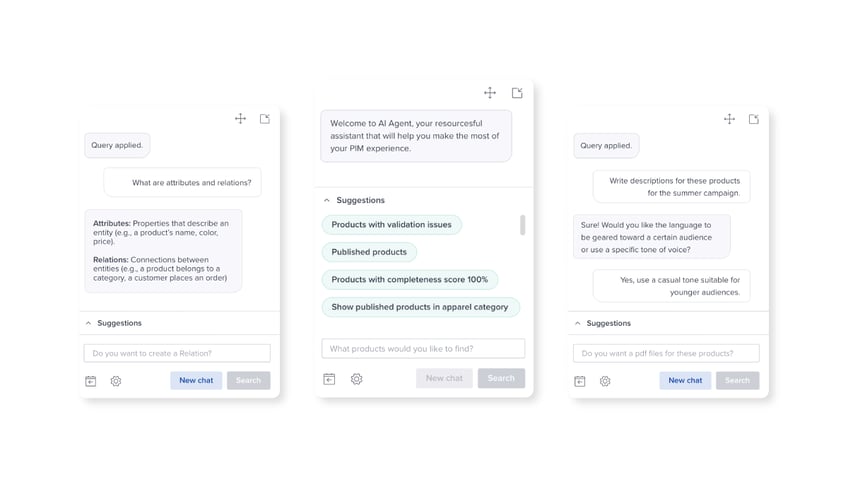

Download free e-book
How Top Retailers Use AI: 7 Smart AI Use Cases for 2026
Packed with real examples, practical tips, and the tools behind the strategies, this e-book is a must-read for retail and e-commerce leaders who want AI to really work for their business.
How Do You Compare AI Agents Across PIM Vendors?
With most PIM vendors now marketing "AI agents," the only reliable way to cut through the noise is a transparent, side-by-side comparison of what each solution actually delivers, not what it claims to.
Use the table below to evaluate PIM vendors on the capabilities with the biggest real-world impact for modern e-commerce: agentic automation, data compliance, and AI flexibility.
| Capability | Legacy PIM | Most “AI” PIMs | Bluestone PIM |
|---|---|---|---|
| Natural language queries and actions |
✗
|
✓ | ✓ (best-in-class) |
| Guided, multi-step automation | ✗ | ✗ | ✓ |
| Fully autonomous product updates | ✗ | ✗ | ✓ (on roadmap) |
| LLM-agnostic (choice of AI model) | ✗ |
✗
|
✓ |
| Bring Your Own API Keys (BYOK) |
✗
|
✗
|
✓ |
| Compliance: self-hosted/private LLMs supported | ✗ | ✗ | ✓ |
| Ecosystem orchestration (agentic commerce) | ✗ | ✗ | ✓ |
What Are the AI Agent Maturity Levels?
Knowing a vendor's true AI maturity is the fastest way to separate genuine automation from AI-washing, marketing language dressed up to sound agentic without the underlying capability to act.
This maturity framework is the result of original research by the Bluestone PIM team, built from analysing real-world customer needs and PIM deployments, to support a higher-confidence PIM buying decision.
If a PIM's AI agent can't act and only suggests, a team misses out on the speed, scale and efficiency modern e-commerce increasingly runs on.
| Maturity Level | Description | Examples |
|---|---|---|
| Level 0 | No Agentic Features | Most PIM vendors |
| Level 1 | Assisted Data Processing | Bluestone PIM AI Analyst, Akeneo AI Classification Agent, Akeneo Data Architect Agent, SalesLayer AI Hub |
| Level 2 | Guided Agent | Bluestone PIM AI Agent |
| Level 3 | Fully Autonomous Agent | (No live vendor solution yet; Bluestone PIM is developing this as a future roadmap) |
Most e-commerce PIMs currently offer only Level 0 or Level 1 capabilities. Bluestone PIM is among the first to deliver Level 2, with Level 3 agentic automation in active development, meaning a business built on this platform can move faster, scale globally, and adapt as the underlying AI models improve.
What Questions Should You Ask When Comparing PIM AI Agents?
Choosing the right PIM solution means asking smarter questions. Use this buyer checklist to reveal each PIM vendor’s true AI capabilities:
-
Can your AI agent act, or only make suggestions?
-
Am I free to select or switch AI models, or am I locked into one vendor?
-
How do you handle data compliance, privacy, and residency for global e-commerce?
-
Can your AI agent connect and automate across all my commerce channels?
-
What manual work will my team still have to do after your AI is “enabled”?
How Does Bluestone PIM Deliver Flexible, Future-Proof AI?
Bluestone PIM's approach to AI in e-commerce rests on three properties:
- LLM-agnostic architecture: choose or switch between OpenAI, Google Gemini, Anthropic, or private LLMs, with no vendor lock-in.
- Full compliance and BYOK (Bring Your Own API Keys): retain data privacy, governance and regional control, essential for global brands operating under different regulatory regimes.
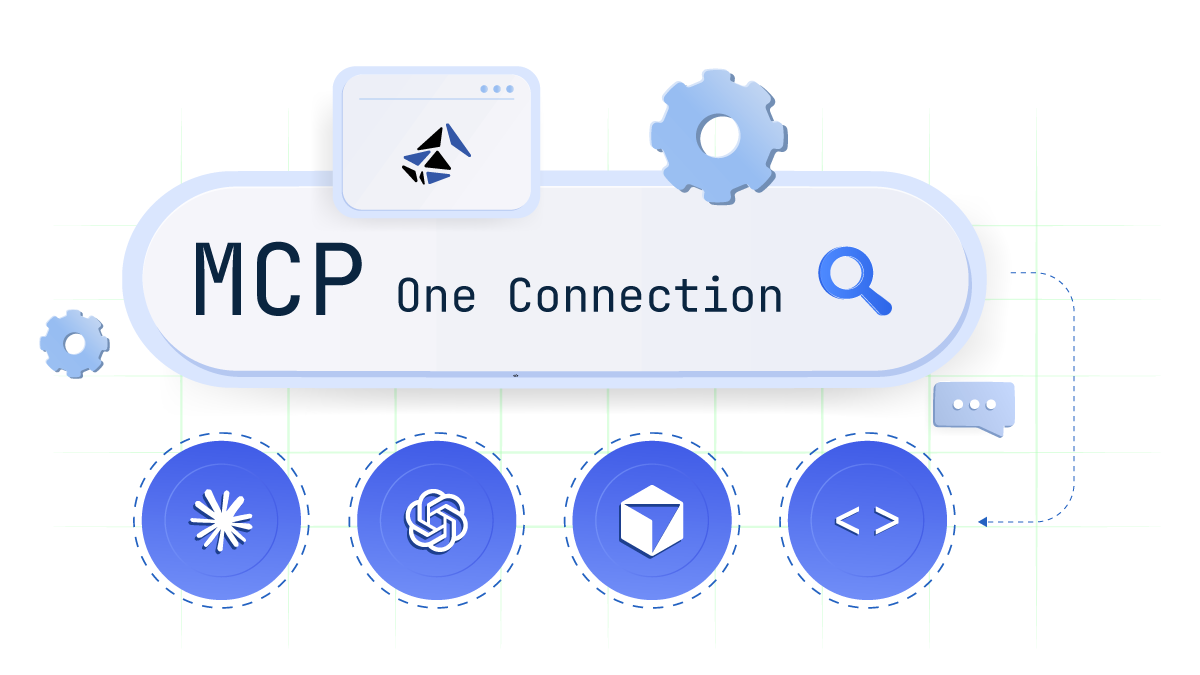
- Headless, API-first design: 700+ task-level API endpoints with full UI/API parity mean any AI agent, Bluestone's own or an external one connecting through MCP, can act on product data with the same access a person has.
That last point is what makes the rest possible. An LLM-agnostic, BYOK setup only delivers real flexibility if the underlying platform is genuinely agent-operable in the first place, composable, API-first architecture is now the baseline expectation across the category, not the differentiator on its own.
Want to see what that automation actually looks like underneath, beyond the demo? The e-book Automation in Product Information Management documents the specific rules, category assignment, workflow handoff, channel sync, that an agentic PIM runs without a person triggering each step.

Download free e-book
Automation in Product Information Management
This e-book explains how automation works in product information management, which catalogue workflows can be automated today, and how an event-based architecture creates the foundation for the agentic PIM.
If you want a PIM built for real automation, not just AI-branded suggestions, see why teams are choosing Bluestone PIM.
Ready to See Real Agentic Automation in Action?
Reach out to Bluestone PIM today for a personalised demo. Not all AI in e-commerce is created equal. As the PIM landscape evolves, the difference between suggestion-only AI and agentic automation will define which brands grow and which get left behind.
With Bluestone PIM, you get a proven framework, a transparent view into AI agent maturity, and a partner dedicated to keeping your product data, automation, and compliance ahead of the curve.
![How To Scale SKU-Heavy Catalogues Without Duplication [Guide For Retailers]](https://www.bluestonepim.com/hubfs/How-To-Scale-SKU-Heavy-Catalogues-Without-Duplication-1.png)