
 Product Information Management
PIM pricing looks simple on paper: pick a plan, pay monthly, get started. The reality is different. The licence fee accounts for a fraction of the total cost. Integration, onboarding, data migration, scaling, and vendor lock-in add up fast, and most buyers only discover these costs after they've signed.
This guide, created for e-commerce leaders with insights from Bluestone PIM and Deloitte Digital, covers everything that affects PIM pricing in 2026: real benchmarks by business size, a full TCO breakdown, a competitor pricing comparison, and the questions you should ask every vendor before committing.
How Much Does a PIM System Cost?
PIM system costs depend on three things: the number of SKUs you manage, the number of channels you publish to, and whether the platform is built on composable or legacy infrastructure.
Here is a practical breakdown of PIM pricing ranges for 2026, mapped by company type and SKU volume:
| Stage / SKU Volume | Typical Annual Budget | What to Expect |
|---|---|---|
| Start-ups & Small Brands (<10k SKUs) | Free – £10k/yr | Basic plans are often free or low-cost. Suitable for companies with a small product range and few users. |
| Mid-market (10k–100k SKUs) | £10k–£50k+ | Costs increase as your catalogue and channels grow. |
| Large / Enterprise (>100k SKUs) | £50k – £100k+/yr | High-volume businesses pay premium prices. This level includes advanced automation, custom integrations, dedicated support, and full enterprise security. |
| Open-source / Self-hosted | Hosting & setup £10k–£100k+ | You’ll need your own IT team for hosting, upgrades, and support. |
What Is the Total Cost of Ownership (TCO) for a PIM System?
Total Cost of Ownership for a PIM system is every cost associated with buying, running, and scaling Product Information Management software over its full lifecycle. TCO goes far beyond the annual subscription.
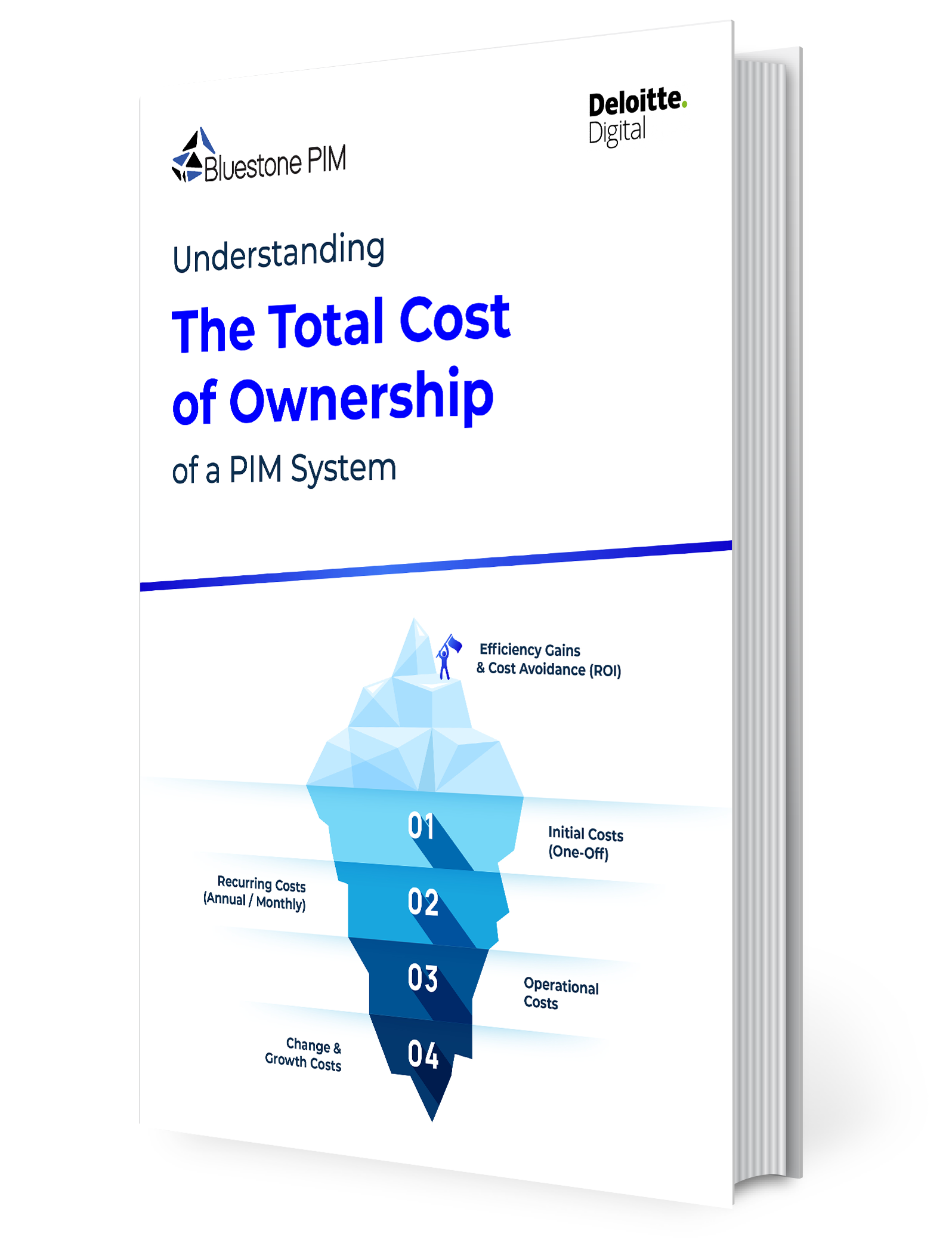
Deloitte Digital's analysis of PIM Total Cost of Ownership, published in partnership with Bluestone PIM, identifies five cost categories that most buyers underestimate:
1. Initial costs: data migration, onboarding, system configuration, and first integrations. For enterprise implementations, this typically adds 20 to 40% to the first-year budget.
2. Recurring costs: licence fees, API call limits, user seats, and activated modules. Some vendors charge per channel, per locale, or per additional connector.
3. Operational costs: enrichment, translations, catalogue updates, and quality assurance. These are the costs of actually using the system day-to-day.
4. Change and growth costs: adding new channels, building new integrations, scaling to more markets, or re-platforming when the system can't keep up.
5. Efficiency gains (ROI offset): automation, fewer product data errors, faster launches, and improved conversion rates. A properly implemented PIM should reduce operational costs enough to offset a significant portion of its own price.
Why does Total Cost of Ownership matter in PIM?
A PIM software with a low upfront price can cost much more in hidden expenses, vendor lock-in, or missed business opportunities. Understanding TCO helps e-commerce managers make decisions based on long-term value rather than just the cheapest quote.
Experts from Deloitte Digital have covered this subject in depth in the Understanding the Total Cost of Ownership of a PIM Solution, get your copy now:
Download free e-book
Total Cost of Ownership: Thinking about investing in a PIM system? The Total Cost of Ownership
This e-book breaks down the true cost of a PIM system: upfront, hidden, and long-term so you can make a confident, informed decision. Get the clarity you need before making a decision.
What Really Affects PIM Pricing? (Easy Explanation)
PIM pricing isn’t just about the sticker price.
It’s shaped by how the PIM software is initially built, how easily it connects with your other tools, and how transparent the vendor is about all the costs you might face.
💡 Recommendation: To avoid your PIM costing more than it should in the long run, always check the system’s infrastructure first. Is it truly a composable PIM, or are you locked into a rigid, legacy platform?
Here’s how to compare PIM solutions to understand their true cost:
| Pricing Driver | Legacy PIM | Composable PIM |
| Infrastructure | You pay for expensive servers and hardware. | Everything runs in the cloud; no hardware to buy. |
| Integration | Custom code is needed to connect systems. | 700+ APIs and prebuilt connectors. |
| Scalability | You have to guess and pay upfront for your max capacity. | Scale up or down instantly,only pay for what you use. |
| Vendor Lock-in | Hard to switch vendors or leave (proprietary tech). | Open architecture (APIs, MACH standard) makes it easy to change vendors. |
| AI & Automation | Rarely included or costs extra. | Built-in AI |
What Hidden PIM Costs Should E-commerce Managers Watch For?
Many PIM buyers only focus on licence price, but hidden costs can easily exceed your budget if ignored.
1. Integration and API Complexity
Connecting your PIM to other systems such as ERP, e-commerce platforms, marketplaces, and DAM is essential for omnichannel success.
Hidden cost: Some PIM solutions require expensive custom development or consultancy for each integration, especially if the API coverage is limited.
What to look for: Check whether the PIM provides well-documented APIs.
2. Onboarding, Training, and Change Management
Adopting a new PIM almost always requires team training and changes to established workflows.
Hidden cost: Budget at least 10 to 15 percent of your first-year PIM spend for onboarding, user training, and process redesign. These costs can rise if the system is complex or poorly supported.
What to look for: Ensure the vendor provides comprehensive onboarding, accessible training resources, and responsive support.

The licence fee is just the tip of the iceberg. The real cost comes from inefficiencies, manual processes, and systems that cannot keep up with business change
3. Vendor Lock-in and Migration Costs
Some PIM platforms use proprietary architectures or data models that make migration to another system difficult, risky, or expensive in the future.
Hidden cost: If you need to switch platforms, you may face high extraction, mapping, and re-platforming fees.
What to look for: Ask about data portability, export options, and whether the PIM uses open standards.
4. Operational Inefficiency
Manual data entry, enrichment, and repeated formatting can drive up operational costs over time.
Hidden cost: Older or less automated PIM systems often require large teams to handle repetitive tasks, leading to higher personnel costs and slower time-to-market.
What to look for: Consider solutions with workflow automation, bulk editing, validation tools, and AI-powered features for enrichment, translation, and data quality control.
5. Scaling and Growth Surprises
Many PIM buyers underestimate the impact of growth on pricing. Some systems charge extra for more SKUs, attributes, users, or new channels.
Hidden cost: Sudden price jumps or tier upgrades can strain budgets as your catalogue or channel count grows.
What to look for: Request clear information on how pricing scales with usage. Consider scenarios where your product count or channel footprint doubles, and ask the vendor for real-world pricing examples.
Practical Checklist: Questions to Ask PIM Vendors
Before you commit to any PIM software, use this checklist to ensure you’re making a future-proof, cost-effective choice:
✅ Is the PIM system API-first, cloud-native, and MACH-certified?
✅ Can it scale easily across new markets, languages, channels?
✅ Does PIM include native AI to enrich product content?
✅ Are connectors available for your existing stack (ERP, CMS, DAM)?
✅ Can you turn features on/off without penalties?
✅ How does cost change if you double your product count or expand channels?
✅ Is there a clear, documented path for migration or exit if needed?
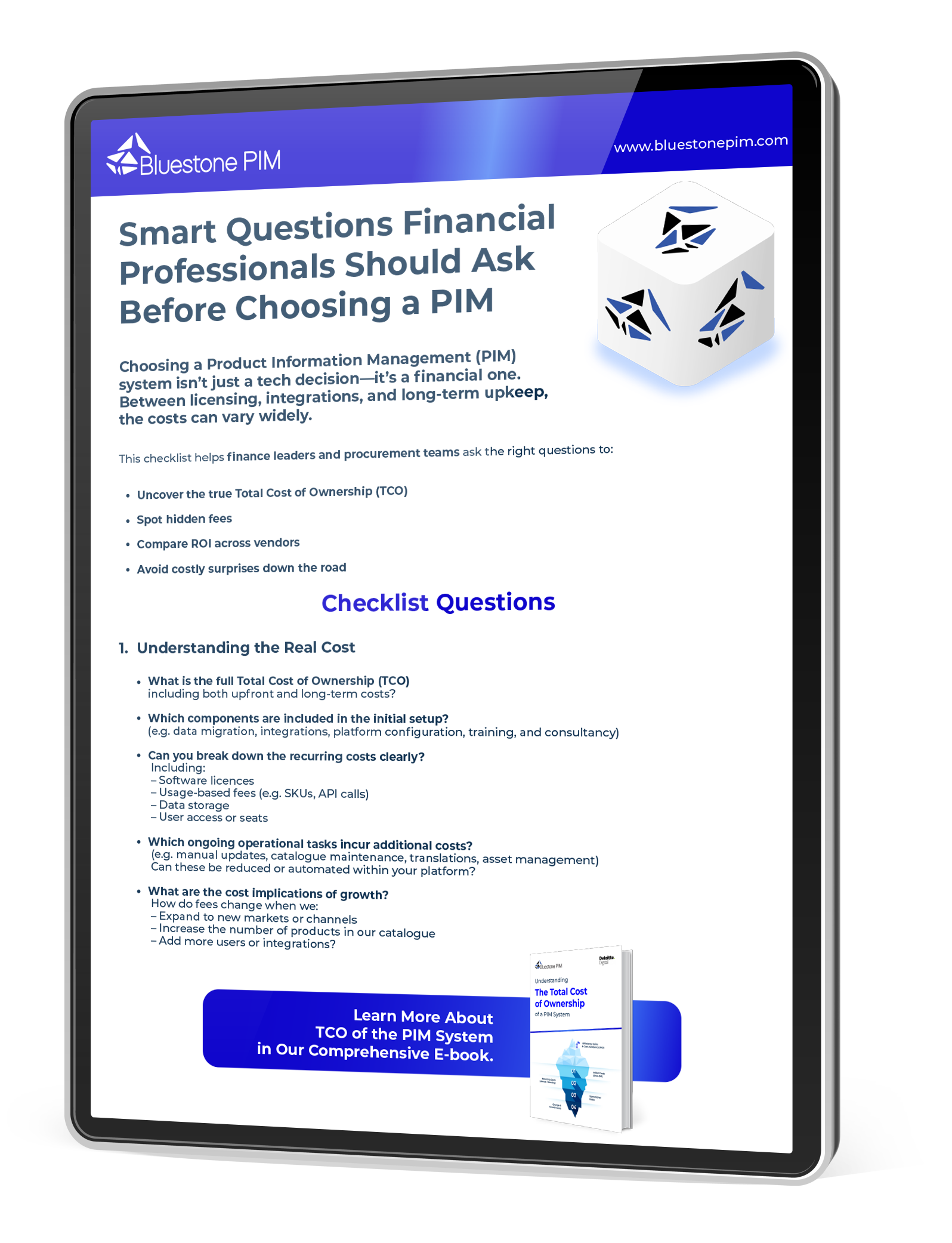
Get the essential checklist to take to every PIM vendor:
Download free e-book
PIM Vendor Evaluation Checklist
When choosing a PIM system don’t just compare features, but ask the right questions. This checklist will help you dig deeper into what really matters: flexibility, scalability, support, and future-proofing.
Free Calculator: ROI of Your PIM Investment
Investing in a Product Information Management system is about measurable returns.
Bluestone PIM recommends tracking these essential metrics to understand your real ROI:
- How fast new products launch to market
- Time and money saved on manual content tasks
- Improved conversion rates and channel performance
Curious about your numbers? Bluestone PIM offers a free, interactive ROI calculator. Just enter your business data to see how much value a modern PIM could unlock for you.
Why Is TCO More Important Than Just PIM Pricing?
TCO reflects every cost and value driver across the entire lifecycle, not just the initial purchase or annual fee.
Choosing a PIM based only on “pricing” can lead to higher costs from manual processes, slow launches, expensive upgrades, and future migration. With the right questions, frameworks, and ROI mindset, you can avoid costly surprises and maximise the value of your investment for years to come.
If you’re evaluating PIM providers, don’t just take their word for it. Experience composable PIM in action: book a free Bluestone PIM demo right away!
![How To Scale SKU-Heavy Catalogues Without Duplication [Guide For Retailers]](https://www.bluestonepim.com/hubfs/How-To-Scale-SKU-Heavy-Catalogues-Without-Duplication-1.png)