
 Product Information Management
Product information integration connects your PIM to every other platform that needs product data: ERP, storefronts, DAM, marketplaces, and CMS. Done properly, data flows automatically between systems with no manual re-entry. For most e-commerce and manufacturing teams, this is the single biggest factor in whether a PIM project succeeds.
The question is rarely whether a PIM can connect to your ERP or your Shopify store. Most vendors say yes. The real question is how: open APIs or proprietary middleware, one-way pushes or two-way sync, and whether your team can build and maintain the connection without filing a ticket every time something changes.
This guide covers the integrations that matter most for retailers and manufacturers, what to look for in each, and the questions worth asking before you sign anything.
What Is PIM Integration And How Does API-First Architecture Change It?
Product information integration connects your product data system to every platform that needs that data: ERP, storefront, DAM, marketplaces, and CMS. Without it, product data gets copied manually between systems. That creates errors, delays, and version conflicts between what one system shows and what another does.
The quality of that connection varies enormously between vendors.
A PIM built on API-first architecture exposes every product data operation through documented, publicly accessible endpoints. Your developers, or your implementation partner, read the documentation, call the endpoints, and build the exact data flow the business needs. No waiting on the vendor to ship a custom connector.
Bluestone PIM works this way. Every capability in the interface has a matching API call: creating products, managing assets, triggering workflows, running completeness checks, publishing to channels. That's what 100% UI/API parity means in practice, across 700+ task-level endpoints covering the full product data lifecycle.
The alternative is a PIM where the API was bolted on afterwards: a thin set of endpoints wrapped around a monolithic core. On those platforms, new integrations depend on the vendor's roadmap, the vendor's bug-fix timeline, and often the vendor's pricing for each additional connection.
If you're evaluating integration options for ERP, CRM, or multiple sales channels, start with the architecture question. Everything else follows from it.
Download free e-book
Complete Guide to PIM
This free guide walks you through everything you need to know about modern Product Information Management (PIM) and how to use it as a foundation for growth.
Which Integration Approach Do You Need: Ready Extension Or Tailored Integration?
Not every system you connect to is the same kind of problem, and treating them the same is where most integration projects go wrong.
-
Standardised platforms (commerce engines, marketplaces, sales channels) share a common data model across every customer who uses them. A pre-built connector fits cleanly, needs no custom mapping, and goes live in days rather than quarters.
-
Systems of record (ERP, MDM, bespoke internal tools) are configured to your business specifically: your fields, your hierarchy, your rules. A generic connector stops exactly where your data model begins.
Bluestone PIM handles these as two distinct problems rather than one generic answer. The Extension Hub covers standardised targets with ready connectors for commercetools, Adobe Commerce, Shopify, and DAM platforms, installed and configured rather than built from scratch. For systems of record, the Connectivity Suite delivers a tailored integration built on patterns proven across real SAP, Oracle, and Microsoft Dynamics projects: bidirectional sync mapped to your own fields and business rules, not a lowest-common-denominator template.
Knowing which camp a system falls into before you scope the project saves you from discovering it the expensive way, mid-implementation.
How Does PIM and ERP Integration Work?
ERP integration is usually the most complex connection in a PIM project, and the most important one to get right. The ERP (SAP, Microsoft Dynamics, or similar) stays the system of record for pricing, stock, supplier codes, and financial transactions. The PIM takes over where the ERP stops: descriptions, images, translations, and channel-specific attributes.
The two systems complement each other rather than compete for the same job.
A typical pattern looks like this: the ERP creates or updates the base product record (SKU, internal codes, basic specs). That flows into the PIM, where commercial teams enrich it with marketing content, images, translations, and category assignments. Once the product is ready, the PIM publishes it out to connected channels.
Bluestone PIM's Connectivity Suite supports this from either end: simple scheduled file imports where that's all a project needs, or fully bidirectional sync where a change in either system updates the other automatically. Stock and pricing generally stay owned by the ERP. Descriptions, media, and channel-specific content belong in the PIM. Fields like dimensions or materials often originate in the ERP and then get validated and enriched inside the PIM before anything gets published.
For the full walkthrough of ownership models and sync patterns, read the PIM ERP integration guide.
How Does PIM Integrate With E-commerce Platforms Like Shopify and Magento?
E-commerce integration is where most teams see the fastest return from a PIM investment. Instead of editing product pages directly in Shopify, Magento, or commercetools, your team manages all product content in the PIM and publishes it to the storefront through an API connection.
This changes the workflow fundamentally. Product data is structured once, validated against completeness rules, and pushed to every connected store automatically. No more logging into each platform separately. No more copy-pasting descriptions between admin panels. No more discovering that your German storefront has different product specs than your UK one.
- Shopify integration with Bluestone PIM uses an event-driven model. After the initial catalogue sync, only changed products are pushed to Shopify. The connector maps both core Shopify fields and metafields, and you can create new metafields directly from the integration interface. For retailers managing multiple Shopify Markets, each market maps to a PIM context, so localised content reaches the right storefront automatically. The full technical setup is covered in the Bluestone PIM Shopify integration guide.
- Magento (Adobe Commerce) integration follows a similar API-driven approach. Bluestone PIM connects to Magento's REST API, synchronising products, categories, attributes, and media. For retailers running multiple Magento stores (different brands, different regions), the PIM acts as the single source of truth that feeds each store with the right content for its market.
- Commercetools integration is where composable architecture shows its full value. Both Bluestone PIM and commercetools are MACH-certified, which means they are built on the same architectural principles: microservices, API-first, cloud-native, headless. The connector transfers product data and images from PIM to commercetools with minimal configuration, and the event-driven model keeps both systems in sync without batch processing delays.
For headless commerce setups, Bluestone PIM's API-first design means the PIM itself runs as a headless service. Product data is available through the API for any front end, mobile app, or custom storefront to pull directly.
What Does PIM and DAM Integration Look Like?
Digital Asset Management integration keeps product images, videos, and documents linked to the right product records across every channel. Split PIM and DAM apart, and teams lose hours relinking assets after updates, fixing broken references, and chasing version conflicts between what marketing uploaded and what's live.
Bluestone PIM takes a different approach here: it includes a native DAM inside the platform itself. Every asset is stored, tagged, and linked directly to its product, and a built-in CDN (powered by AWS CloudFront) serves assets globally without extra infrastructure to manage.
Upload an image, link it to a product, and it's live everywhere that product publishes. No sync jobs between separate systems, no asset IDs breaking because someone renamed a file.
Teams already running a dedicated DAM (Cloudinary, QBank, Tenovos) aren't locked out of this. Bluestone PIM connects through its API and ready-made connectors instead: assets stay where they are, the PIM references and maps them, and distribution happens alongside the product data.
How Does PIM Connect to Marketplaces and Distributor Portals?
Marketplace integration multiplies complexity fast. Amazon, eBay, Zalando, and sector marketplaces each demand their own attribute sets, image specs, category taxonomies, and compliance rules. A product complete for your own storefront might be missing half of what Amazon requires.
A PIM solves this by managing channel-specific variations within a single product record. Base data stays constant. Channel-specific attributes, descriptions, and media layer on top through contexts or market-specific views, so each channel gets exactly what it needs on publish.
Bluestone PIM handles marketplace distribution through Extension Hub connectors and direct API integrations. Productsup, for one, connects Bluestone PIM to 2,500+ channels and manages the feed transformation each marketplace demands.
For manufacturers, the challenge shifts slightly. Distributor portals want data in whatever format each partner uses, whether that's CSV, a proprietary format, or an API feed. Bluestone PIM's Content Store gives partners and resellers a customisable portal to pull product data directly, cutting out the back-and-forth of emailed spreadsheets.
The practical effect: instead of someone manually reformatting product data per distributor, the PIM generates the right output automatically, freeing that person to work on data quality instead of data reformatting.
How Does PIM Integrate With CMS Platforms?
CMS integration connects enriched product data to the pages where customers actually see it. Whether you run a headless CMS like Contentstack, a traditional one like WordPress, or a hybrid like Sitecore, the PIM feeds structured content in so editors aren't re-entering product details by hand.
The pattern is straightforward: the CMS pulls product data from the PIM via API. Update a product in the PIM, and the CMS gets the new content automatically. Layouts and editorial content stay in the CMS. Specifications, attributes, pricing, and media come from the PIM.
For headless CMS setups specifically, the integration is cleaner still, since both systems expose content through APIs and the front-end application assembles the page from both sources at render time.
What Keeps Every Connected System Current?
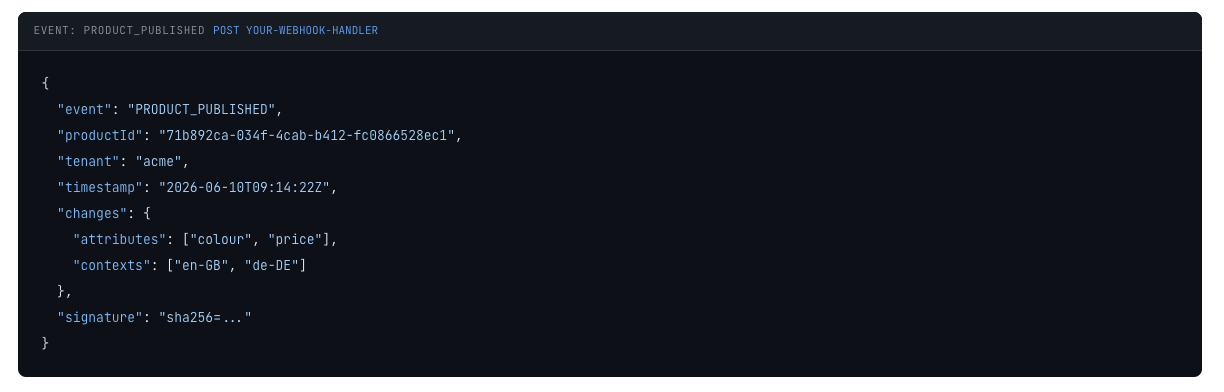
Every meaningful change inside Bluestone PIM fires an event the instant it happens, across 19+ predefined webhook types, delivered through enterprise message queuing (AWS SQS) rather than a scheduled batch job. Connected systems react to the events they care about. Nothing polls, nothing waits for an overnight run.
Here's what a connected system actually receives the moment a product publishes:
What Should You Ask Your PIM Vendor About Integration?
Asking "do you integrate with Shopify?" or "can you connect to SAP?" is not enough. Every vendor will say yes. The useful questions go deeper.
Ask about API coverage. How many public endpoints does the platform expose, and does every UI operation have an API equivalent? Bluestone PIM exposes 700+ endpoints with full UI/API parity, so your team builds against the same capabilities they see on screen.
Ask about event-driven updates. Webhooks and event-based sync, or scheduled batch jobs? Event-driven means changes propagate in near real time. Batch means your storefront might run a day behind.
Ask what's pre-built versus what's tailored. Are there ready connectors for the platforms you already run, and a proper integration path for the systems that aren't standardised? Bluestone PIM splits this deliberately: the Extension Hub for commercetools, Algolia, Productsup, and more, and the Connectivity Suite for SAP, Oracle, and Dynamics.
Ask who builds the integration. Can your developers or implementation partner build it independently, reading documentation and calling endpoints? Or does every new connection need the vendor's professional services team?
Ask about data sovereignty and hosting. Where does the data live, is the platform cloud-native, and does it comply with GDPR? Bluestone PIM runs on AWS across multiple regions, with GDPR compliance and ISO 27001 certification.
Ask for an architecture diagram. Before the demo gets to the interface, ask the vendor to show how their platform sits alongside your ERP and e-commerce stack. If they can't produce one quickly, that says something about how well documented their integration story actually is.
Manual reformatting works fine at a small scale. The problem shows up once you're managing thousands of products across multiple markets, which is where dedicated infrastructure like Bluestone PIM stops being optional.
Once you have confirmed that a PIM fits your stack, the next step is planning the implementation itself. For a practical, step-by-step guide covering data migration, team structure, integration setup, and go-live, read How to Implement a PIM System in 10 Steps.

Download free e-book
PIM Vendor Evaluation Checklist
When choosing a PIM system don’t just compare features, but ask the right questions. This checklist will help you dig deeper into what really matters: flexibility, scalability, support, and future-proofing.
Product information integration isn't a one-off project you finish and forget: every new channel, marketplace, or ERP upgrade tests whether your data model actually holds up. Bluestone PIM gives you the architecture to handle that as it happens, with 700+ API endpoints, event-driven sync, and a tailored path for the systems that were never going to fit a generic connector anyway.
Book a demo and walk through your own stack with the Bluestone PIM team.
![How To Scale SKU-Heavy Catalogues Without Duplication [Guide For Retailers]](https://www.bluestonepim.com/hubfs/How-To-Scale-SKU-Heavy-Catalogues-Without-Duplication-1.png)