
![How To Scale SKU-Heavy Catalogues Without Duplication [Guide For Retailers]](https://www.bluestonepim.com/hubfs/How-To-Scale-SKU-Heavy-Catalogues-Without-Duplication-1.png) Product Information Management
Product Information Management
Managing multiple e-commerce stores means controlling product data, content, and operations across several storefronts without creating duplication or inconsistency. If you run multiple brands, sell in different regions, or operate across marketplaces, the challenge is not the number of stores. It is how you manage product information behind them.
This guide explains how modern retailers handle multi-store management using a single system, and how Bluestone PIM supports that setup.
What Does It Actually Mean To Manage Multiple E-Commerce Stores?
Managing multiple e-commerce stores means running several storefronts while keeping one consistent, reliable product catalogue behind them. In a multi-brand setup, this often includes different brand identities, regional stores, marketplaces, and even separate B2C and B2B environments, all operating at the same time.
From the outside, each store looks independent. Each has its own design, tone of voice, and customer experience. Behind the scenes, though, many of these stores rely on the same core product data. The real challenge is not managing the storefronts themselves, but controlling how that shared data is created, structured, and distributed.
This is where a PIM system becomes central to the operation.
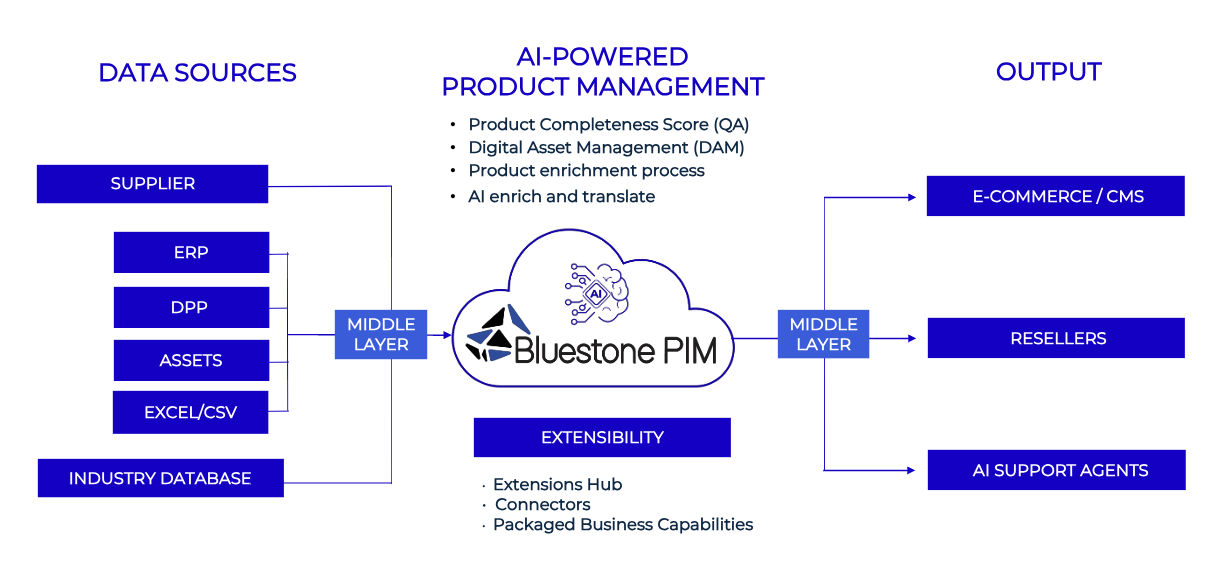
A PIM acts as the control layer between your internal systems, such as ERP platforms and supplier feeds, and your external channels, including e-commerce platforms, marketplaces, and apps. It takes raw product data, structures it, enriches it, and prepares it for each specific use case.
In a multi-brand environment, this role becomes even more important. The same product may need to appear differently depending on the brand, market, or channel, without losing consistency at its core.
In practice, this means:
- One product dataset feeds multiple storefronts, brands, and channels.
- Each store receives its own version of the product, adapted for language, pricing, and content.
- Updates are made once and reflected everywhere, without duplication.
Without this structure, product data quickly becomes fragmented. Descriptions fall out of sync, important attributes are missed, and updates become slower and harder to manage as more stores are added.
Bluestone PIM supports multi-brand model by giving teams a central place to manage product data, while allowing each brand or market to shape that data to fit its needs. Through API endpoints and connectors, product information flows consistently to every channel, so teams stay in control even as the business grows.
Why Does Managing Multiple Retail Stores Get Messy So Quickly?
Managing multiple retail stores becomes difficult when product data is copied instead of shared, and small inconsistencies begin to build across systems and teams.
At the start, managing one or two stores feels straightforward. As the business grows, new brands are introduced, regional stores are launched, and marketplaces are added. Each step increases the number of places where product data needs to be updated.
Over time, a familiar pattern appears:
- Different brands managing their own product spreadsheets
- Regional teams rewriting the same product descriptions
- Inconsistent attributes across storefronts
- Slow onboarding of new products or brands
One of Bluestone PIM customers, a large multi-brand retailer, faced this exact situation. Different divisions managed their product data independently, which worked in isolation but slowed everything down at scale.
By introducing a Bluestone PIM central product data layer, they were able to keep brand autonomy while ensuring that thousands of products could be published each week with consistent, structured data. The underlying issue was not complexity, but a lack of shared structure.

Download free e-book
5 Signs You Need a PIM System
Stop guessing. See the red flags teams miss until product data starts slowing growth. A quick, practical guide for e-commerce, marketing, and product teams.
How Do You Manage Multiple E-Commerce Stores From One System?
Managing multiple e-commerce stores from one system means creating a clear and repeatable flow for product data, instead of letting each store manage it independently.
A PIM system supports this by acting as the single source of truth where product data is collected, structured, enriched, and distributed across channels.
In practice, this means:
- Product data is collected from multiple sources such as ERP systems and supplier feeds
- It is structured and enriched so it can be used across channels
- It is adapted for different markets, brands, and storefronts
- It remains consistent across every touchpoint
In Bluestone PIM, this happens through four clear stages:
1. Centralise Product Data
All product information is brought together in one place, including supplier data, ERP inputs, images, and descriptions. This creates a reliable foundation for every store.
2. Structure and Enrich
Products are organised properly, attributes are completed, and content is refined so it works across different channels and audiences.
3. Adapt for Each Store
Each store receives its own version of the product, shaped by brand, market, language, and channel requirements.
4. Distribute Across Platforms
Product data is pushed to webshops, marketplaces, and other channels through API endpoints, keeping everything aligned without manual effort.
Bluestone PIM supports this full workflow, allowing teams to manage products on multiple platforms without repeating the same work in different systems.
How Does Multi-Store Management Work In Practice?
Multi-store management works by separating shared product data from store-specific content, so teams can reuse the same foundation while adapting it where needed.
Instead of duplicating products, retailers structure them in layers:
| Layer | What changes | What stays the same |
|---|---|---|
| Core product | Specs, materials, SKU | Shared everywhere |
| Brand layer | Tone, naming, visuals | Varies per brand |
| Market layer | Language, compliance | Varies per country |
| Channel layer | SEO, formatting | Varies per platform |
This structure allows one product to exist once, while still appearing differently across brands and stores.
Bluestone PIM enables this through contextual data modelling, where each variation is managed within the same product rather than as separate entries.
Example: A Nordic retailer, one of Bluestone PIM customers, uses this approach to expand into multiple markets without rebuilding their catalogue each time. Instead of duplicating data, they reused it and adapted it locally, which reduced manual work and improved consistency.
How Do You Handle Managing Products On Multiple Platforms Efficiently?
Managing products on multiple platforms efficiently means removing the need to update each channel separately.
Without a central system, teams often upload and edit products in each store or marketplace individually. This leads to inconsistencies, missed updates, and a constant need to double-check data.
With a PIM in place, the process changes. Product data is updated once, and those changes are automatically reflected across all connected platforms. This keeps information aligned and reduces the risk of errors.
This approach is especially useful when working with:
-
Multiple regional stores
-
Marketplaces such as Amazon or Zalando
-
Mobile apps and in-store systems
Bluestone PIM supports this by connecting directly to commerce platforms through API endpoints and ready-to-use connectors. For example, integration with Shopify allows product data to flow smoothly into storefronts without manual uploads, while connectors for platforms like commercetools and Adobe Commerce make it easier to manage more complex, composable setups.
Instead of adapting your product data to fit each platform manually, Bluestone PIM prepares and structures that data so each system receives exactly what it needs. This includes handling differences in attributes, formats, and requirements across channels.
The result is not just faster updates, but a more reliable way to manage products on multiple platforms as your business grows.
How Do You Manage Multiple Retail Stores Across Regions And Languages?
Managing multiple retail stores across regions means balancing consistency with local relevance.
Retailers need to maintain a shared product structure while adapting content for different languages, regulations, and customer expectations. If every market starts from scratch, the workload quickly becomes unmanageable.
A more effective approach is to build from a shared base and refine locally.
In Bluestone PIM setups:
-
A central team defines the core product content
-
Local teams adjust language, messaging, and compliance details
-
AI tools support translation and consistency
One retailer managing seasonal collections across several countries used this model to reduce manual effort. Instead of rewriting content for each market, teams could focus on refining and improving what already existed.
This allows localisation to scale without becoming a bottleneck.

Download Case Study
How Zeeman Cut Product Localisation from 6 Weeks to 1
Zeeman aimed to modernise their e-commerce stack and reduce dependency on legacy systems. Using Bluestone PIM’s MACH-based platform they transformed product data operations and optimised their customer buying journey foundations.
Get your copy hereWhat Setup Supports Scalable Multi-Store Management?
Multi-store management at scale depends on systems that work together, each with a clear role.
Many retailers use a composable setup that includes:
-
PIM for product data
-
Commerce platforms for transactions
-
CMS for content
-
Search and merchandising tools
Bluestone PIM connects these systems through API endpoints, allowing businesses to introduce new stores, expand into new markets, or update their technology without disrupting operations.
This approach follows MACH architecture, where systems are modular and can evolve independently over time.

Download free e-book
MACH-Based PIM: The Ultimate Guide
Going deeper into MACH and product data? This e-book explains how MACH-based PIM supports composable commerce in practice.
What Changes Once You Get Multi-Store Management Right?
When multi-store management is set up properly, the impact is felt across the organisation.
Product launches become faster, data remains consistent across stores, and teams spend less time on repetitive tasks. Expanding into new markets becomes more predictable, rather than a constant source of friction.
If you want to see how this works in practice, it’s worth speaking with the Bluestone PIM team.