
 Product Information Management
I have sat in enough e-commerce project reviews to know how this story goes. Six figures spent on a new platform. And eighteen months later, the return rate has barely moved.
Everyone looks at the platform. Nobody looks at the product data.
In my view, this is the most expensive blind spot in e-commerce right now. The platform is not what determines whether a customer buys the right product or returns it three days later. The product information does.
This article explains what is actually driving your product returns, why your platform migration could not fix it, and what Bluestone PIM does to close the gap.
Why Do E-Commerce Replatforming Projects Often Miss Their Targets?
E-commerce replatforming projects fail to move conversion and return metrics for one consistent reason: they improve the container, not the content.
When you migrate to a new platform, you bring your product data with you. The same descriptions. The same inconsistencies across channels.
Reports show that only 14% of businesses are satisfied with their current e-commerce platform, so the pain driving migrations is real.
But the information your customers see at the point of purchase has not changed. And that is where most performance problems originate.
What Do Return Rates Actually Tell You About Your Product Data?
A high return rate is almost always a product data problem, not a platform problem.
According to the NRF's 2025 Retail Returns Landscape report, retailers project $849.9 billion in returns in 2025, with 19.3% of all online sales expected to be returned.
The average e-commerce return rate sits at 20.4%, compared to 8.7% for in-store purchases. More than twice the rate, for the same products. The gap exists because online shoppers make decisions based entirely on product information. When that information is incomplete, they guess. And when the guess is wrong, they return.
22% of all e-commerce returns fall into a single category: the product did not match its description, according to research compiled by Lifesight.
Not a broken checkout. Not a slow page. Wrong or missing product information.
Processing each return costs between 20% and 65% of the original item value, according to the NRF. For a fashion retailer running a 25 to 30% return rate, this is one of the largest margin leaks in the business and it sits entirely upstream of the platform.
Download free e-book
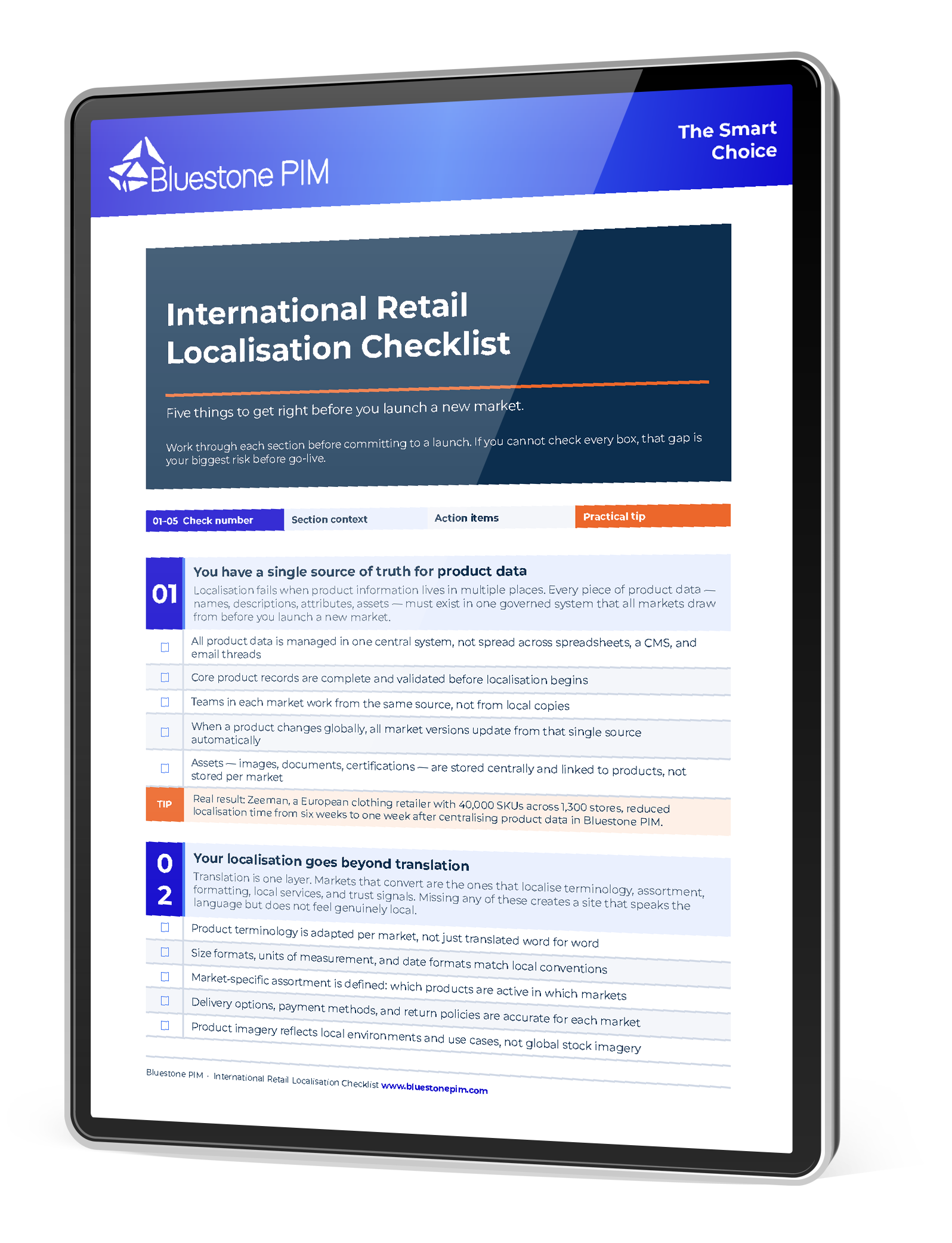
Bluestone PIM Checklist: International Retail Localisation Checklist
We put together this checklist so your team has a clear starting point — work through each section before go-live and you'll know exactly what's ready and what still needs attention.
What Happens When You Fix the Platform But Not the Data?
If incomplete data goes in, nothing useful comes out.
This is most visible in site search. Every replatforming project promises a meaningful revenue uplift from better product discovery. But if the catalogue feeding that search engine is incomplete or missing key attributes, the engine cannot surface the right products. The uplift never arrives. And the platform gets blamed for a data problem.
The same logic applies to every channel in your omnichannel commerce operation. A modern platform improves technical performance: traffic handling, page speed, flash sale capacity. These are real gains. But they address the technical layer, not the quality of the purchasing experience.
Consider what Amazon found when it invested in 3D product visualisation: the feature reduced returns by 40%.
Amazon did not reduce returns by building a faster checkout. It reduced them by giving customers better product information at the moment of decision. That is the distinction most e-commerce investment strategies miss.

💡 Pro tip: Before scoping your next platform project, audit completeness across your top 20% of SKUs by revenue. The attribute gaps you find will tell you more about your return rate than any platform benchmark.
What Are Retailers with Improving Metrics Doing Differently?
The retailers seeing genuine improvements treat master product data as infrastructure, not an operational task.
That means three things in practice.
- A single source of truth for all product information, where data is collected, validated, and maintained centrally, and every channel is fed from it automatically.
- Validation rules that catch incomplete or inaccurate data before it reaches the point of purchase.
- The ability to enrich and update content in bulk across every channel without a manual process for each one.

Download free e-book
MACH-Based PIM: The Ultimate Guide
Going deeper into MACH and product data? This e-book explains how MACH-based PIM supports composable commerce in practice.
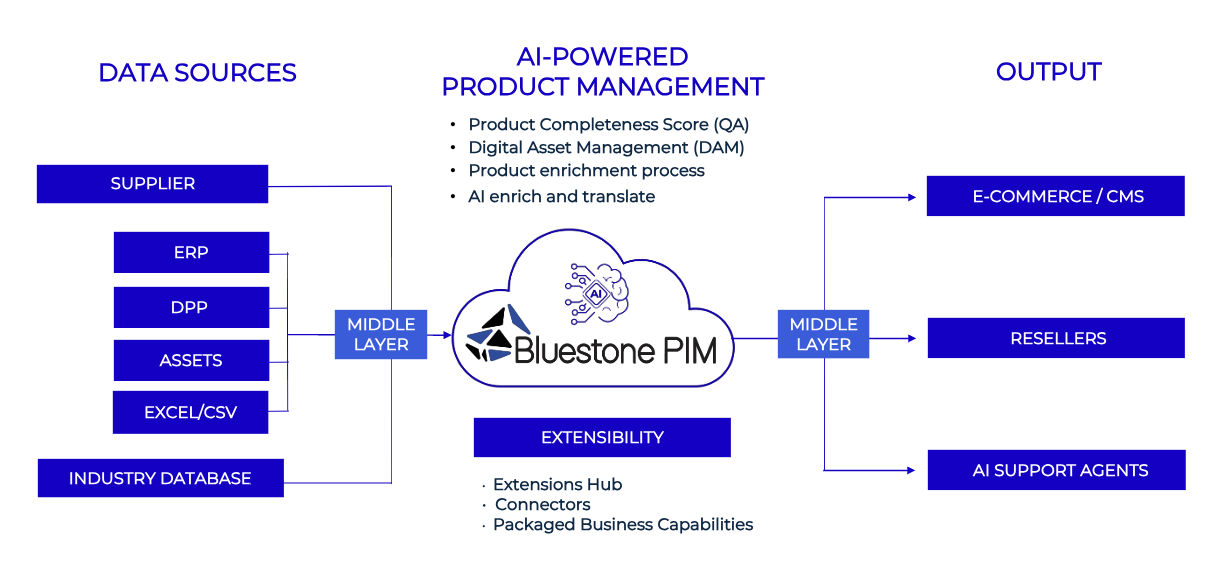
Bluestone PIM gives enterprise retailers all three. One place to centralise product data from suppliers and internal systems, apply completeness scoring and validation rules, enrich content with native AI, and distribute to every channel via an API-first, MACH-certified architecture with 700+ API endpoints.
When product information changes, it updates everywhere.
What Is the Right Way to Sequence a Digital Transformation Project?
Here is the opinion worth stating plainly: the industry's default sequencing is backwards. Platforms first, product data last, is precisely the configuration that produces the results most teams are currently frustrated by.
Product data quality should be an explicit workstream within every major e-commerce initiative, not an assumption that someone else will handle after go-live.
🕒 Last-minute idea: If a replatforming project is already underway, run a product data completeness audit in parallel.
Identify which attribute gaps most directly affect return rates in your highest-volume categories and prioritise those for enrichment before launch, not after. Bluestone PIM can run this analysis automatically: its AI scans your catalogue, flags incomplete or inconsistent records, and surfaces the specific gaps most likely to affect conversion. No manual SKU-by-SKU auditing required.
The Platform Is Not the Problem
Product data determines whether customers make good purchasing decisions. It drives conversion rates, shapes return rates, and decides whether your search, personalisation, and AI features can do their jobs.
Bluestone PIM helps enterprise retailers build the product data foundation that makes every other commerce investment perform as intended: centralised product information, completeness scoring, native AI enrichment, and API-first distribution to every channel from one platform.
 Connect with me on LinkedIn!
![How To Scale SKU-Heavy Catalogues Without Duplication [Guide For Retailers]](https://www.bluestonepim.com/hubfs/How-To-Scale-SKU-Heavy-Catalogues-Without-Duplication-1.png)